


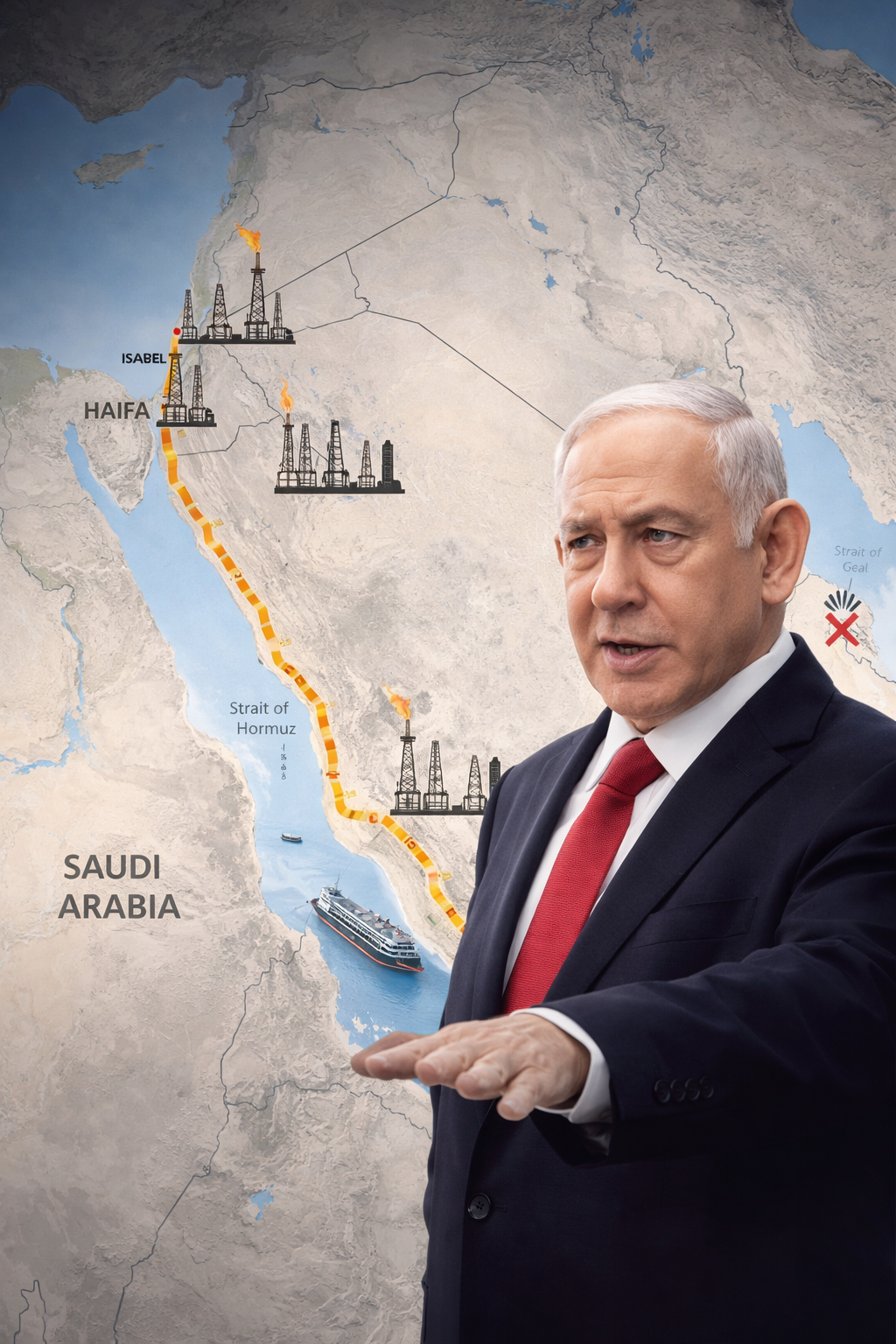






New Delhi: Israeli Prime Minister Benjamin Netanyahu declared on Thursday his postwar vision: rerouting Middle East oil and gas through Israeli ports via new pipelines across the Arabian Peninsula, according to Reuters.

Speaking at an in-person press conference in Jerusalem, Netanyahu said, “Just have oil pipelines, gas pipelines, going west through the Arabian Peninsula, right up to Israel, right up to our Mediterranean ports and you’ve just done away with the choke points forever.” He framed the idea as a lasting strategic shift that would neutralize Iran’s ability to threaten the Strait of Hormuz, the narrow waterway carrying about one-fifth of global oil and liquefied natural gas supplies.
As per Reuters, Netanyahu said Iran has lost its uranium enrichment capacity and missile production ability after nearly three weeks of US-Israeli military operations. Netanyahu added that Israel is targeting not only remaining ballistic missiles and nuclear sites but also the industries supporting them. He suggested a possible ground component to the campaign but declined to elaborate.
The remarks came one day after Israel struck Iran’s massive South Pars gas field — a sharp escalation in the war that began on February 28. Netanyahu insisted Israel acted alone and that President Donald Trump had urged restraint on further attacks, Reuters reported. Trump, facing political heat from rising US fuel prices, has pressed allies to help secure the strait.
The conflict has already triggered the largest supply disruption in the history of global oil markets. Iranian retaliatory strikes on Gulf energy facilities, combined with attacks on shipping, have effectively closed the Strait of Hormuz. Daily oil exports from the region have plummeted by at least 60 percent. The International Energy Agency estimates the war has slashed regional production by at least 10 million barrels per day, contributing to a projected global supply drop of 8 million barrels daily this month — equivalent to nearly 250 million barrels lost.
Brent crude futures have surged dramatically, climbing from around $70 per barrel before the war to peaks above $119, with prices settling Thursday around $107–$115. Analysts war the prolonged disruption could push Brent toward $135 or higher, feeding global inflation by 0.5–0.6 percentage points and shaving 0.3 percent off worldwide GDP growth.
Netanyahu portrayed the war’s energy fallout as an opportunity. By bypassing the Hormuz chokepoint through Israeli infrastructure, he argued, the region could achieve permanent stability. Whether Gulf states embrace such pipelines remains uncertain amid ongoing tit-for-tat strikes that have damaged facilities in Saudi Arabia, Qatar, Kuwait, and the UAE.
As the nearly three-week conflict continues, Netanyahu said it is too soon to predict whether Iranians will rise against their government. “It’s up to the Iranian people,” he stated.
Speculations about Netanyahu and press conference
For last several days, social media had been abuzz with Netanyahu’s absence and his alleged assassination. The press conference, like his videos posted on social media, have triggered speculations whether these are AI generated deep fake videos and if anyone physically attended the press conference and met Netanyahu in person. Pre-event announcements from The Times of Israel explicitly called it a “virtual press conference with foreign reporters” (his second virtual one since the Iran war began).
However, post-event coverage from CNN, Reuters, and others describes it as an “in-person” or “rare in-person news conference” in Jerusalem, with live Q&A (including from CNN’s Jeremy Diamond), professional photos credited to Reuters photographer Ronen Zvulun/Pool showing Netanyahu at a podium in a press-like setting.

The footage and transcripts include direct interactions and his opening “I am alive — and you are all witnesses,” but visuals/transcripts do not clearly show journalists in frame, leaving room for debate on whether it was hybrid, remote questions via video, or fully in-person. Without an official attendee list, explicit video proof of reporters in the room, or contradictory clarifications, physical attendance remains unconfirmed beyond these descriptive inconsistencies.