


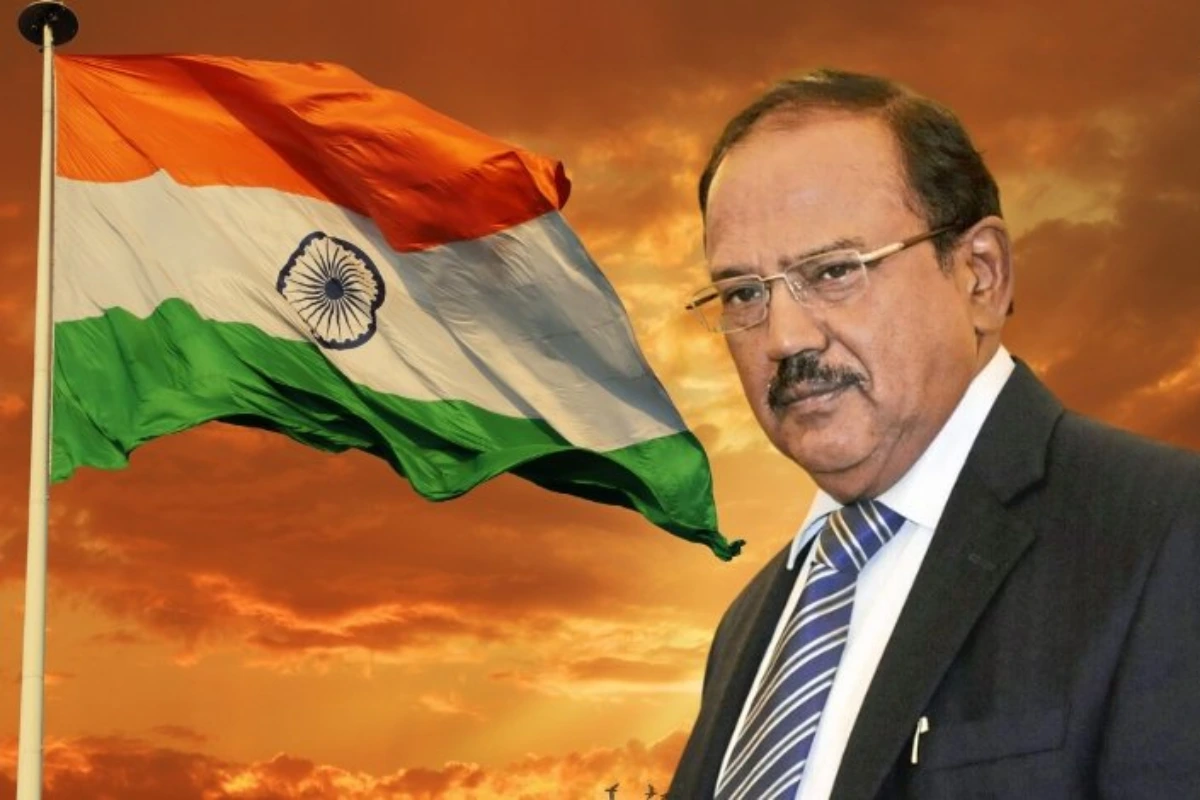






The Modi government may have achieved much over the past 11 years. But security and strategic affairs are certainly not among its accomplishments. In fact, the chief architect of the Modi government’s security and strategic policy—National Security Advisor Ajit Doval—has brought not only ignominy but also cornered India on multiple critical fronts, even opening new ones.

Take, for example, Ladakh. Soon after the Modi government revoked Article 370 in 2019 and reorganised the state of Jammu & Kashmir into two Union Territories, the Ladakh region—bordering the Tibetan Autonomous Region under China—celebrated the move. After decades of struggle for a separate Union Territory, the dream of Ladakhis had finally been fulfilled. However, the euphoria faded quickly as Ladakh found itself disenfranchised from electoral democracy and legislative powers under the new arrangement.
Initially, many in Ladakh, especially in Leh, believed separation from Jammu and Kashmir would bring greater autonomy and development. Instead, the absence of a legislature left governance to Delhi’s bureaucrats, sidelining local institutions like the Ladakh Autonomous Hill Development Councils (LAHDCs). Resentment grew resulting into demands for statehood and Sixth Schedule protections for tribal identity and land rights. Over time, protests intensified, fuelled by fears of demographic change, loss of jobs to outsiders, environmental degradation from unchecked development, and stalled talks with the Centre.
By 2025, frustration erupted into mass protests against the central government. Last month, the peaceful demonstrations in Leh turned violent under mysterious circumstances, leaving four dead and over 90 injured. Activist Sonam Wangchuk spearheading the movement for statehood and sixth schedule was arrested under the National Security Act for allegedly inciting violence. Whether Wangchuk is guilty or not is for the courts to decide, but the violence—triggered by genuine public resentment over broken promises—was an aberration, not the norm.
Ladakhis have been unwaveringly patriotic, peaceful, and patient despite decades of neglect by successive governments. The recent killings, coupled with the government’s narrative casting doubts on their national loyalties, have deeply scarred Ladakh’s people, leaving them alienated as never before. Tragically, the region that once stood as a steadfast defender of India’s frontiers against Pakistan (1999 Kargil war) and China (1962 war) has now become a new front of domestic discontent.
This when the standoff along the Line of Actual Control with China, ongoing since the 2020 Galwan valley clash, remains unresolved. Despite multiple rounds of talks led by Doval and his Chinese counterpart, Chinese troops remain entrenched. In the northeast, the situation is equally grim. Since the Doklam crisis, China has continued to needle India over Arunachal Pradesh, while Manipur has been engulfed in a new ethnic conflict with hundreds killed and thousands displaced. The violence that erupted in May 2023 between Meiteis and Kukis exposed both state collapse and central indifference, with allegations of bias in the security response deepening divisions.
Post-Article 370, the Kashmir Valley—long a battleground from the 1980s until 2019—witnessed a decline in bloodshed and terrorism. Yet, the region remains a challenge. Many remnants of the old “conflict industry” that had thrived under former RAW chief AS Dulat continue to resist change. Also, even as there has been significant drop in terrorism, but the targeted killings of Kashmiri Pandits and other minorities post-370, did not create conducive atmosphere for complete peace and normalcy. Nor did NSA Doval make any effort to facilitate truth and reconciliation, prosecute those responsible for the ethnic cleansing, or establish a legal framework for the safe return and rehabilitation of Kashmiri Pandits.
Instead, Doval followed his predecessor Dulat’s policy of accommodating the same dynasties and power brokers responsible for decades of suffering among Hindus and Muslims alike. Many criminals, separatists, and terror-accused individuals were permitted to contest parliamentary and state assembly elections. On the other hand, Jammu—once relatively peaceful—also became a renewed theatre of cross-border terrorism during this period.
The recent Pahalgam attack, which the government itself admitted was the result of a major intelligence and security lapse, stands as a stark indictment of the Doval doctrine and his apparatus. The terror attack demonstrated that Pakistan continues to possess both the intent and capability to infiltrate and wreak havoc in Kashmir.
India’s defence forces have never lacked courage—their swift retaliation showcased operational excellence. Yet diplomatically, India stands weak and strategically adrift: Operation Sindoor delivered a tactical victory but exposed a strategic vacuum. Neither the “Look East” nor “Look West” policy has yielded results. The international response was telling—at best, calls for restraint from both India and Pakistan; at worst, silence on cross-border terrorism by Pakistan. The United States, once a strategic partner, drew false equivalence between victim and aggressor—and even praised Pakistan. Russia, historically a steadfast ally, stood neutral urging both the countries to deescalate.
Soon after the four-day conflict, Pakistan (already aided by China in an axis against India) astonishingly received another billion-dollar IMF loan, signalling that the international community did not view it as the perpetrator of the Pahalgam attack. The Financial Action Task Force (FATF), which had grey-listed Pakistan for terror financing from 2018 to 2022, once curtailed its access to global markets. Yet, despite India’s pleas and clear evidence—including videos of Hafiz Saeed, the chief of the banned Lashkar-e-Taiba, whose shadow group The Resistance Front claimed responsibility for the Pahalgam attack—global leaders refused to hold Pakistan accountable. Instead, it seemed Pakistan was being rewarded.
India’s diplomatic loss of face is glaring. Those cheering support from Israel fail to understand the architecture of international power: one ally does not constitute a strategic safety net, especially when that ally itself faces global condemnation for its horrendous war in Gaza.
The symptoms of the Modi government’s strategic failures have been visible even beyond the conventional domain of security. In 2023, Canada and the US publicly accused India of involvement in the killing of Khalistani separatist Hardeep Singh Nijjar. Ajit Doval was forced to skip Modi’s US trip after a New York court issued a summons against him in a lawsuit filed by Khalistan advocate Gurpatwant Singh Pannun—effectively making India’s NSA a fugitive from US law. The fallout was swift and bruising. India expelled diplomats and halted visa services for Canadians. Washington backed Trudeau. Eventually, India climbed down, agreeing to cooperate with the investigation—a damaging reversal that exposed not just diplomatic weakness but rot within the security establishment.
While keeping four Indian suspects in its custody, Canadian authorities continue to probe potential Indian government links, recently designating the Lawrence Bishnoi gang—a transnational crime syndicate with alleged ties to Indian intelligence—as a terrorist entity, which they claim orchestrated the killing as part of a broader pattern of violence against Sikh activists. In the US, the legal proceedings against two Indian nationals linked to Indian intelligence agencies, have advanced significantly in the case of an attempted assassination of Pannun. In its attempt to leverage anti-Khalistani rhetoric for domestic Hindu-majority consolidation, the Doval doctrine has cost India its global credibility, with reports of hate crimes against Indians increasing in Canada.
At home, Punjab remains gripped by a devastating drug crisis. The narcotics trade, largely fuelled by smuggling across the Pakistan border, has destroyed a large section of youth in Punjab. Between 2020 and 2025, narcotics worth roughly USD 875 million were seized from Gujarat’s ports, particularly Mundra—operated by Adani Ports—revealing how deep the networks run. These hauls, tied to smuggling routes from Afghanistan, Iran, and Pakistan, also link to terror financing. The US, under the Trump administration, even accused certain Indian chemical companies and executives of aiding global fentanyl production, placing India among the world’s major drug transit and production countries.
Beyond these catastrophic domestic and regional failures, India under the Doval Doctrine has lost influence in its immediate neighbourhood—Afghanistan, Sri Lanka, Nepal, Bangladesh, and Myanmar—despite its proclaimed “Neighbourhood First” policy. In none of these countries could India protect friendly governments or prevent destabilising regime changes.
In theory, national security is a shared mandate among the Ministries of Home, Defence, and External Affairs, and the NSA. In practice, it is concentrated in the hands of an all-powerful NSA heading the National Security Council Secretariat (NSCS), the apex advisory body on security, under Prime Minister’s Office.
Since 2019, amendments to the Government of India (Allocation of Business) Rules elevated the NSCS into a legal constitutional body and raised the NSA’s rank to that of a Union Cabinet Minister. As chair of the Strategic Policy Group (SPG), the NSA gained sweeping powers—convening inter-ministerial meetings, issuing directives, and intervening across ministries. The result: excessive centralisation and power without accountability.
India is not short on capability. It is short on strategic clarity. And clarity cannot emerge from echo chambers or one-man policymaking. Today, India possesses great military strength—but also unprecedented diplomatic isolation. That is not the mark of a rising power. It is the symptom of a nation in retreat, even before its arrival. With great power comes great responsibility—and India’s national security leadership has failed on both.