


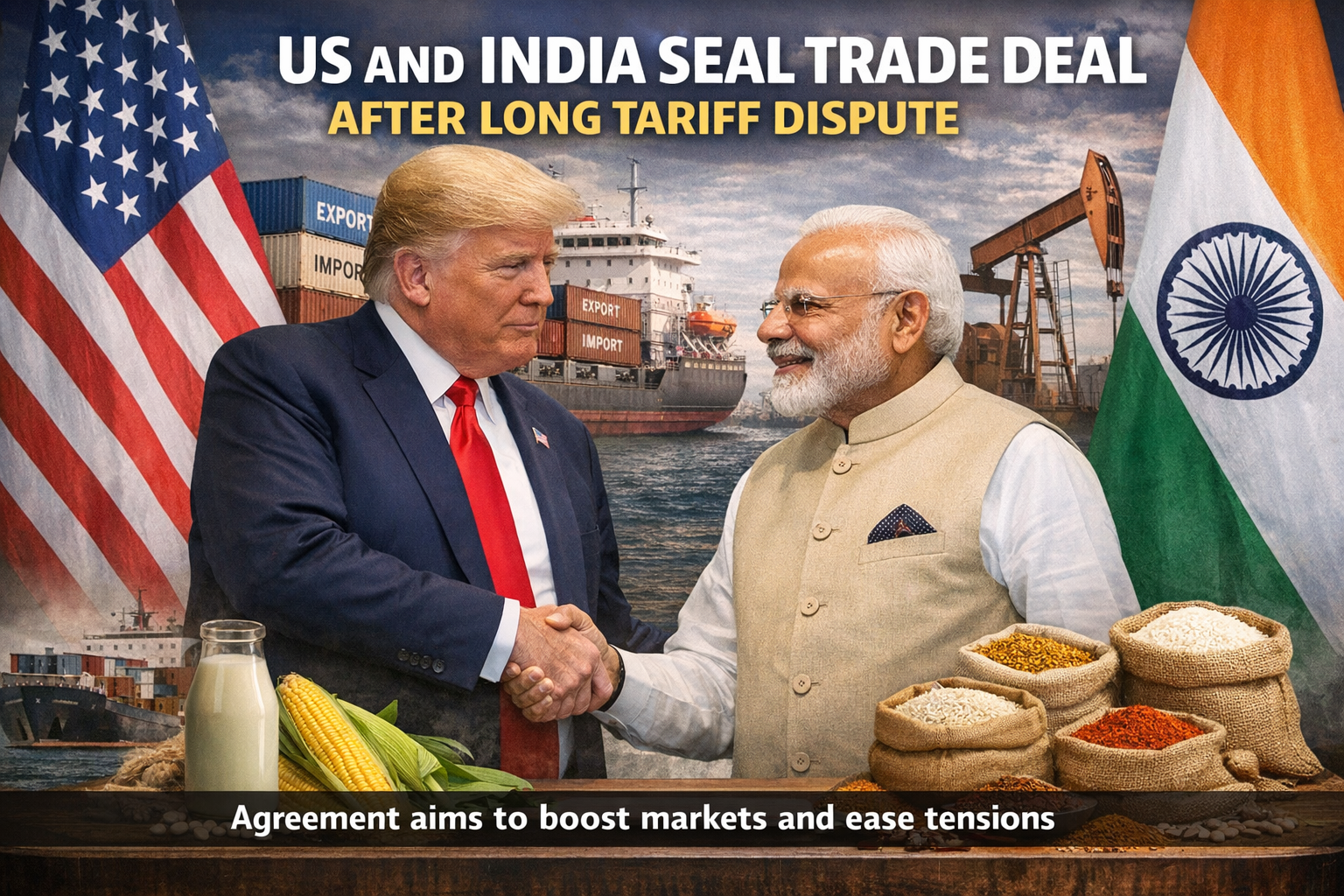






New Delhi: The United States and India have reached a landmark trade agreement, US President Donald Trump announced on Monday, ending months of friction that pushed bilateral relations to their lowest point in decades.

Under the agreement — announced by Trump on his social media platform following a phone call with Modi — the United States will reduce its reciprocal tariffs on Indian imports to 18 per cent from previous levels, a significant rollback from effective rates that, after additional levies, reached as high as 50 per cent. At the same time, India has committed to eliminate tariffs and non-tariff barriers on US goods, with New Delhi signalling it will reduce duties on American products to zero.
A central part of the deal involves energy: India has agreed to halt purchases of Russian oil, a move long sought by the Trump administration as part of its broader geopolitical strategy linked to the Russia–Ukraine conflict. The United States said India will shift energy imports towards US sources and potentially Venezuela, part of a pledge — cited by Trump — that New Delhi will buy more than $500 billion worth of American goods, including energy, technology, agricultural and coal products.
“We agreed to a trade deal that will strengthen our amazing relationship with India,” Trump said, framing the pact as both economic and strategic. Leaders from both countries spoke of potential boosts in jobs, growth, and bilateral investment.
Despite the announcement, key elements of the deal are not yet fully reflected in official texts released by either side. Meanwhile, US officials were quick to champion the agreement’s benefits for American growers. Agriculture Secretary Brooke Rollins said the pact would expand market access for US farm exports and “bring significant new opportunities to rural America,” particularly in sectors such as wheat, corn and dairy that have long sought deeper footholds in India.
However, India’s agricultural sector — a politically sensitive area at home — remains a sticking point. Indian officials have not yet issued formal confirmation of the full scope of market access for US agricultural products, and New Delhi’s long-standing assurances that it would protect domestic farmers — repeated by Modi over recent months — have left some questions unresolved.
Energy independence and the transition away from Russian crude purchases also pose practical challenges. India has deep ties with Russian energy suppliers, and shifting its import structure could entail economic and logistical hurdles.
The announcement marks a sharp reversal from a bruising year in US-India trade relations. After Trump returned to the White House in 2025, his administration launched a tariff war against India, imposing steep duties on Indian exports and linking them to New Delhi’s energy ties with Moscow.
In August 2025, the United States escalated tariffs on many Indian goods to an effective 50 per cent, including a 25 per cent penalty for continued Russian oil purchases. This triggered significant strain in diplomatic and economic ties.
The punitive measures hit industries such as textiles, gems and jewellery, and engineering products, with some exporters reporting sharp declines in orders and market access. While Indian exports overall weathered part of the shock due to exemptions for pharmaceuticals and electronics, smaller firms faced mounting pressure.
Beyond economics, security and geopolitical divergences — including India’s long-standing defence and energy relationship with Russia — compounded differences. In response to tariff hikes, New Delhi had at times threatened reciprocal measures and raised concerns at global trade forums, deepening mistrust between the capitals.
The pace of negotiations between the two countries quickened following the appointment of Sergio Gor as US ambassador to India. Since taking office late last year, Gor has pressed for closer cooperation and helped facilitate talks between trade officials in both capitals — a dynamic officials credit with helping to bring the long-stalled discussions to a conclusion.
That said, neither capital has provided a comprehensive official text of the agreement, leaving analysts cautious about its long-term impact.