


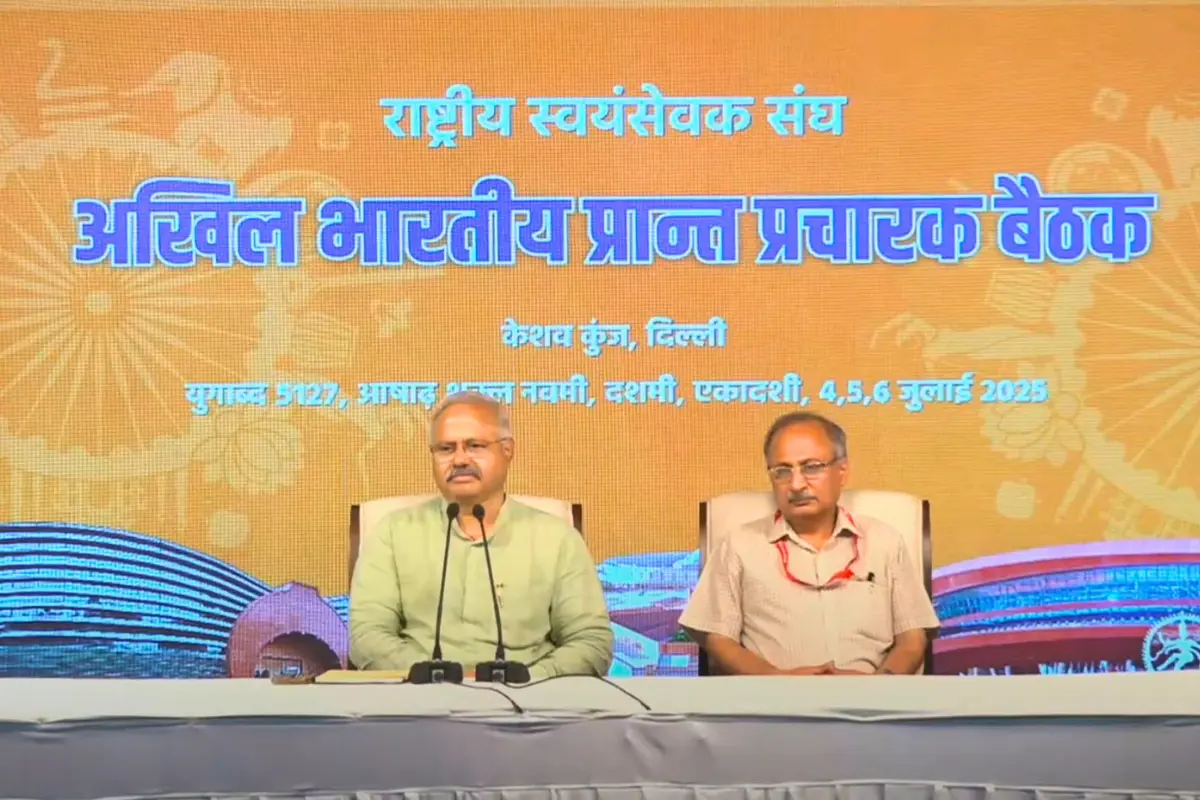






NEW DELHI: In a significant organisational gathering ahead of the RSS centenary in 2025, the Rashtriya Swayamsevak Sangh (RSS) announced a major expansion in its outreach strategy across India — including over 11,000 social harmony meetings, Hindu Sammelans in every mandal and basti, and door-to-door campaigns in all districts.

Addressing a press briefing after the Akhil Bharatiya Prant Pracharak Baithak held in Bhopal from July 4 to 7, RSS Akhil Bharatiya Prachar Pramukh Sunil Ambekar outlined the contours of Sangh’s nationwide initiatives as it nears 100 years of its founding.
“This was an organisational meeting — no resolutions are passed, but experiences and insights shared here guide our future direction,” said Ambekar, underlining that the focus remains on expansion, outreach and societal cohesion.
Outreach in the Centenary Year
The Sangh, founded in 1925, will mark its 100th anniversary in 2025. To commemorate this milestone, the RSS plans to organise Hindu Sammelans (congregations) in every basti and mandal — across urban and rural India.
“These Sammelans will unite society at the grassroots. Everyone — irrespective of caste, region or language — must feel connected to our civilisational ethos,” Ambekar stated.
Additionally, the RSS will organise 11,360+ social harmony programmes (samajik samrasta baithaks) involving representatives from various communities to foster mutual understanding and eliminate caste and communal divides.
Massive Door-to-Door Contact Campaign
The Sangh’s most ambitious plan, however, is a door-to-door campaign across all districts, in what Ambekar called “the biggest grassroots outreach in Sangh history.”
“Every district, town, and village must feel included in this centenary effort,” he said. “It’s not just outreach — this is integration.”
The campaign will involve swayamsevaks directly interacting with families to understand local needs, challenges, and aspirations while conveying the Sangh’s ideas of collective nation-building.
Sangh’s Stand on Conversion and Languages
Responding to questions on conversions, Ambekar reiterated RSS’s position on the matter:
“Conversion by force, fraud, or inducement is wrong. We believe in freedom of belief — but not deception.”
He also stressed linguistic unity and diversity, calling all Indian languages “national languages”, while urging that regional pride should not become divisive.
“RSS has always believed all Indian languages are national languages. Hindi, Tamil, Telugu, Marathi, or Assamese — all are part of Bharat’s soul.”
Harmony in Manipur, Focus on Borders
On the situation in Manipur, Ambekar said the RSS had received “positive feedback” from its swayamsevaks in the state, who have been working with both Meitei and Kuki communities.
“Early signs of harmony are returning. Our volunteers continue to engage all communities in dialogue and relief,” he added.
He also spoke of the Sangh’s increased welfare and community initiatives in border regions, which include areas along the Indo-Nepal, Indo-Bangladesh, and Indo-Tibet borders.
“In these regions, our workers are shoulder to shoulder with locals — running welfare activities, schools, and awareness campaigns.”
Training and Participation Numbers
According to Ambekar, over 21,879 swayamsevaks from various Indian states, including Jammu and Kashmir, participated in RSS training camps (shiksha vargs) this year.
“The Sangh is expanding geographically and socially. From Kashmir to Kanyakumari, swayamsevaks are undergoing rigorous training.”
Vijayadashami & Intellectual Engagement
As part of the centenary preparations, record-level participation is expected during the Vijayadashami celebrations in October 2025.
“We expect lakhs of swayamsevaks to attend uniformed drills and celebrations in every city and town,” he said.
The Sangh also plans to hold intellectual symposiums in every district involving prominent citizens, academicians, and professionals to discuss India’s cultural, economic, and spiritual journey in the next century.
“Every district will host such a symposium. Nation-building is a shared responsibility — and Sangh wants to listen as well as speak,” Ambekar added.

With just months left before the RSS turns 100, the Sangh is gearing up for one of its largest-ever mobilisation drives, focusing not just on visibility but on dialogue, harmony, and grassroots connection. The coming year is likely to see a marked increase in Sangh presence — in villages, cities, border areas, and intellectual forums alike.
