


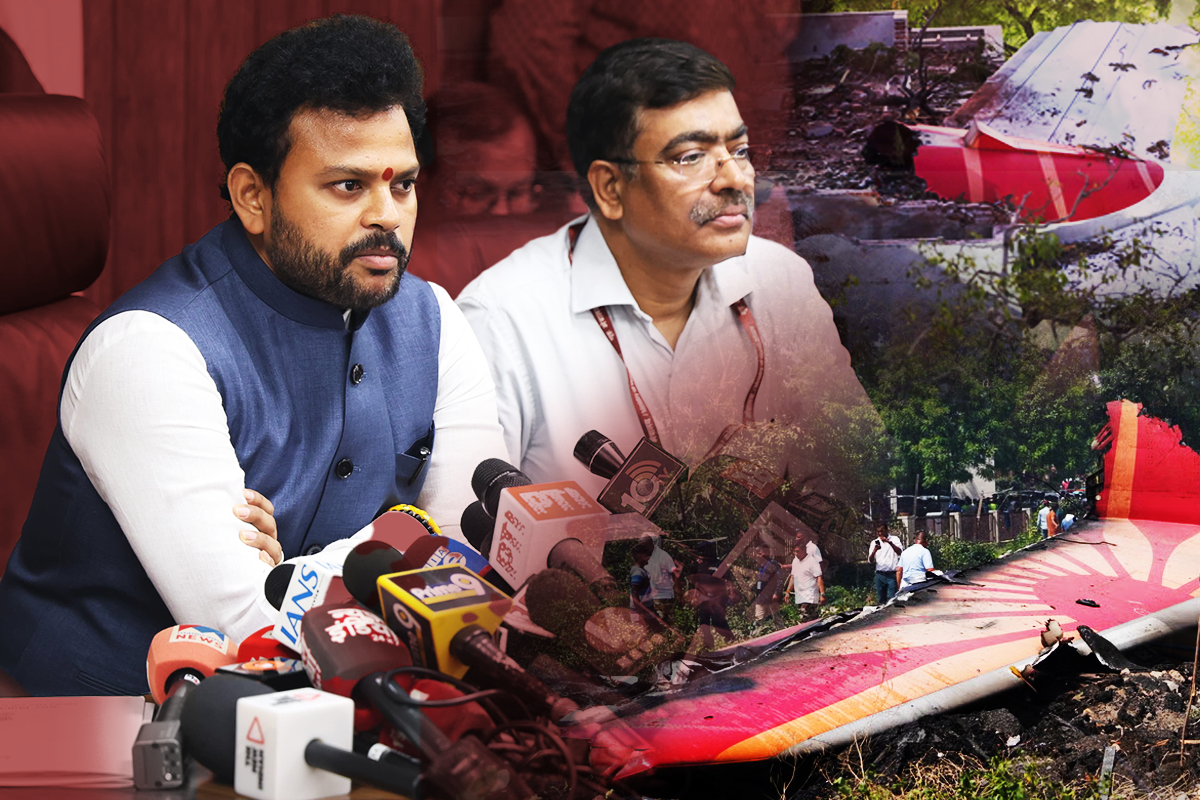






NEW DELHI: In the aftermath of the tragic crash of Air India Flight AI171, Union Civil Aviation Minister Ram Mohan Naidu addressed a high-stakes press briefing on Saturday at Udaan Bhawan, New Delhi. Flanked by Minister of State Murlidhar Mohol, Civil Aviation Secretary Samir Kumar Sinha, and senior officials from DGCA, BCAS, and AAI, the Minister laid out the government’s immediate response, ongoing investigations, and long-term reforms aimed at overhauling aviation safety in the country.

The press briefing began with a solemn one-minute silence observed in honour of the victims.
Tragedy in the Skies: What Happened
On June 12, 2025, Air India Flight AI171—a Boeing 787-8 Dreamliner—crashed within one minute of take-off from Sardar Vallabhbhai Patel International Airport in Ahmedabad, en route to London’s Gatwick Airport. The crash took place in the densely populated Meghani Nagar area of Ahmedabad, killing all 242 on board, including 230 passengers, 2 pilots, and 10 cabin crew members.
Among the deceased were several young medical students from Meghani Nagar, whose loss the Minister described as “not just a personal tragedy for families, but a loss for the nation’s future.”
Top Leadership On Ground
Within hours of the crash, Prime Minister Narendra Modi reached the site, visited injured survivors at the Ahmedabad Civil Hospital, and held a high-level meeting at the airport with emergency response officials.
Union Home Minister Amit Shah also visited the scene shortly after the incident, personally reviewed the situation, and directed all central agencies to provide full support to the victims’ families and state authorities.
Minister Ram Mohan Naidu, along with MoS Murlidhar Mohol, reached Ahmedabad the same day. They met with grieving families, interacted with medical teams, and reviewed the rescue and investigation efforts. Later, they chaired multiple inter-agency coordination meetings.
Addressed the media today regarding the tragic Ahmedabad plane crash. pic.twitter.com/3IKxFJuji0
— Ram Mohan Naidu Kinjarapu (@RamMNK) June 14, 2025
‘I Understand the Pain’: Minister’s Personal Reflection
In an emotional address, Minister Naidu said:
“This incident has shaken the entire nation. We have lost many young lives, including students who had their entire future ahead of them. I lost my father in an accident. I can understand the trauma and the pain that a family feels. It is not just about a technical failure—we are dealing with a humanitarian crisis.”
Emergency Response and Family Support
The Ministry of Civil Aviation activated a 24×7 control room at its headquarters within hours. Representatives from DGCA, BCAS, AAI, and CISF coordinated efforts from this center. A parallel media coordination hub was set up at the National Media Centre.
Several helpline numbers were activated to assist affected families:
- Ahmedabad Airport Emergency Helpline: 9974111327
- MoCA Control Room: 011-24610843 / 9650391859
- Air India Passenger Helpline: 1800-5691-444
The government has instructed Air India to ensure:
- Immediate disbursement of ex gratia compensation
- Dedicated logistical and emotional support for families
- Deployment of senior Air India officers to assist the next of kin
- A dedicated support cell in Gatwick, London, to aid British nationals and their families
- Help with documentation, repatriation, and hospital coordination for the injured
The Minister stressed that, “Every possible support must be extended to the families—not just now, but throughout the long road of healing and justice.”
Technical and Holistic Investigations Underway
The Aircraft Accident Investigation Bureau (AAIB) launched its investigation immediately. A five-member “Go Team” led by the Director General of AAIB was sent to the crash site and has since been joined by forensic and medical experts.
A critical development came on June 13, when the aircraft’s black box was recovered at around 5 PM. The decoding of the flight data and cockpit voice recorder is expected to provide vital clues about the final moments before the crash.
High-Level Committee for Systemic Review
A High-Level Committee, chaired by the Union Home Secretary, has been formed to conduct an independent, multi-agency investigation. Members include officials from:
- Ministry of Civil Aviation
- Ministry of Home Affairs
- Government of Gujarat
- DGCA, BCAS, Indian Air Force, Intelligence Bureau
- National and State Disaster Response Authorities
- National and state-level forensic institutions
Key responsibilities of the committee:
- Examine the incident from technical, operational, and regulatory perspectives
- Identify institutional or systemic gaps
- Submit a comprehensive report within three months
- Recommend long-term reforms on certification, crew training, emergency protocols, and air traffic systems
“While the AAIB is focused on technical analysis, this High-Level Committee will guide policy and institutional reforms for the future,” said Naidu. “It will not be business as usual.”
The committee will begin its formal deliberations on Monday, June 16.
Aircraft Inspections and Safety Surveillance
The DGCA has directed Air India to immediately inspect all Boeing 787-8 and 787-9 aircraft with Genx engines. India operates 33 such Dreamliners across carriers; 8 have already been inspected, with the rest undergoing urgent checks.
The DGCA is also intensifying:
- Surveillance of maintenance protocols
- Review of airworthiness certification
- Cross-audit of wide-body aircraft fleets in India
India’s Aviation Safety Record
Minister Naidu reaffirmed India’s commitment to global safety standards:
“India’s aviation regulatory system is one of the most robust in the world. ICAO has repeatedly certified our systems as globally compliant and effective. But we are not complacent. We will go beyond compliance to ensure absolute safety.”
Call for Responsible Media and Public Patience
Appealing to the media and public, the Minister added:
“I urge everyone—let us avoid speculation. Let the experts complete their work. The black box is with us. The truth will come out, and we will not hesitate to take action, whatever it may be. Justice will be delivered. Let us not forget the families who are grieving. Our focus must remain on them.”
The crash of AI171 is one of the worst aviation tragedies in recent Indian history. But the government’s swift action, multi-level investigations, and strong focus on long-term reform reflect a turning point in how aviation safety will be approached in the country.
As the black box is decoded and expert committees begin their reviews, the nation watches closely—with grief, with hope, and with the expectation that the skies will be safer for generations to come.