








New Delhi: India’s opposition, led by Congress leader Rahul Gandhi, has intensified its political offensive against Prime Minister Narendra Modi’s government, accusing it of suppressing uncomfortable information, compromising national interest and surrendering policy space under foreign pressure.

The coordinated attack unfolded in Parliament and on social media on Monday and Tuesday, centring on three separate but politically charged issues: a row over references to former army chief General M M Naravane’s unpublished memoir, mentions of India in newly released Jeffrey Epstein-related documents in the United States, and the India–US trade deal announced by President Donald Trump.
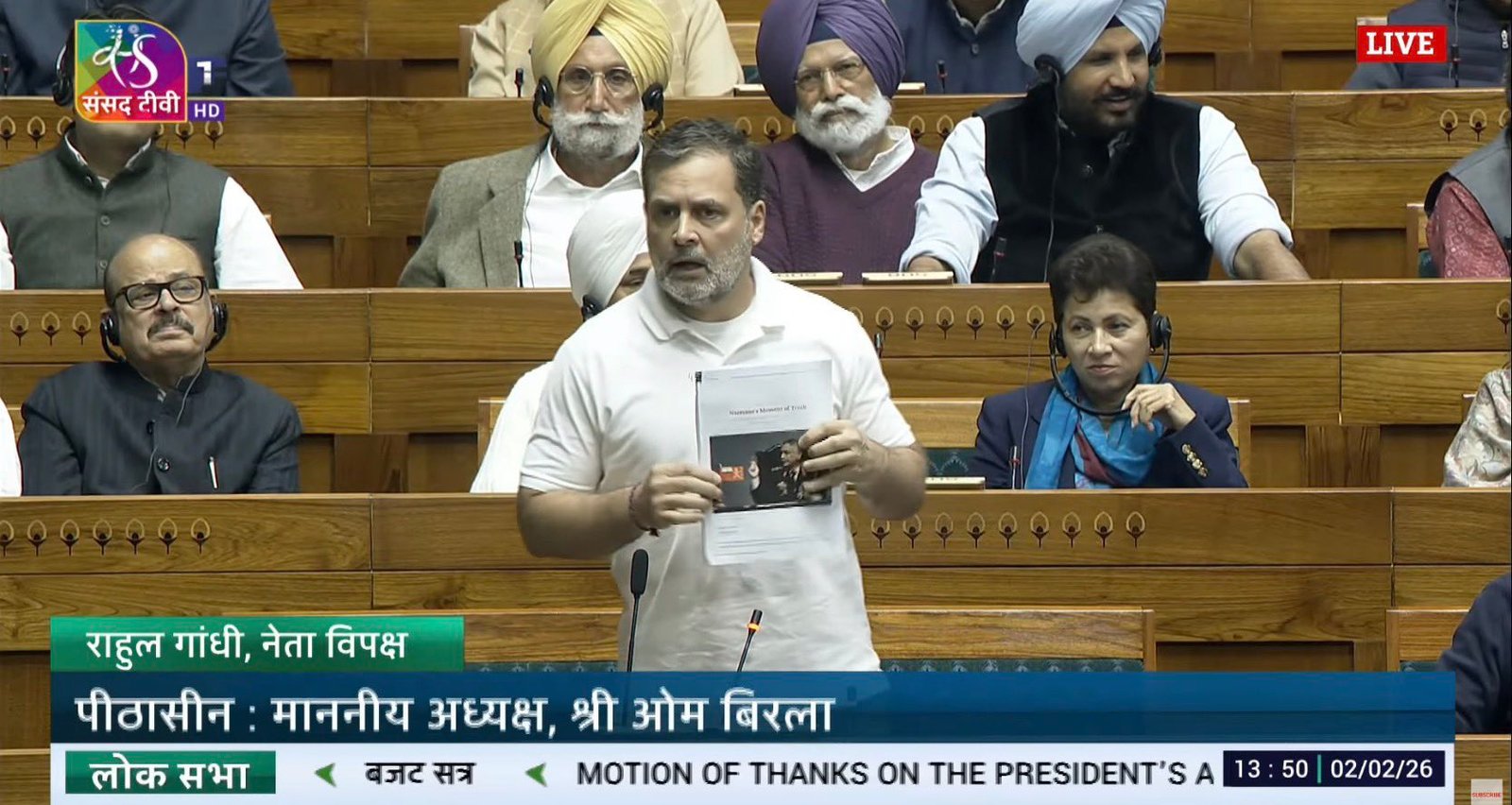
The sharpest parliamentary confrontation came during the debate on the President’s address in the Lok Sabha, when Gandhi attempted to quote passages he said were from General Naravane’s forthcoming memoir, Four Stars of Destiny. The Speaker, Om Birla, disallowed the references, citing parliamentary rules that bar the use of unauthenticated or unpublished material. Defence Minister Rajnath Singh and Home Minister Amit Shah objected strongly, prompting repeated disruptions and a brief adjournment.
Speaking outside Parliament, Gandhi questioned the government’s reluctance to allow discussion. “What are they scared of?” he asked reporters. “If there is nothing to hide, why can’t Parliament discuss what the former army chief has written about China?” He alleged that the delay in clearing the memoir — which remains under defence ministry review — amounted to suppressing uncomfortable facts about the 2020 India-China border crisis.
Opposition leaders from other parties echoed the charge. Kanimozhi Karunanidhi of the DMK wrote on X: “Blocking discussion on a former Army Chief’s book only deepens suspicion. Transparency strengthens institutions, secrecy weakens them.” The Trinamool Congress’s Derek O’Brien called the restrictions “a gag order by another name”.
The government has rejected claims of censorship, with officials saying that all military memoirs are subject to standard review procedures to prevent disclosure of sensitive operational details. General Naravane himself has said publicly that his book is “under review” and has not accused the government of political interference.
The second line of attack has focused on references to India and its leadership in a fresh tranche of documents linked to the late US financier Jeffrey Epstein, released as part of American court proceedings. Opposition leaders have seized on passages that they say raise questions about India’s international dealings, even though the documents do not allege any wrongdoing by Indian officials.
The Ministry of External Affairs dismissed the references as “trashy ruminations by a criminal” and said they had “no bearing on India’s official engagements or foreign policy”. Nevertheless, Gandhi linked the disclosures to what he described as growing external pressure on the Prime Minister.
In a statement to reporters, he said: “There is extreme pressure on Narendra Modi. The Prime Minister is compromised. This is why decisions are being taken in haste and without transparency.” Congress general secretary Jairam Ramesh wrote on X that the government’s silence on the Epstein documents contrasted with its “selective outrage on global morality”.
The government has repeatedly said that the Epstein material contains unverified claims and speculation, and that India has no case to answer.
The opposition’s most sustained criticism, however, has been directed at the India–US trade deal, announced by President Trump on 2 February, which rolls back punitive tariffs imposed during the past year while committing India to expand purchases of American goods. US officials, including the agriculture secretary, have said publicly that the agreement will significantly benefit US farmers.
That claim has become a flashpoint in Indian politics. Gandhi accused the Modi government of allowing Washington to control the narrative. “The Prime Minister had said Indian farmers’ interests are non-negotiable,” he told reporters. “Now US ministers are celebrating access to Indian markets. Why is our government silent? What has been conceded?”
In another statement, Gandhi went further, saying: “Farmers should understand that their hard work, their blood and sweat, have been sold out.” Congress MP Shashi Tharoor described the agreement on X as “headline diplomacy without footnotes”, adding that Parliament had not been informed of the full terms.
Leaders from the Aam Aadmi Party, Samajwadi Party and Shiv Sena (UBT) also demanded a detailed parliamentary debate, warning of possible risks to agriculture, dairy and small manufacturers if safeguards are weakened.
The government has defended the deal as a strategic reset after months of damaging tariff escalation. Ministers say India has not compromised on agriculture, and that implementation details will be shared in Parliament. The ruling Bharatiya Janata Party (BJP) has accused Gandhi of undermining India’s negotiating position and “manufacturing panic” for political gain.

With state elections due later this year and a general election on the horizon, analysts say the opposition is attempting to knit together disparate controversies into a single narrative of weakened leadership and lack of accountability. The government, for its part, appears determined to frame the debate around economic recovery and global engagement — even as parliamentary tempers continue to flare.