








NEW DELHI: A recently published autobiography sheds new light on how key Congress leaders have for decades refused to play the part expected of them in legitimate politics. For instance, an effort to organise a party procession on Srinagar’s main road by the party that then dominated the country was strongly discouraged.

That is evidently a continuing story. As I had pointed out during the assembly elections in September, the Congress did little to contest the recent assembly elections—thus ceding ground to forces which might potentially polarise the place.
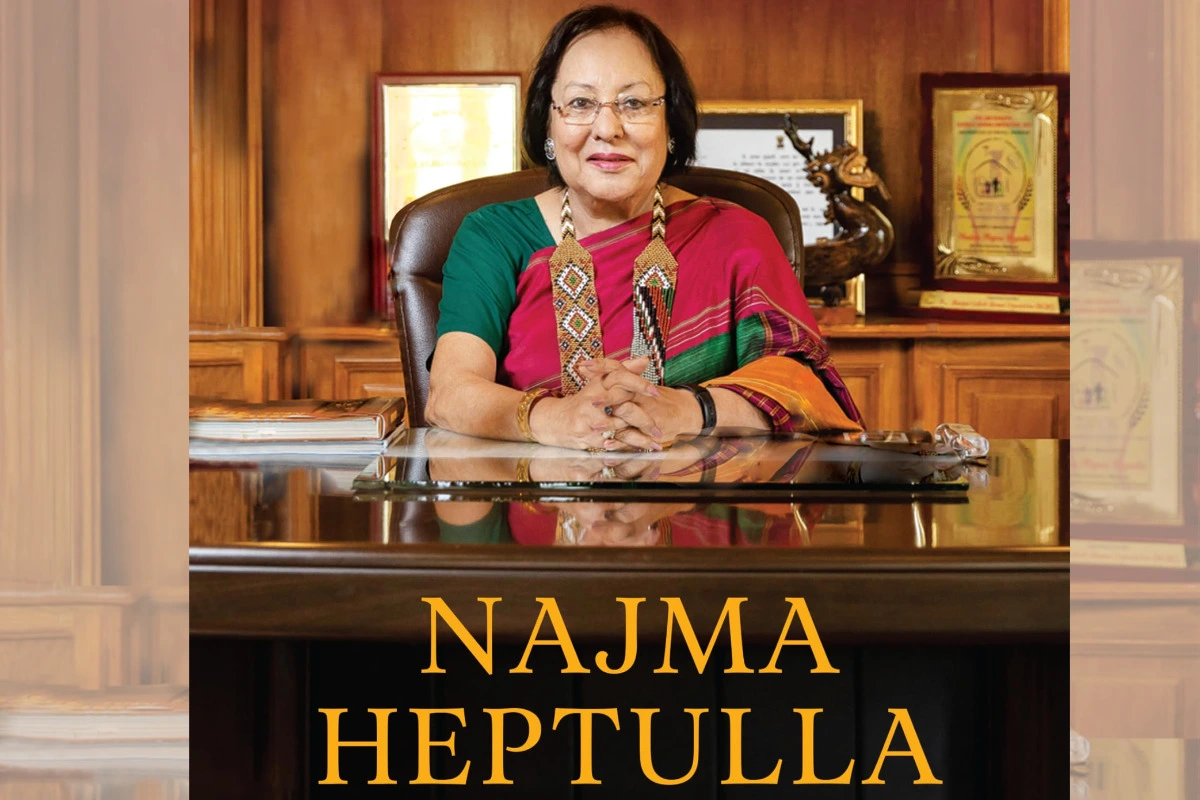
In Pursuit of Democracy, Beyond Party Lines, is the story of Najma Heptulla’s life. She spent many years as the deputy chairman of the Rajya Sabha, but she took a break from that when Rajiv Gandhi had briefly appointed her the Congress general secretary in charge of Jammu and Kashmir in 1985.
She writes that, `Soon I realised that the Congress in Kashmir never visited people living in far-flung areas,’ adding that, when she went to Srinagar, she found that local party leaders operated from their homes, and the party office was `derelict.’
That was a crucial time. For, although agitations had got going the previous year, there were still no blasts or gunfire—and political activity and outreach was very much possible. But, `although there was no insurgency or terrorist attacks from Pakistan, they seemed scared to step out,’ she writes about the party’s top local leaders.
So, she asked local Youth Congress volunteers to help her to clean the party headquarters. She then took NSUI members from Delhi for a march down Maulana Azad Road, on which the party headquarters is situated.
The party’s leading light of the time, `Mufti (Mohammed Sayeed) Saab vehemently advised me against it: “Don’t do it. You may get killed,”’ he told her. Sayeed left the party in `87, and was the country’s home minister when VP Singh was the prime minister and the insurgency exploded with vigour in the winter of `89-`90.
Heptullah writes that she replied with a smile that `it doesn’t matter’ (if she got killed), and went ahead, `walking shoulder to shoulder with the young people and waving party flags…’ down that road. Clearly, it was very much doable.
The Fotedar factor
Later, Heptulla writes that she was insulted by another influential leaderfrom Kashmir, Makhan Lal Fotedar. She claims that Fotedar told her sheshould not have gone to Kashmir. When she asked whether he didn’t know that she was the general secretary in charge of the state, he replied that she still should not have gone, and that Rajiv Gandhi was `very angry.’
She goes on: `With brows furrowed in rage, he started to step up the invectives. Upset at this unwarranted behaviour, I stopped him short’ and walked off. She later realised that his anger stemmed from the fact that Rajiv had left `the Kashmir lobby’ in the party out when he negotiated the Kashmir Accord of 1986 with Farooq Abdullah.
In any case, Heptulla writes that Fotedar was `not part of the official secretariat’ but acted as a political secretary to Rajiv. `There was deep resentment and fear in the party over his habitual bad behaviour and his dangerous capacity to maintain a wall of inaccessibility around the prime minister.’ She adds that Fotedar had treated four-time chief minister of Maharashtra, Vasantdada Patil so shabbily that an outraged Patil had resigned from the Congress party.
Soon after the elections of March 1987, Heptulla resigned as party general secretary. When she announced this at a party meeting, Rajiv asked her why, and Heptulla spiritedly replied: `Fotedar Saab is going to push my car into a ditch someday.’
She writes that, `Azad gaped in stunned silence; Moopanar looked thunderstruck, while Rajiv was at a loss for words. I continued, “He has behaved so badly with me, and cast aspersions on my character that any woman with an iota of self-respect would find unacceptable.”
Intriguing reluctance
It is intriguing that the most influential Congress leaders from Kashmir during the 1980s were apparently holding it back. That decade gave an opportunity for secular, inclusive political outreach among Kashmiris—especially after many had become disillusioned with Sheikh Abdullah by the end of the `70s, and with Farooq by around `84. Instead, the fundamentalist ideology of the Jamaat-e-Islami spread during that decade, beginning with a Wahadat Conference organised by its youth wing off Lal Chowk in 1981. Later, the Jamaat became a major vote bank for Mufti Sayeed’s party in south Kashmir after he founded the PDP in 1999.
It was while Mufti was the home minister of the country that the large majority of the Valley’s Pandit community fled between January and August 1990. It was also the time when the Jamaat began the process of taking over Hizb-ul Mujahideen. In January that year, Pakistan—with the Jamaat-e-Islami chapters there on board—had dropped JKLF and patronised Hizb instead for its proxy war.