








NEW DELHI: From Delhi’s corridors of power to the blood-soaked soils of Pulwama and the tense landscapes of Shopian, my journalistic pursuit has often taken me beyond mere headlines. As the author of Nagrota Under Siege and Undaunted: Lt. Ummer Fayaz of Kashmir, I’ve sat across the table from soldiers who’ve fought unimaginable battles, consoled families shattered by terror, and confronted the raw truths buried beneath official reports.

In one such journey to Pulwama, I recall my car being pelted with stones — a visceral reminder that this isn’t just a political conflict; it’s a war of ideologies, a war of youth led astray. In Nagrota Under Siege, I uncovered that the infiltrators were under the influence of narcotics, evidenced by syringes left behind — a chilling pointer to Pakistan’s hybrid war strategy of using drugs and terror in tandem.
This war, waged in the shadows yet bleeding out into daylight, is orchestrated meticulously through Pakistan’s infamous ISI doctrine and its executional arm, the so-called Karachi Project.
As the violence has evolved over decades—from armed infiltration in Punjab and Kashmir to the weaponisation of drugs and disinformation—India has been forced to match it step for step. While the world debates conventional warfare, India is engaged in a relentless battle where heroin is ammunition, WhatsApp groups are battlegrounds, and disillusioned youth are weaponised.
A Stone’s Throw from Terror: My Encounter in Pulwama
The day had begun with resolve. I was scheduled to travel to Shopian, deep in the heart of Kashmir’s insurgency belt, as part of my research for Undaunted: Lt Ummer Fayaz of Kashmir. It was meant to be a journey into understanding courage—not to experience fear firsthand. But the Valley had other plans for me.
Just hours before I was due to arrive, a counter-insurgency operation had taken place in Pulwama. A few local terrorists had been neutralised by the Indian Army. In retaliation, a violent unrest erupted. The streets, already tense, descended into chaos. A mob—young, volatile, and unforgiving—gathered and began hurling stones at Army convoys and any vehicles that crossed their path.
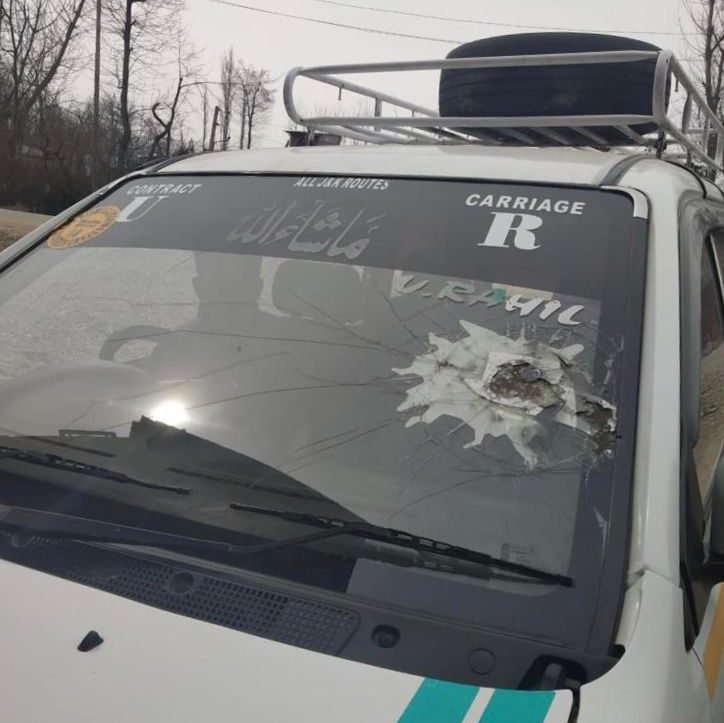
And I was caught in the middle of it. My vehicle was a civil-hired one, blending in but not immune. Suddenly, amidst the deafening chants and clatter, a stone came hurling towards my car. It shattered the windshield with such force that I was momentarily stunned. My heart pounded not just from the shock but from something far deeper—an aching question: How had we reached a place where our own soil was so unsafe?
I wasn’t just afraid for myself. I was grieving, in real-time, for a country where children had become pawns in a game of destruction.
I remember the boy who threw the stone. He couldn’t have been more than 15. As he raised his arm to strike again, my eyes caught something chilling—his forearm, marred by multiple blue injection marks. Five, maybe six. Faint but unmistakable. The kind left behind by intravenous drug use. He was not just angry. He was under the influence—his body hijacked, his mind numbed, his soul possibly lost.
I turned and saw more of them—ten to twelve boys, no older than 25, fuelled by something beyond rage. I could see the haze in their eyes, the erratic aggression in their limbs. My driver, who knew the Valley well, whispered urgently, “Yeh nasha ki wajah se hai. Bacche nashe mein hain, madam.” These children, he told me, had been poisoned—by ideology, yes—but also by drugs. They were both radicalised and drugged, a terrifying combination.
A Rashtriya Rifles unit nearby got wind of the attack and swiftly intervened. They pulled me out and escorted me to safety. But the fear lingered. The vulnerability I felt wasn’t just as a woman or a civilian. It was as an Indian—watching her country bleed from a thousand invisible wounds.
At the Heart of Insurgency: Pakistan’s Narco-Terrorism Doctrine
At the heart of this insurgency lies Pakistan’s persistent effort to destabilise India through the ISI’s deep involvement in narco-terrorism. Intelligence sources indicate that drug routes have been carefully cultivated from across the Line of Control (LoC) into Kashmir and Punjab, with consignments often dropped via drones.
These drugs—mainly heroin and methamphetamine—are then funnelled through a network of couriers, often young boys and villagers tempted or coerced into service. The revenue from these narcotics directly funds terrorist activities.
Investigations by the NIA and Punjab Police have revealed how smuggling rings have links not just with Pakistani handlers, but also with operatives based in the Gulf—particularly in Dubai and Muscat. These offshore financiers offer logistical support and money laundering services, often using hawala networks to fund attacks within India.
Cases like the 2020 seizure of 532 kg of heroin at the Attari border and the 3,000 kg haul at Gujarat’s Mundra port point towards Pakistan’s systematic exploitation of Indian vulnerabilities. What’s more alarming is that a portion of these drugs is circulated within India, contributing to the crisis of drug addiction among the youth—especially in border states like Punjab.
From behind prison walls in India, arrested terrorists continue to communicate with handlers in Pakistan. Mobile phones are frequently recovered during jail raids, revealing blueprints for recruitment and instructions for attacks. The radicalisation pipeline is alive even behind bars.
Propaganda is yet another powerful weapon. Pakistani handlers run thousands of social media accounts targeting Indian Muslims and Sikhs, often with customised messaging: for Kashmiris, it is the myth of Indian oppression; for Sikhs, the ghost of 1984 is rekindled to instigate pro-Khalistan sentiments.
Carefully edited videos, fake news, and emotional triggers are used to sow distrust and lure vulnerable minds into extremism. The ISI’s endgame is clear: bleed India with a thousand cuts. Whether through a heroin packet crossing a fence at midnight, a doctored video causing unrest in a university, or a radicalised teenager turning into a suicide bomber, the methods vary but the motive is singular—destabilisation.
Needles of War: The Drug Trail at Nagrota
If Pulwama was fear, then Nagrota was fury.
While writing my fifth book on the Nagrota attack that took place in 2016, I was flabbergasted by the findings of the Army and NIA. The 2016 attack at the Army unit in Nagrota was another chapter in this insidious playbook of death. Terrorists from Pakistan-based Jaish-e-Mohammed had crossed the Line of Control with a singular motive—mass destruction. They wanted to take hostages, blow up the ammunition dump, and cause a spectacular strike on Indian military infrastructure.
But they underestimated our soldiers. Our Army’s quick action and tactical brilliance ensured the terrorists were neutralised before they could reach their targets.
What was left behind were not just bodies but revelations—bags filled with syringes and chemical drug vials. It wasn’t just bullets and grenades they had carried across the border. They carried chemical influence—mind-altering substances to enhance aggression, suppress fear, and perhaps strip them of any last remnants of humanity.
This wasn’t merely religious indoctrination. No holy book commands you to commit suicide missions under a drug haze. This was pharmacological programming—a cocktail of ideology and intoxication.
As I combed through the details for my book Nagrota Under Siege, the implications became disturbingly clear. These weren’t just brainwashed young men from madrasas. They were high-functioning zombies—driven by doctrine but sustained by syringes.
The enemy was no longer just across the border. It was inside our veins. Inside our streets. Inside our children.
The Battle for India’s Soul Begins with its Youth
Pakistan’s strategy is not just to cross borders with armed men—it is to infiltrate minds, numb spirits, and fracture India from within. From narcotics wrapped in ideology to social media warfare dressed in the language of justice, this hybrid assault is far more insidious than conventional conflict.
It wages war not just on our security apparatus, but on our youth—the most vulnerable, the most vital.
Having stood on the frontlines of these truths—from shattered windshields in Pulwama to blood-soaked barracks in Nagrota—I have come to understand that this is not just a story of militancy or narcotics. It is the story of a nation fighting for its future.
The ISI’s intent is clear: to poison India’s youth with a toxic mix of drugs and despair, and then weaponise that despair against their own country.
India’s response must be equally strategic—but with a beating heart at its center. Surveillance and surgical strikes can only go so far. What we need is a generational firewall—built not with barbed wire, but with education, employment, purpose, and pride.
A Kashmiri boy with a MacBook is far more dangerous to Pakistan’s designs than a radicalised one with an AK-47. As journalists, thinkers, policymakers, and citizens, we must ask not only how many terrorists were neutralised, but how many young lives were reclaimed.
This is a war we cannot afford to lose—not because of the damage it inflicts, but because of the innocence it erodes.
And in that war, every pen, every platform, every story—counts.

Article by: Bhaavna Arora