


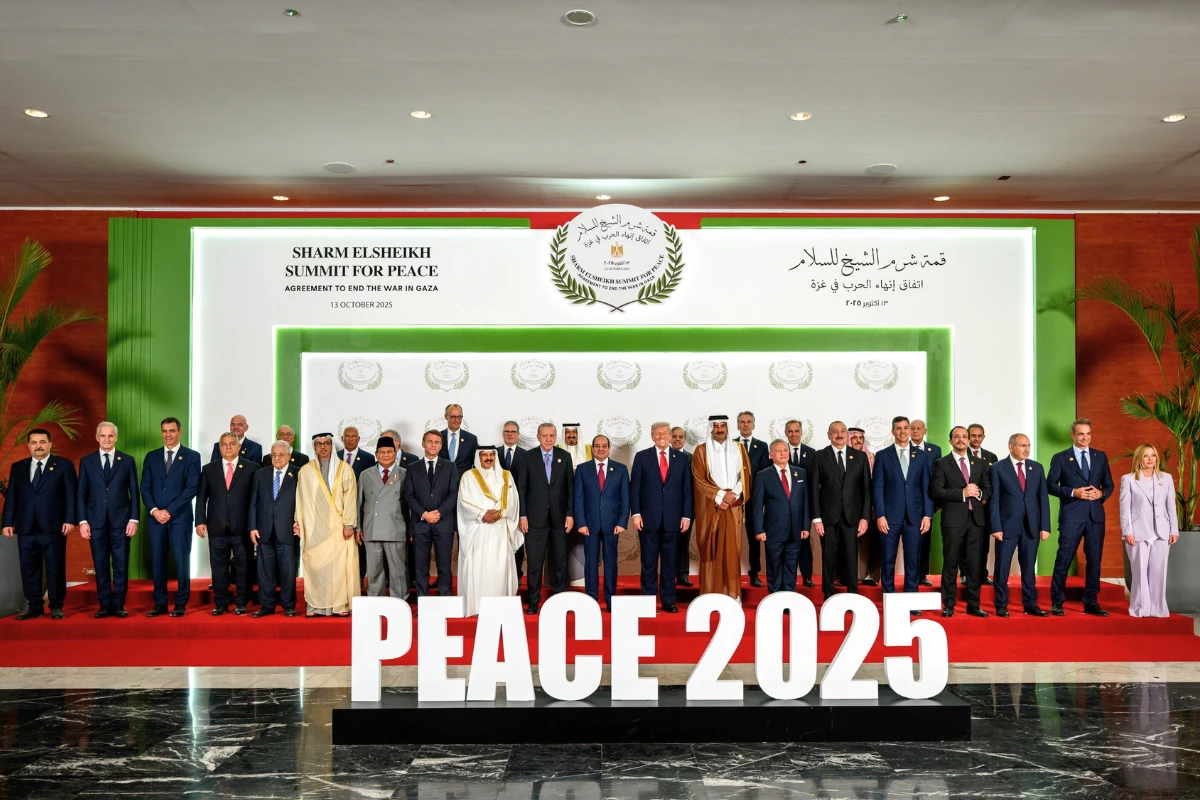






NEW DELHI: In a historic diplomatic breakthrough, President Donald Trump and leaders from over 20 nations convened in Sharm El-Sheikh, Egypt, to sign the “Trump Declaration for Enduring Peace and Prosperity,” a comprehensive agreement aimed at ending the Gaza conflict that has persisted since October 2023.

The summit, co-chaired by President Trump and Egyptian President Abdel Fattah el-Sisi, marked a significant step toward regional stability.
The agreement follows the recent release of all 20 living Israeli hostages by Hamas, a pivotal moment in the peace process. In exchange, Israel freed nearly 2,000 Palestinian detainees, facilitating the first phase of the ceasefire.
Despite these steps, challenges remain, as Hamas has yet to return the bodies of 20 deceased hostages. President Trump emphasized that the peace process is “not done” and announced the initiation of a second phase of the plan.
The Trump Declaration outlines several critical components designed to stabilize Gaza and ensure lasting peace.
It establishes an interim government in Gaza, with the possibility of oversight by international figures such as former UK Prime Minister Tony Blair, to manage administrative affairs during the transition. The agreement also calls for phased disarmament of Hamas, supported by the deployment of an International Stabilization Force to assist in security and dismantling militant infrastructure.
Reconstruction of Gaza’s essential services and housing forms a central part of the plan, alongside facilitating international humanitarian aid, contingent upon compliance with the ceasefire terms.
The agreement received praise from various international leaders, including British Prime Minister Keir Starmer and French President Emmanuel Macron, who viewed it as a step toward durable peace in the region.
However, the absence of Israeli Prime Minister Benjamin Netanyahu and representatives from Hamas at the summit raised questions about the long-term viability of the deal.
Netanyahu’s absence was attributed to ongoing legal matters, while Hamas has expressed reservations regarding the proposed governance structure and disarmament measures.
Human rights organizations highlighted ongoing concerns about the humanitarian situation in Gaza, emphasizing the need for rapid action to address the civilian population’s immediate needs.
The United Nations also called for increased support for reconstruction efforts and stressed the importance of protecting individual rights during the transitional period.
While the signing of the peace deal represents a significant achievement, the path to lasting peace remains complex.
The successful implementation of the agreement will depend on cooperation among all parties involved, including Hamas, Israel, and the international community.

Ongoing diplomatic efforts and careful monitoring will be essential to ensure that the terms of the agreement are upheld and that the people of Gaza can begin rebuilding their lives in a secure and peaceful environment.