


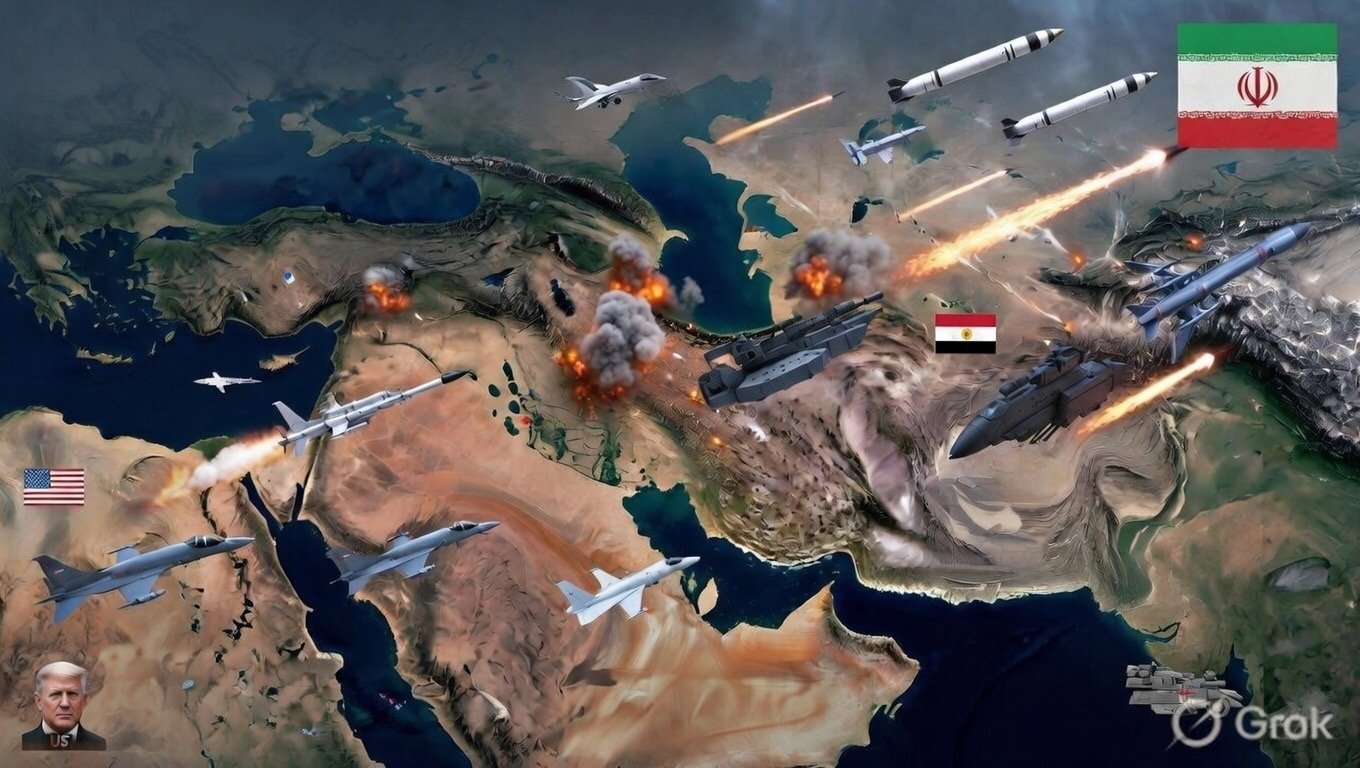






New Delhi: In a dramatic escalation of long-simmering tensions, the United States and Israel launched coordinated military strikes on Iran on Saturday, targeting nuclear facilities, ballistic missile sites, and military installations across the country.

Explosions rocked Tehran and other cities, with plumes of smoke rising over the capital as air raid sirens wailed, as per news reports. President Donald Trump described the operation as “massive and ongoing,” aimed at eliminating “imminent threats” from the Iranian regime. Israeli Defense Minister Israel Katz called it a “pre-emptive attack” to neutralize existential threats, following months of joint planning.
The strikes come amid a backdrop of failed nuclear negotiations in Geneva, where Iran was accused of advancing its nuclear program despite international warnings. Tensions have intensified since the 2025 Israel-Iran war, which saw U.S. involvement in targeting Iranian enrichment sites like Natanz and Fordow.
Trump, in a video posted on Truth Social, urged Iranian forces to lay down arms and called for the overthrow of the government, stating, “The hour of your freedom is at hand.” Israeli Prime Minister Benjamin Netanyahu echoed this, emphasizing the goal of degrading the “Iranian terror regime.”
Iran swiftly retaliated, launching a barrage of ballistic missiles and drones toward Israel and U.S. military bases in the region. The Islamic Revolutionary Guard Corps (IRGC) confirmed the “first wave” of strikes, targeting facilities in Bahrain, Qatar, the UAE, Kuwait, Jordan, Saudi Arabia, and Israel, as per news reports.
Explosions were reported at the U.S. Navy’s 5th Fleet headquarters in Manama, Bahrain, and Al Udeid Air Base in Qatar, with Bahrain confirming at least three missiles struck the site. In Israel, air raid sirens blared nationwide as missiles were intercepted, though some impacts were reported. Iranian state media claimed the response would be “crushing,” with an official vowing no red lines in retaliation.
The attacks have plunged the Middle East into chaos, with multiple countries—including Iran, Israel, Iraq, Qatar, Kuwait, Bahrain, and the UAE—closing their airspace, disrupting global flights and trade routes. Casualties remain unconfirmed, but Trump warned of potential American losses, while Iranian sources reported initial deaths in the hundreds. The Pentagon dubbed the U.S. operation “EPIC,” focusing on Iran’s missile arsenal to prevent nuclear weapon development.

This crisis could trigger a broader regional conflict, potentially involving Iranian proxies like Hezbollah and the Houthis once again. Oil prices surged amid fears of disruptions in the Strait of Hormuz. International calls for de-escalation have poured in, but with both sides entrenched, the risk of prolonged warfare looms large. As of late afternoon IST, operations continue, marking a perilous new chapter in U.S.-Iran relations.