


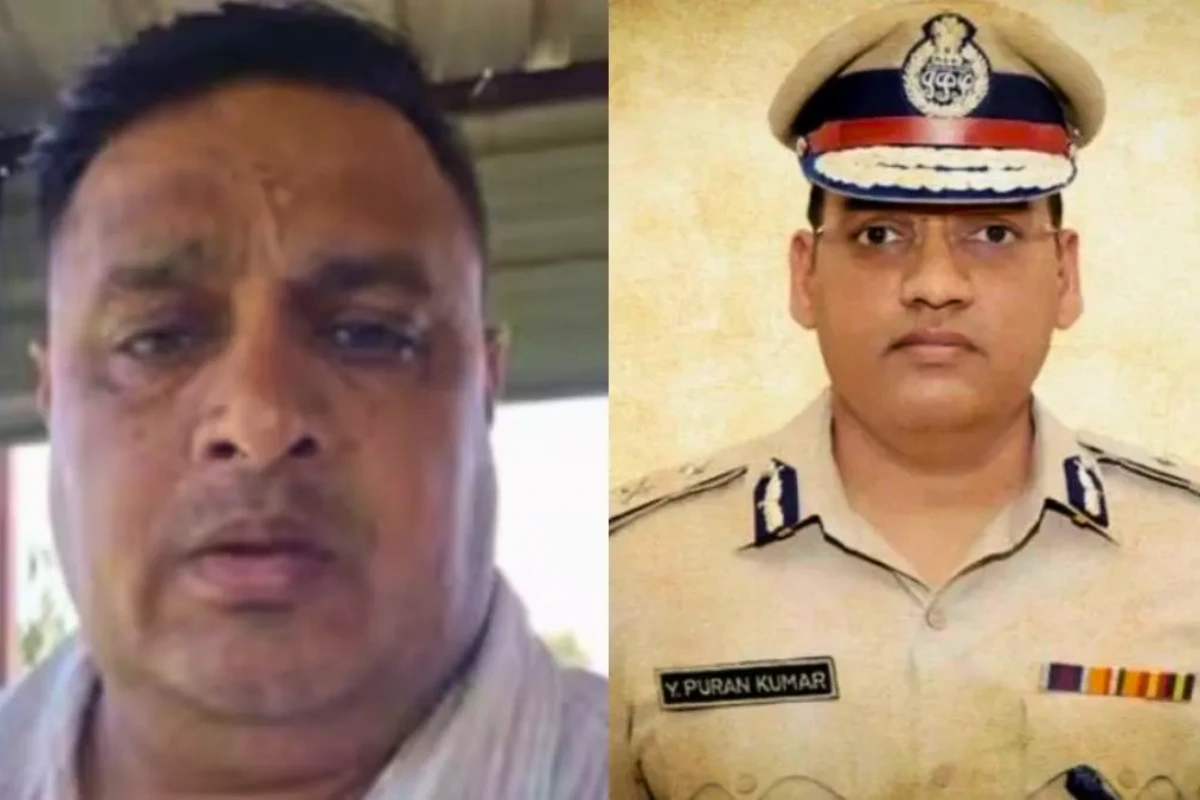






NEW DELHI: The perplexing case of Haryana IPS officer Y. Puran Kumar, who died by suicide on October 7, has taken a dramatic turn with the death of an Assistant Sub-Inspector (ASI) Sandeep Kumar.

The ASI, who was reportedly investigating allegations of corruption against the IPS officer, ended his own life in Rohtak, leaving behind a recorded video message and suicide note accusing Puran Kumar of deep malfeasance.
The new developments have broadened the investigation, triggered political outrage, and raised pressing questions about internal accountability in the police.
#FLASH: Haryana IPS suicide case shocker
ASI Sandeep Lather, probing IPS Y Puran Kumar, also dies by suicide, alleging corruption & discrimination.
Shot himself dead with his service revolver in a field in Rohtak. He left behind a video and a three-page suicide note.… pic.twitter.com/C7Vx25crPr
— The New Indian (@TheNewIndian_in) October 14, 2025
Starting Point: The Death of Y. Puran Kumar
Y. Puran Kumar, a 2001-batch IPS officer, was found dead in the basement of his residence in Chennai (despite being posted in Haryana) on October 7. He is believed to have shot himself with his service revolver.
At the time of his death, authorities recovered a lengthy “final note,” roughly eight pages, in which Kumar accused multiple senior officers, including the state DGP Shatrujeet Kapur and Rohtak SP Narendra Bijarnia, of “blatant caste-based discrimination, targeted mental harassment, public humiliation and atrocities.”
In his note, Kumar alleged that despite his professional merits, he was marginalized because of his Dalit background. He claimed that promotions, transfers and postings had been manipulated to sideline him, and to protect influential individuals.
His wife, Amneet P. Kumar, a senior IAS officer, has been vocal in seeking justice and demanding that the officers named in the note be held accountable. The family has withheld consent for post-mortem and cremation until key demands are met, including inclusion of stronger legal provisions under the SC/ST (Prevention of Atrocities) Act.
Laptop Roadblock in the Investigation
The probe into Puran Kumar’s death has encountered procedural snags, most notably regarding his laptop. Chandigarh police issued a notice to his wife demanding that the device be surrendered, claiming it may contain crucial evidence. Amneet Kumar, however, has refused, arguing that the laptop holds personal and private information.
Officials argue that the laptop may contain emails, messages, or documents that further illuminate the relationships and pressures the late officer was under.
Twist: ASI Sandeep Kumar’s Suicide & Allegations
On October 14, in a development that has shocked observers, ASI Sandeep Kumar, posted at the Rohtak cyber cell, shot himself with his service revolver in a field. He left behind a three-page suicide note and a video message.
In his final note, Sandeep accused Y. Puran Kumar of systemic corruption and claimed the IPS officer used caste discrimination issues to shield his wrongdoings from scrutiny.
He alleged that honest officers were replaced with corrupt ones under Puran Kumar’s influence. He framed his decision as a sacrifice “for truth” and urged a full probe into the IPS officer’s assets.
While the narratives in the two suicides differ, the first focusing on caste harassment, the second on corruption, the overlapping personnel, internal dynamics, and mutual accusations have intensified public and official scrutiny.
Administrative Shake-Up & Legal Reconfiguration
In response to mounting pressure, the Haryana government has placed DGP Shatrujeet Kapur on leave. The Rohtak SP, Narendra Bijarnia, was transferred — Surinder Singh Bhoria has taken over the role.
In parallel, the FIR registered in connection with the Puran Kumar death has been amended. At the request of his wife, officials added Section 3(2)(v) of the SC/ST (Prevention of Atrocities) Act, which allows more stringent penalties for acts of humiliation, harassment, and discrimination targeted at Scheduled Castes and Scheduled Tribes.
The police special investigation team (SIT), led by Chandigarh’s IG Pushpendra Kumar, confirmed this inclusion.
Meanwhile, with the DGP’s leave, the state has assigned OP Singh (a 1992-batch IPS officer) as the new Haryana DGP, at least in additional charge, to bring leadership continuity amid the turmoil.
Political Reaction & Calls for Accountability
The twin tragedies have triggered uproar across party lines and civil society. Rahul Gandhi, on meeting the family in Chandigarh, said that the incident sends a chilling message to Dalits: that even “capable” individuals may be pushed to ruin. He urged action against those named in the note.
Lok Sabha MP Dr. Raj Kumar Chabbewal demanded immediate arrests of officers named in the suicide note, accusing the state government of protecting key figures. The revenue officers’ union in Haryana also rallied behind the family, declaring a day of solidarity and calling for an independent, impartial inquiry.
State-level leaders pointed to larger patterns of caste-based injustice and called for structural reforms.
Some protests were staged in Rewari and Gurgaon by Dalit groups, demanding parliamentary oversight and stricter implementation of SC/ST protections.
Opposition parties have accused the state administration of shielding its “blue-eyed” officers.
Key Issues & Open Questions
As the case unfolds, several central questions and challenges remain:
- Which narrative is closer to truth?
The original note by Puran Kumar emphasizes caste-based harassment and institutional humiliation. The second note from Sandeep Kumar focuses on corruption and abuse of office. The overlap in accused individuals, however, suggests that caste and corruption may have had a complex, intertwined role. - What role did the laptop play?
The refusal to hand over Puran Kumar’s laptop has become a flashpoint. Investigators view it as a potential goldmine for digital evidence, while the family argues for privacy. The standoff underscores tensions between procedural integrity and personal rights. - How independent will the investigation be?
The addition of SC/ST Act provisions to the FIR raises the stakes and scope. Whether the SIT and state agencies can maintain impartiality amid political pressure will be critical. - Will accountability be enforced?
There is widespread demand for arrests of senior officers named in the notes. But political promise and administrative action do not always align, implementation will be closely watched. - What systemic reforms may emerge?
The case has reignited debates around caste equity in policing, internal grievance redressal mechanisms, and protections for whistleblowers within law enforcement.
Context & Precedents
While this case is extraordinary in its tragedy and scale, it echoes past instances of institutional pressure driving public servants to extreme actions. The interplay between caste, bureaucratic hierarchies, and police accountability has long been a thorn in India’s governance landscape.
Moreover, cases where internal investigators become targets or die under mysterious circumstances have historically deepened suspicion around cover-ups. The dual suicides here reinforce the need for transparency, forensic rigor, and independent oversight.
The suicides of Y. Puran Kumar and ASI Sandeep Kumar have created a complex saga of abuse, counterclaims, and administrative turmoil.

What began as a solitary death has become a storm, implicating top police officers, raising systemic questions about caste and corruption, and demanding accountability from the very institutions that enforce the law. In the days ahead, the public will closely observe whether the SIT’s probe is rigorous and fearless, whether key figures are held to account, and whether the lessons from this tragedy can translate into institutional reform, so that no officer feels compelled to die to reveal a truth.