


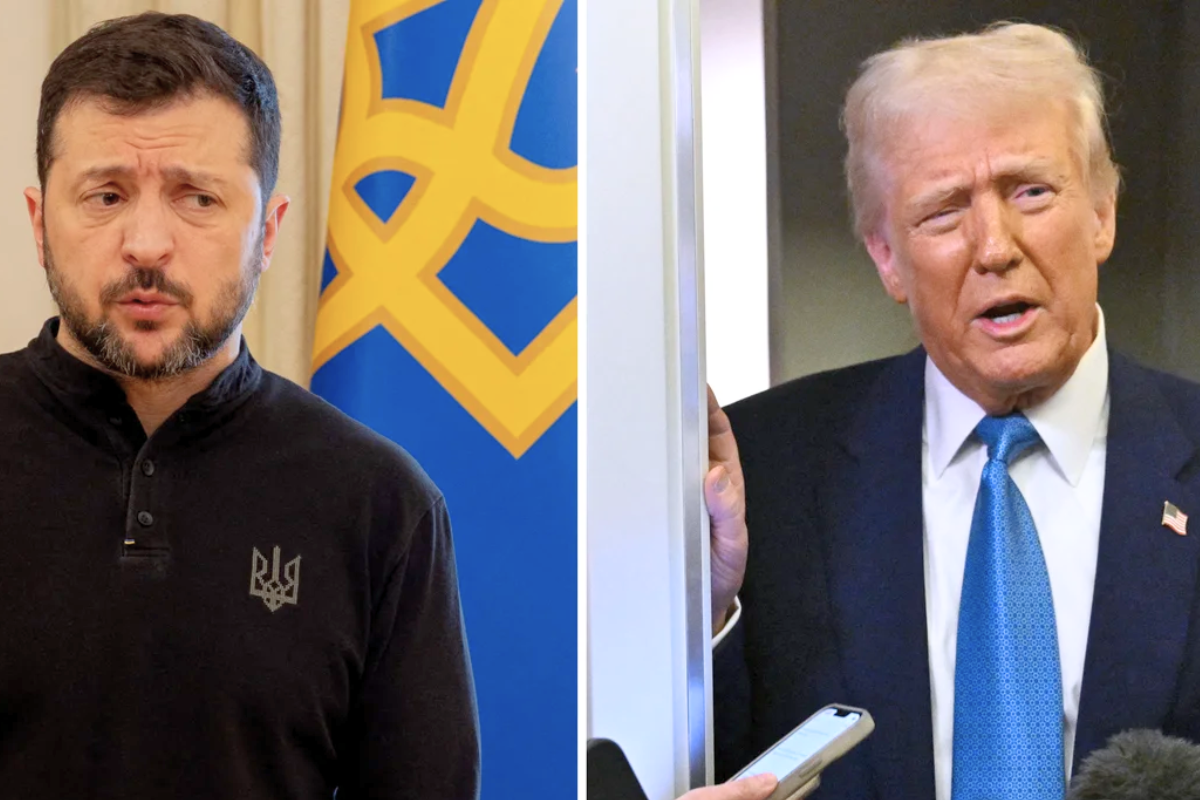






The globally televised spat between Ukraine’s President Zelenskyy and
President Trump (along with vice-president Vance) of the US was a
public negotiation, from which the US delegation walked away, letting it
be known to the media that Zelenskyy could return `when he’s ready to
make peace.’

It’s a time-honoured tradition of deal-making—to pretend to walk away
uninterested, convinced that the other party will reach out for restored
talks, returning much weaker than before. The meeting shocked almost
all those watching, but it was an important lesson in how Trump will deal
with the world: he believes he holds trump cards, and he expects those
he considers weaker to kowtow, not negotiate as equals.
UK Prime Minister Kier Starmer had pitifully kowtowed just the day
before, as had Jordan’s King Abdullah a few days earlier. And Trump
openly scoffed at other visitors. But, the big question after the
Zelenskyy meeting is whether Trump may be overplaying his own
hand on the global level, even as he curtly told Zelenskyy that
`you’re not in a good position right now. You don’t have the cards.’
Trump and Vance inadvertently strengthened President Putin’s
hand in the really high stakes game between the three major
geopolitical poles.
After all, it is with a strong Putin in mind that, at least on that fateful
Friday, Zelenskyy was determined to get security guarantees in
exchange for signing over his country’s remaining rare earth minerals to
the US.
He knew those rights were/are his trump card, especially if Russia gets
to keep the 20 per cent of his country that it has conquered—parts that
have about 40 per cent of the country’s minerals. For, more than half of
Ukraine’s rare earths—perhaps half of its lithium, and a smallish portion
of its titanium and zirconium—are in the eastern Ukraine regions that the
Russian army has occupied.
In fact, Russia is said to have suggested to the US that it claim rights to
half of Ukraine’s mineral rights—presumably the other half! The idea
evidently was to sweeten the deal for the Western superpower’s deal-
maker boss to lean on Ukraine to accept an immediate ceasefire.
The corollary would probably be that Russia would hold on to regions it
has captured—where the majority of residents speak Russian and are
said to be pro-Russia. Zelenskyy, on the other hand, seems determined
to reclaim those areas, for that has been the nub of the geopolitical and
military struggle since 2014.
But Ukraine has made no progress on those `meat-grinder’ killing fields
for the past 18 months, i.e., half of the three-year old war. So, Indeed, in
light of the fact that Europe gets short shrift in Trump’s multi-polar
worldview, one might even argue that Zelenskyy should have been
grateful that Trump declared that he saw himself as even-handed
between Ukraine and Russia—meaning he would give Ukraine as
much importance as Russia.
Europe supports Ukraine
At the level of realpolitik, Trump counted on Zelenskyy to sign over the
mineral rights in order to prevent his country from collapsing under
Russia’s assaults if his troops run out of arms. Both sides know that US
military aid has been crucial to prevent that over the past three years.
But Zelenskyy evidently believes that the European Union—which some
reports say has promised 300 billion Euros in aid—can help him stave
off a collapse on those battlefields.
Indeed, echoing each other exactly, several top EU officials tweeted in
tandem: “Your dignity honors the bravery of the Ukrainian people. Be
strong, be brave, be fearless. You are never alone, dear President
Zelenskyy. We will continue working for you for a just and lasting peace.’
Plus, as a media person in the Oval Office asked during the argument:
wouldn’t the US have to station troops in Ukraine to safeguard its rare
earths? Trump—who appeared not to have considered this—replied that
the strength of his reputation was enough.
As things stand, the US, and not just Trump’s MAGA backers, seems to
believe in the US’s unchallengeable clout, especially under its
obstreperous current president. Conservative analyst Scott Jennings
expressed that hubris to CNN succinctly: `All Zelensky had to do today
was put on a tie, show up, smile, say thank you, sign the papers. That’s
it…”
Still functional, or a basket case?
Another set of frames of reference was widely divergent. The US side
saw Ukraine as being on its knees, largely destroyed, and unable to
stave off an imminent rout by Russia without the help of the US and its
European friends. As Vice-president Vance told Zelenskyy: `The
President (Trump) is trying to save your country.’
Zelenskyy, on the other hand, insisted that his country was functioning,
that buildings are standing, and children go to school—even if they
study online in places near the frontlines. He insisted that Ukrainian
soldiers are fighting vigorously, and seemed to suggest that the
country’s morale was intact.
Trump’s statement, issued after the meeting broke down, seemed to
reject that framing of Ukraine’s situation. `I have determined that
President Zelenskyy is not ready for Peace if America is involved,
because he feels our involvement gives him a big advantage in
negotiations. I don’t want advantage, I want PEACE.’
There’s an obvious difference, however, between how the two
presidents view what kind of peace is acceptable. Trump wants a
ceasefire at the current frontlines. Zelenskyy wants restored sovereignty
over lost territory, and (at least) guarantees against fresh aggression.
There’s another crucial difference of perception—on how much the US
has given Ukraine to fight this war. It’s a crucial point because Trump
apparently wants to offset the value of the minerals against that amount.
Zelenskyy tried to say `no’ when Trump claimed that the US has given $
350 billion, and that the US has given much more than European
countries.
One independent estimate (by the Kiel Institute) of the military, financial
and humanitarian aid sent from the US to Ukraine since the war began
puts the amount donated at $ 118 bn. The US Department of Defense
puts the figure of its assistance 55 per cent higher than that, at nearly $
183 bn.
If the US wants to be reimbursed—in rare earths or by other
means—one can understand the importance to Ukraine of getting the
figure right. But, to Trump, what matters is that Zelenskyy holds a weak
hand, and that Ukraine is relatively less important in the world than
countries like Russia or China.

In that scheme of things, not just Ukraine but other European countries
(not to mention all of Latin America, and countries like India) will have to
do the best they can to secure themselves.