


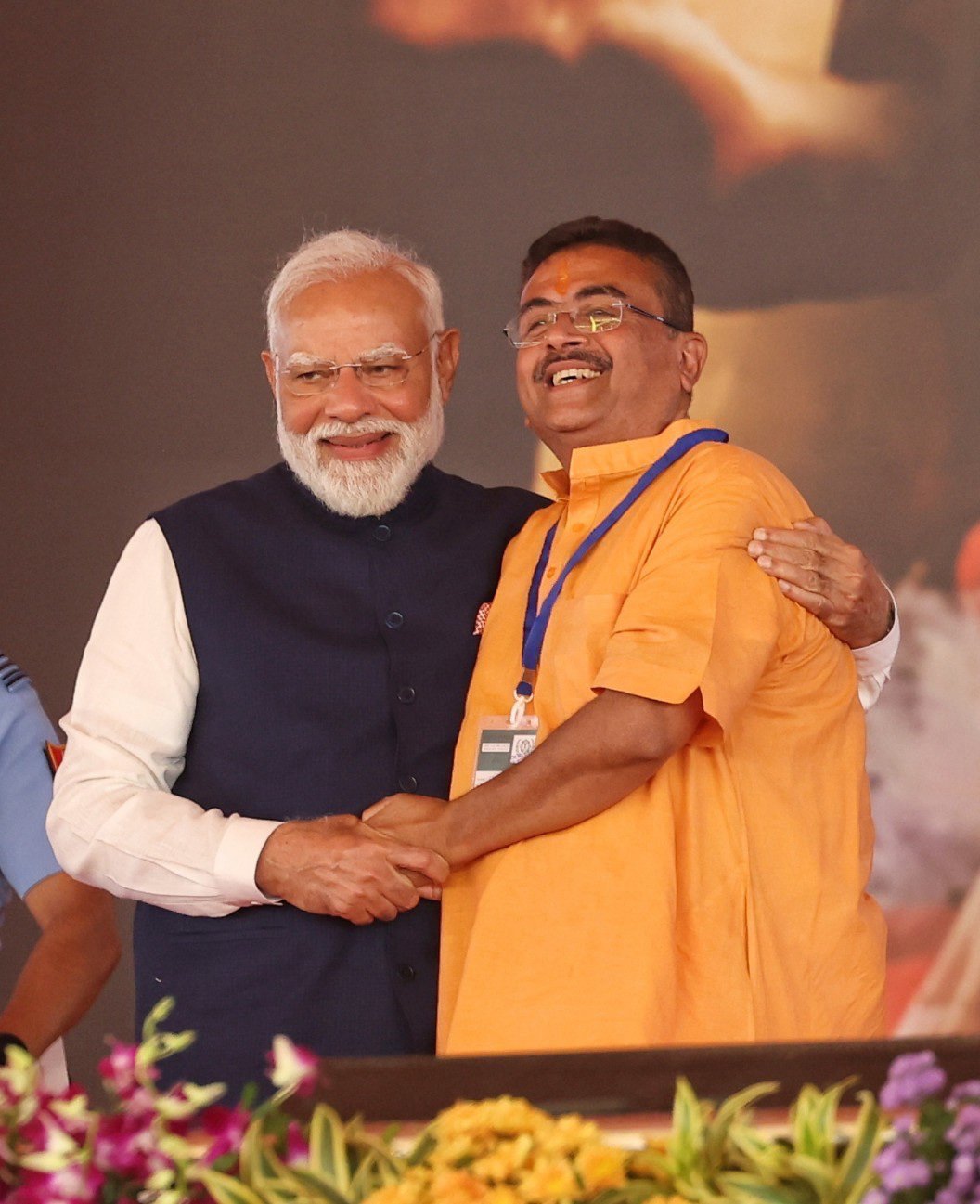






New Delhi: Suvendu Adhikari was sworn in as West Bengal’s 9th Chief Minister on Saturday, becoming the first from the Bharatiya Janata Party (BJP) to lead the eastern state and ending more than 15 years of Trinamool Congress rule.

Governor R.N. Ravi administered the oath of office and secrecy to Adhikari at a grand public ceremony at Kolkata’s iconic Brigade Parade Ground. Prime Minister Narendra Modi, Union Home Minister Amit Shah, and several NDA chief ministers attended the event, which featured Bengali cultural performances and drew thousands of supporters. Five other BJP MLAs, including senior leaders Dilip Ghosh and Agnimitra Paul, were also sworn in as ministers.
In his first remarks after taking oath, Adhikari vowed to rebuild the state. “Education is lost, culture is destroyed, and we will rebuild Bengal,” he said, adding that his government would focus on “Sonar Bangla” — a vision of golden Bengal emphasizing development, good governance, and an end to political violence.
Prime Minister Modi congratulated Adhikari, writing on X: “He has established his identity as a leader closely connected with the people. He has come to know their hopes and aspirations very closely. I extend my heartiest best wishes to him for a successful tenure in the future.” Modi also extended greetings to the newly sworn-in ministers and bowed in ‘Sashtang Pranam’ before the gathering, signalling gratitude to the people of Bengal.
The BJP’s leaders hailed the moment as historic. Home Minister Amit Shah said he has full faith that under the leadership of Prime Minister Narendra Modi, Chief Minister Suvendu Adhikari’s “BJP government will realize the dream of the great luminaries’ ‘Sonar Bangla’.” This resolve to free the people of the state, who have endured the scourge of corruption, extortion, and syndicate rule for years, and to build a developed, prosperous, secure, and fearless West Bengal will surely be fulfilled under your leadership, he asserted.
Adhikari, 55, led the BJP to a decisive victory in the 2026 Assembly elections, securing over 200 seats and defeating Mamata Banerjee in Bhabanipur. Once a key TMC leader and minister who played a prominent role in the 2006-08 Singur and Nandigram agitations, Adhikari joined the BJP in late 2020 and rose as the party’s face in the state.
Jana Sangh Roots and Bengal’s Place in BJP Ideology
The BJP traces its ideological lineage to the Bharatiya Jana Sangh, founded on October 21, 1951, in Delhi by Dr. Syama Prasad Mookerjee (1901-1953), a Bengali scholar, educationist, and former Congress leader. Mookerjee, who served as Vice-Chancellor of Calcutta University and Union Minister in Nehru’s cabinet, broke with the Congress over issues including the handling of Partition’s aftermath and Article 370 on Jammu and Kashmir. With support from the Rashtriya Swayamsevak Sangh (RSS), he established the Jana Sangh as a nationalist alternative emphasising Bharatiya culture, unity, and strong federal structure. Mookerjee died in 1953 while in detention in Kashmir protesting the special status granted to the state. The Jana Sangh later merged into the Janata Party in 1977 before the BJP’s formal launch in 1980.
PM Modi on Saturday posted on X, “Today, as the first BJP government in West Bengal takes oath, it is only natural for all of us to remember Dr. Shyama Prasad Mukherjee and his everlasting contributions to the nation and especially to West Bengal. We will not spare any effort in realizing his dream.”
On the occasion, he met Makhonlal Sarker a described him as a “devoted patriot” who had worked with Dr. Mukherjee and was also arrested during his time as a companion in Jammu and Kashmir. “He has dedicated his life to expanding the base of our party across West Bengal and inspiring people from all levels to join the party,” the Prime Minister said adding that “as BJP workers, we are proud that our party has such inspirational figures who have worked among the people to strengthen our party.”
Adhikari, addressing the gathering, said his government would work under Modi’s leadership to fulfil the people’s mandate for change. Senior BJP leaders described the swearing-in as the start of a “new era” focused on peace, investment, and welfare.

The ceremony, held on Rabindranath Tagore’s birth anniversary, blended Bengali tradition with political symbolism, featuring folk artists from across Bengal. Security was tight amid reports of heightened political tensions following the polls.