


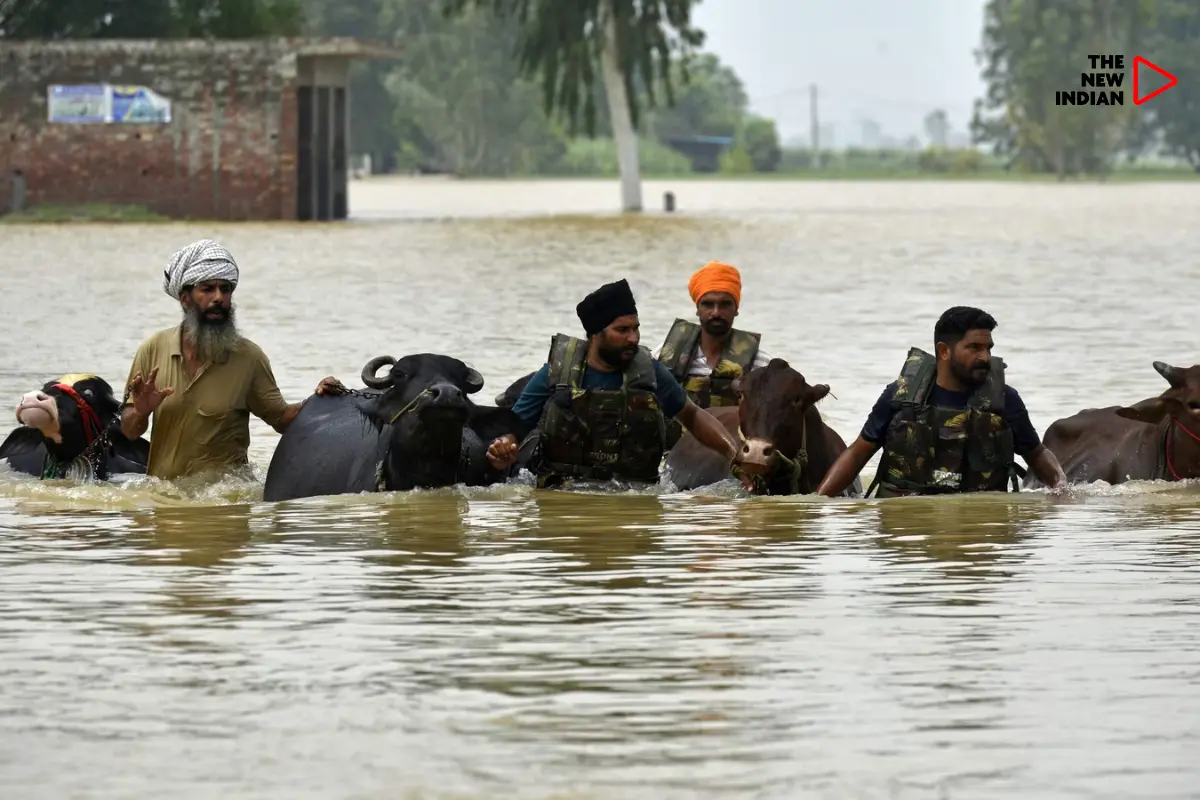






NEW DELHI: In one of the most compassionate responses to a natural disaster, the Punjab government has extended its flood relief operations beyond humans to protect and rescue animals.

Amid devastating floods that submerged over 1,400 villages and impacted 3.5 lakh people, Chief Minister Bhagwant Mann directed that “no living being, whether human or animal, will be left behind.”
Over 5 Lakh Animals Saved
Animal Husbandry, Dairy Development and Fisheries Minister Gurmeet Singh Khuddian said more than 5.16 lakh animals were saved during the floods. A total of 481 veterinary teams, each comprising veterinary officers, inspectors, pharmacists and staff, were deployed to provide urgent medical care. To date, 22,534 animals have been treated, while fodder and feed were distributed widely across affected areas.
Khuddian said the department has supplied 12,170 quintals of feed and 5,090 quintals of green and dry fodder, alongside ₹31.50 lakh released for animal treatment. In Fazilka alone, 5,000 feed bags were distributed.
Stories of Survival
From Pathankot to Fazilka, countless stories emerged of animals rescued from rooftops and cattle sheds. Gurchan Singh, a dairy farmer from Pathankot, recalled boats arriving not only for villagers but also for his 12 buffaloes: “I thought I had lost everything, but then I saw my animals being saved too.”
In Fazilka, AAP leader Dr. Amarjeet Kaur shared how her team rescued a cow shielding her newborn calf for three days: “When we lifted them into the boat, I saw tears in the eyes of our team members. That moment showed us the true meaning of service.”
Losses and Damage
Despite the large-scale rescue effort, the floods claimed the lives of 504 cattle and buffaloes, 73 sheep and goats, 160 pigs, and nearly 18,304 poultry birds. In total, about 2.52 lakh animals and 5.88 lakh poultry birds were affected across 14 districts, including Pathankot, Gurdaspur, Amritsar, Ferozepur, Fazilka, Kapurthala, Barnala, Bathinda, Hoshiarpur, Tarn Taran, Patiala, Jalandhar, Rupnagar and Moga.
Coordinated Relief Effort
The operation involved not only government teams but also NGOs such as Kalgidhar Trust, which reached 125 villages to support more than 5,000 families with fodder supplies. Modern technology, including drones, was used to identify stranded livestock. 27 Army columns, 9 helicopters, 158 boats, and numerous veterinary teams worked round the clock to evacuate and treat animals.
Principal Secretary Animal Husbandry Rahul Bhandari said 24×7 control rooms have been set up at both the state and district levels, with helplines such as 0172-5086064 for farmers needing urgent support.
Compassion as Policy
Rural Development Minister Tarunpreet Singh Sond said the government’s philosophy was reflected in distributing animal feed along with human rations during the third phase of relief. “Every living being is family,” he said.
Beyond Disaster Response

The 2025 Punjab floods will be remembered not only for their devastation but also for Punjab’s inclusive response. By saving both people and animals, the Mann government and citizens of Punjab demonstrated that compassion is the truest measure of leadership.