


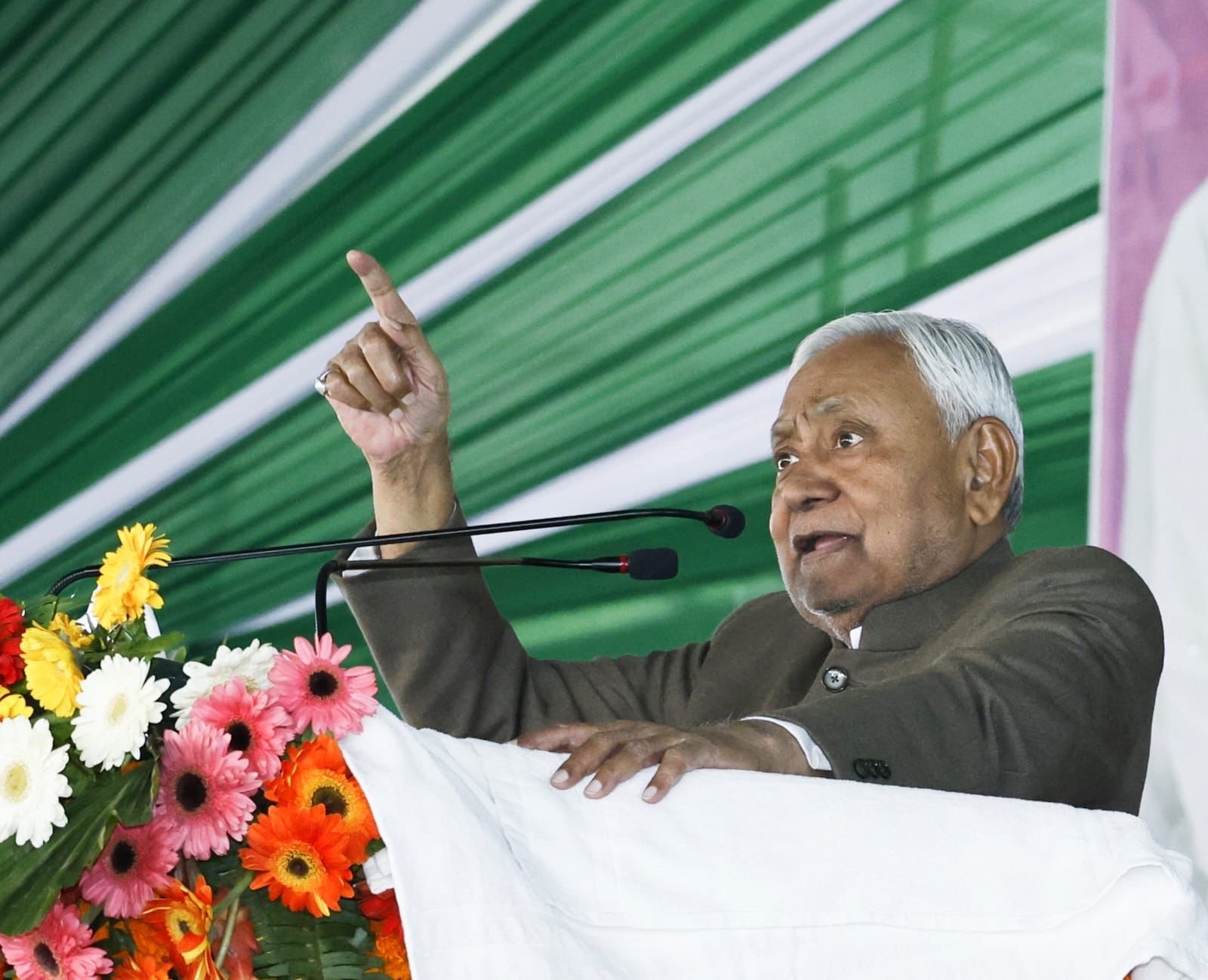






New Delhi: Bihar Chief Minister Nitish Kumar announced on Thursday that he will step down from the top post and contest the upcoming election to the Rajya Sabha, marking a significant turning point in Bihar’s political landscape after nearly two decades of his dominant presence in state politics.

The veteran leader confirmed the move in a post on the social media platform X (Twitter), saying that he intends to shift his focus to national politics while continuing to work for Bihar’s development.
In his message, Kumar said, “For more than two decades, you have consistently placed your trust and support in me, and it is on the strength of that trust that we have served Bihar and all of you with complete dedication. It was the power of your trust and support that has enabled Bihar today to present a new dimension of development and dignity. For this, I have expressed my gratitude to you many times in the past as well.
From the very beginning of my parliamentary journey, there has been a desire in my heart to become a member of both Houses of the Bihar Legislature as well as both Houses of Parliament. In keeping with this aspiration, I seek to become a member of the Rajya Sabha in the elections being held this time.
I want to assure you with complete honesty that my relationship with you will continue in the future as well, and my resolve to work together with you to build a developed Bihar will remain steadfast. The new government that will be formed will have my full cooperation and guidance.”
His announcement effectively ends one of the longest and most influential chief ministerial tenures in India. Kumar has taken the oath as Bihar’s chief minister a record ten times and has been the state’s longest-serving leader, dominating its politics since the mid-2000s.
A four-decade political journey
Born on March 1, 1951 in Bakhtiarpur in Patna district, Kumar trained as an electrical engineer before entering politics through the socialist movement inspired by Jayaprakash Narayan during the 1970s.
He first became a member of the Bihar Legislative Assembly in 1985 and later emerged as a prominent figure in national politics through the Janata Dal. In 1994 he co-founded the Samata Party along with George Fernandes, and later served as a Union minister in the government led by Atal Bihari Vajpayee.
Kumar’s defining political phase began in 2005 when the Janata Dal (United) formed a coalition with the Bharatiya Janata Party to win the Bihar Assembly election, bringing him to power as chief minister.
His tenure is widely associated with improvements in law and order, road infrastructure, electricity supply and school enrolment in a state that had long struggled with weak governance. Supporters dubbed him “Sushasan Babu”, or the man of good governance, for these reforms.
However, Kumar’s career has also been marked by shifting political alliances. He broke with the BJP in 2013, joined hands with the Rashtriya Janata Dal and the Indian National Congress in the 2015 “Mahagathbandhan,” before returning to the BJP-led coalition in subsequent years.
Political implications
Kumar’s move to the Rajya Sabha is widely viewed as a strategic transition from state politics to a national role. Political observers say it could reshape Bihar’s power structure, particularly within the ruling alliance.
With Kumar stepping aside, attention has turned to potential successors within the BJP-JD(U) coalition, with several BJP leaders reportedly in contention for the chief minister’s post.
The shift may allow the BJP to assume a stronger leadership role in Bihar while the JD(U) recalibrates its political strategy under Kumar’s continued guidance from the national stage.
At the same time, Kumar’s presence in the Rajya Sabha could give him a platform to influence national political debates and coalition dynamics, particularly within the broader framework of the National Democratic Alliance.
End of an era
For many in Bihar, Kumar’s resignation symbolizes the closing of a political era. Over nearly two decades, he transformed himself from a regional leader into one of the most enduring figures in Indian state politics, navigating complex caste equations and coalition politics with remarkable adaptability.
While the transition to Parliament marks a new chapter in his career, Kumar indicated that his relationship with Bihar will remain central to his political identity.
“The new government will have my full cooperation,” he said in his message, underscoring that his commitment to the state’s progress will continue even from the national stage.

With Bihar preparing for a change in leadership, Kumar’s move to Delhi may not only redefine the state’s political landscape but also reintroduce the veteran leader into the centre of national parliamentary politics.