


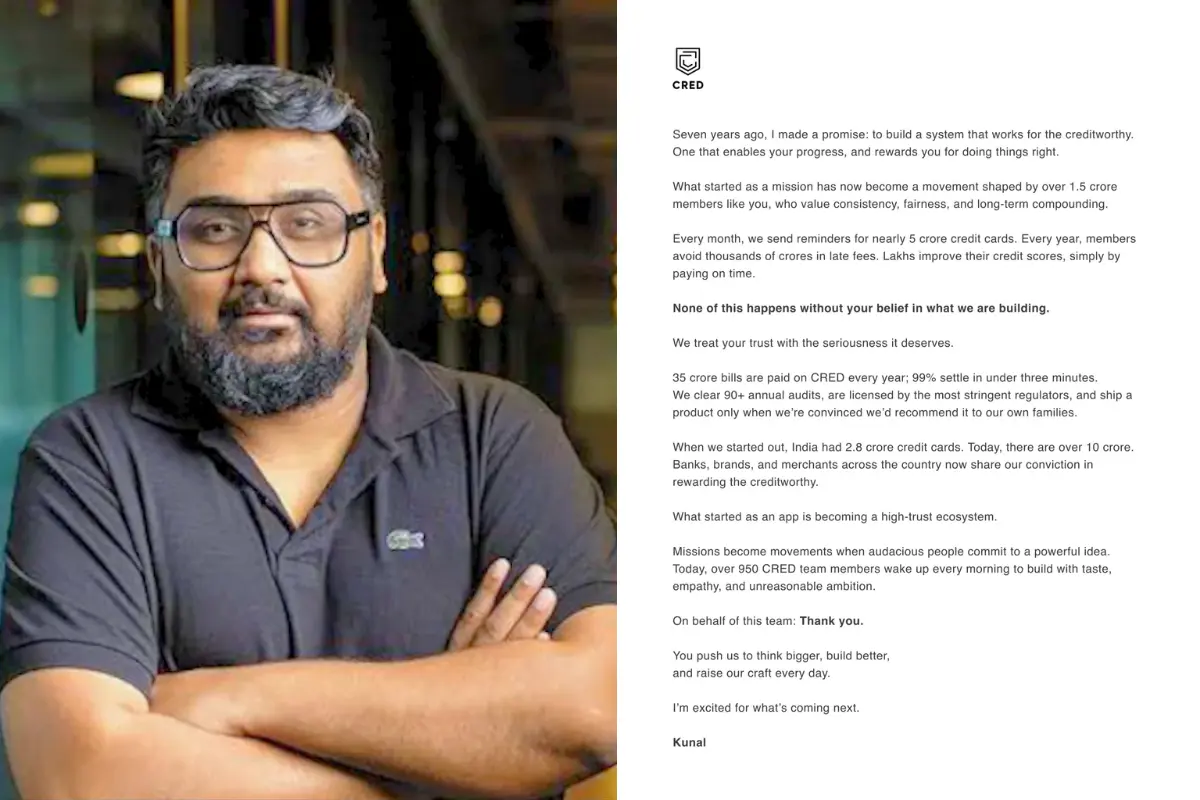






NEW DELHI: CRED’s founder Kunal Shah marked the company’s seventh anniversary with a message to its user community, calling it a “movement built on trust, discipline, and rewards.”

He reminded users that what started as a simple credit-card bill payment app has now according to him evolved into a “high-trust ecosystem” managing billions in bills and offering multiple services.
But instead of cheers, the post triggered a wave of cynicism and sarcasm.
If you are sending 5Cr reminders/month, but only 35Cr are being paid/year – that means roughly 25Cr is not being paid via Cred.
It would be amazing if we can see the credit card default rate on Cred vs general.
— Celsius 233 (@Celsius233Books) November 27, 2025
Far from being congratulatory, many responses turned into brutal questioning of the company’s value:
- “At least on the 7th year tell us what to do with the points?” — directed to @kunalb11 and @CRED_club
- “You’re just fleecing people! @CRED_club”
- “7 years of burning VC money and doing nothing.”
- “CRED is the Palantir of India — nobody knows what they do.”
- “Genuine question!! What does CRED do? How do you earn money?”
These lines resonated widely online, reflecting mounting frustration among many who even after seven years, remain unconvinced of CRED’s real utility.
Joined one month after your bday… using it as my primary mode of card payments and have shopped a lot as well pic.twitter.com/5AsLhjPesf
— Let’s do the impossible (@shreyans_jain) November 26, 2025
What CRED Claims: The Anniversary Post & Official Numbers
In his note, Kunal Shah laid out key metrics to highlight CRED’s growth and reach. According to him, the platform now serves over 1.5 crore users.
He further claims that CRED sends reminders for nearly 5 crore credit cards every month and processes roughly 35 crore bills a year, asserting that “99% settle in under three minutes.”
CRED launched in 2018, began as an invite-only app for credit-card-bill payments.
Over time, it has expanded into other services including lending, payments, utility bill payments, and a marketplace for rewards/offers.
Recent financial disclosures further show that CRED’s revenue jumped significantly: for the fiscal year ending 2024, its revenue reportedly touched nearly ₹2,500 crore.
Meanwhile, its operational loss narrowed by 41%, shrinking from ₹1,024 crore in the previous year to around ₹609 crore.
at least on the 7th year tell us what to with the points ? @kunalb11 @CRED_club https://t.co/vyqLBv3a3i
— vishal vinakiya (@VinakiyaVishal) November 27, 2025
According to various analyses, CRED currently monetises its user base through multiple “engines”:
- Bill and utility payments — processing fees/commissions when users pay credit-card bills, utility bills, or use UPI via the app.
- Lending — offering instant credit lines, loans and other credit products (e.g. “CRED Stash”, “CRED Mint”), often in partnership with banks or NBFCs, generating interest income and commissions.
- Insurance & financial products — CRED reportedly provides access to insurance offerings and other financial services through tie-ups, earning fees or lead-generation commissions.
- Brand partnerships, marketplace, and rewards-based shopping — through a “CRED Store” or “Offers/Discover” section where premium brands advertise or list products/services; when users redeem “CRED Coins” (earned for on-time bill payments) for offers, CRED earns a cut from partner merchants.
CRED markets itself as a fintech catering to “creditworthy” users, typically those with good credit history and high spending capacity thereby positioning its model on exclusivity and premium engagement rather than mass-market volume.
You’re just fleecing people! @CRED_club https://t.co/RVYhHsdxXB
— Indian dude (@theindianledger) November 27, 2025
Why Critics and Many Users Are Unimpressed: The Pushback
For all its claims, several observers including users, analysts, and public commentators remain skeptical about CRED’s real utility. The harsh reactions to the anniversary post echo long-running concerns:
Opaque Value & “Rewards Over Substance”
Many users feel that beyond bill-payment reminders, rewards, and a flashy app interface, CRED offers little that ordinary banking apps and UPI platforms don’t already provide.
Redemption of “CRED Coins” is often seen as underwhelming or confusing; some say the offers are of low value or hard to use.
7 years of burning VC money and doing nothing https://t.co/OU5gitkuo8
— Sachin Bapure (@sachinbapure) November 27, 2025
One common refrain: even after paying bills for years through CRED, what tangible benefit did they gain? The anonymity and complexity of “premium offers” often targeted at affluent users leave many ordinary users wondering what’s in it for them.
Heavy Dependence on Venture Capital, Not Profitability
Despite rising revenue, critics note that CRED has posted substantial losses for years, burning through investor money while chasing growth and “brand appeal.”
The updated FY24 numbers, showing reduced losses help, but CRED is far from a “profitable fintech.”
Some view the 7-year anniversary hype as an attempt to paper over deeper structural issues.
Niche Audience, Limited Reach
CRED’s focus on high-credit-score, affluent users – though good for a premium user base, inherently limits its addressable market.
CRED is the Palantir of India – nobody knows what they do. https://t.co/zfRvtZkLa9
— vik (@vkas_x) November 27, 2025
Many Indians with credit cards or digital-payment needs fall outside this “elite” segment, meaning CRED may struggle to scale like mass-market fintech players.
Uncertainty About Long-Term Value and Differentiation
As more Indian fintechs and payment apps evolve, skeptics ask: what differentiates CRED, beyond branding and aspirational appeals?
If someone wants to pay bills or take loans, there are banks, other fintechs, and UPI apps already doing that — often with simpler, more transparent fees.
Genuine question !!
What does cred do ?
How do you earn money? https://t.co/wubM16PlpU— Dataman_chennai (@dataman_chennai) November 27, 2025
People pushing sharp comments like “You’re just fleecing people!” suggest that for many, CRED’s perceived value doesn’t match marketing hype.
Why the Anniversary Post Triggered a Backlash, Not Cheer
The timing of founder’s celebratory note may have inadvertently opened the floodgates to accumulated frustration. The mood of many comments seems to be: after 7 years of “promise,” show us real substance — not more marketing.
Some of the bluntest critiques — such as “7 years of burning VC money and doing nothing,” or “CRED is the Palantir of India — nobody knows what they do” — reflect a growing impatience among users and industry watchers.
Bros company turned 7 and I still don’t know what these mfs do 😭 https://t.co/2c3BD4MviS
— Sammy (@Samir4122000) November 27, 2025
The backlash underscores a larger sentiment: many are no longer impressed by glossy ads or star-studded campaigns; they want clear value, transparent pricing, and real financial utility.
What This Says About India’s Fintech Landscape and the Road Ahead for CRED
CRED’s journey mirrors broader trends in India’s fintech ecosystem: rapid growth, heavy investor backing, and strong emphasis on branding and “premium” positioning. But as users mature and alternatives proliferate, fintech firms increasingly need to prove actual utility, not just promise.
7 years and I still don’t know what to do with cred coins https://t.co/htlrl0KJL0
— Prayag Chhabra (@PrayagChhabra) November 27, 2025
For CRED, some paths forward may include:
- Expand and better communicate tangible benefits — make bill payments, offers, or financial-services features clearly more convenient/valuable than standard banking apps.
- Focus on profitability and cost control — reducing burn from marketing/promotions and leaning more on sustainable revenue streams like lending, insurance, and financial-services fees.
- Broaden their audience — moving beyond elite credit-card users to a wider base; or accept that they remain a niche “premium fintech,” but behave like one: deliver premium, high-quality services.
- Increase transparency: clarity on fees, interest rates, redemption value, and actual benefits — so users feel confident they’re not just “data fodder” for marketing partnerships.
Seven years since launching, CRED stands at a crossroads. Its founder’s message of growth, scale and “movement” may appeal to investors and early adopters — but for a growing faction of users and critics, the question remains blunt: “After 7 years: what does CRED actually do — for me?”
Relax, your app is just a payment gateway with a reminder feature. https://t.co/UpUWoq7akL
— CA SANJAY SHARMA 🇮🇳 (@iamsanjaysharma) November 27, 2025

Until CRED delivers answers that go beyond ads and aspirational branding, skepticism is likely to stay.