


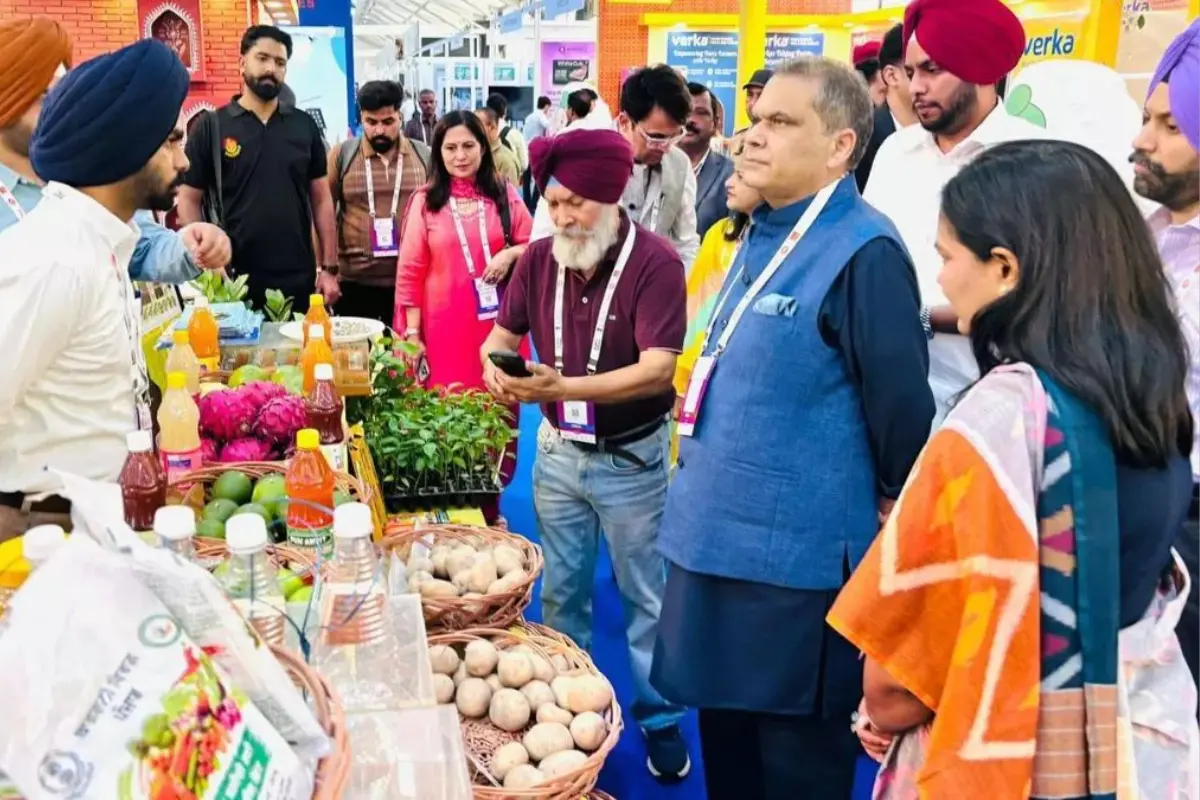






NEW DELHI: Punjab is witnessing a surge in foreign investment in its agriculture and food manufacturing sector, marking a significant transformation under Chief Minister Bhagwant Mann’s leadership.

The state government’s aggressive push for food processing is not only enhancing farmers’ income but also generating new employment opportunities across rural Punjab.
The Mann government has implemented several progressive initiatives to ensure that farmers receive fair prices for their produce and that agriculture becomes a profitable venture. Large-scale Food Parks have been established in Fazilka, Kapurthala, and Ludhiana, where farmers’ crops are being converted into value-added products like pickles, juices, jams, and packaged vegetables. This model allows farmers to earn higher profits by selling their produce for processing rather than as raw crops.
Punjab now ranks among the top three states under the Mega Food Park Scheme. Additionally, four smaller centres in Hoshiarpur, Amritsar, Abohar, and Talwandi Sabo have been linked to the Ludhiana Food Park, creating a connected ecosystem for food preservation and manufacturing. These hubs provide essential infrastructure to store fruits, vegetables, and dairy products, ensuring that farmers’ produce remains fresh and saleable.
To encourage entrepreneurship in rural areas, the state government is facilitating the establishment of 7,373 small-scale units with a total investment of ₹306 crore. Financial aid and skill training are being provided to youth, women, and farmer groups to launch agro-based ventures. Under the initiative, entrepreneurs can avail 35% assistance for setting up new businesses, while individuals from the Scheduled Castes receive up to 50% support. This targeted approach is creating a ripple effect of self-employment and rural prosperity.
The Mann government has also prioritized building cold storage and warehouse infrastructure across Punjab. This has resolved one of the farmers’ most pressing challenges — post-harvest wastage. Crops such as potatoes and onions, which once spoiled quickly, can now be stored and sold when market prices are more favorable. The new system has reduced the exploitation of farmers by middlemen, allowing them to earn directly from their produce.
Punjab Agriculture Minister Gurmeet Singh Khuddian has urged the central government to sanction another Mega Food Park in Bathinda, which would especially benefit the farmers of the Malwa region. The long-term vision of the state government is to ensure that every district has access to modern food processing facilities. Special concessions and incentives are being extended to foreign investors, encouraging multinational companies to set up manufacturing units in Punjab. These investments are expected to create thousands of jobs in the coming years.
In parallel, the government has launched training and awareness programs for farmers to adopt organic and modern farming techniques. Through these efforts, Punjab’s youth are being encouraged to innovate, with start-ups and agri-entrepreneurs receiving loans and subsidies to implement new technologies. The state has set an ambitious target to double farmers’ income, underscoring its commitment to rural development and sustainable growth.
Chief Minister Bhagwant Mann has reiterated his government’s resolve to make Punjab not only the food bowl of India but also a national hub for food processing and value addition. “The more products we make from farmers’ produce, the higher their income will be,” he stated. “We are working to ensure that every farmer’s family is prosperous and that our villages become centres of opportunity and progress.”

With several new food parks, cold chains, and processing units planned in the next phase, Punjab is moving swiftly toward an era of agricultural modernization. The Mann government’s initiatives are positioning the state as a leader in India’s food processing revolution, promising both economic growth and rural prosperity.