


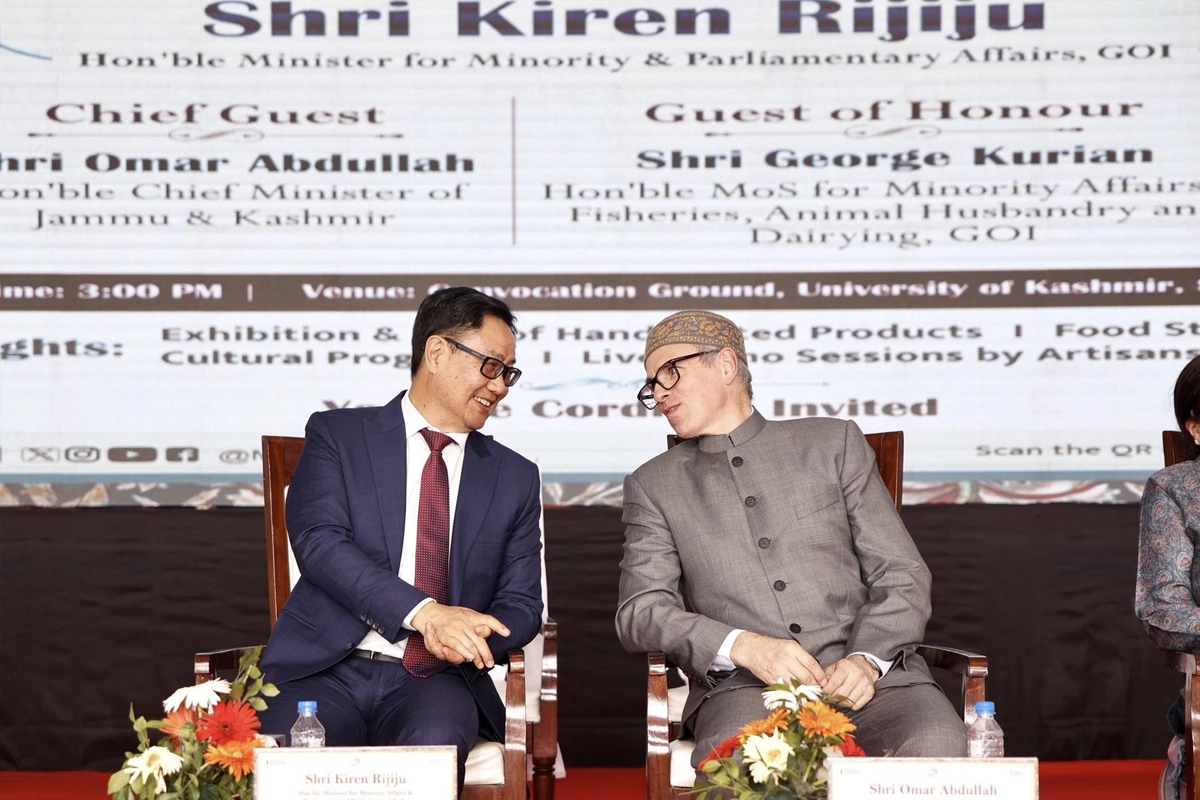






SRINAGAR: Union Cabinet Minister for Parliamentary Affairs and Minority Affairs, Kiren Rijiju, on Sunday asserted that the recent modifications to the Waqf (Amendment) Bill are set to significantly aid economically weaker sections among Muslims, especially women and socially backward groups.

Speaking to media representatives on the sidelines of the Lok Samvardhan Parv, being conducted at the University of Kashmir from April 5 to 13 under the theme “Bhagidari Se Bhagyodaya” (Progress Through Participation), Rijiju remarked, “Those who have misinterpreted the amendments are naturally disappointed. But setting political bias aside, anyone who truly comprehends these changes will recognize the long-term advantages they offer to poor Muslims, women, and marginalized communities over the next few years.”
ALSO READ: Amit Shah: NC, Congress Ruined J&K, Modi To Deliver Peace
The event, which was formally opened by Kiren Rijiju himself, saw Jammu and Kashmir’s Chief Minister Omar Abdullah as the special guest of honour, with George Kurien, Minister of State for Minority Affairs, also in attendance.
In his keynote address, Omar Abdullah appealed to the Union Government to fast-track long-pending development proposals submitted by the Jammu and Kashmir administration. “I earnestly urge that all feasible support and approvals for our proposals be extended so that the people of J&K can witness meaningful progress,” he said.
He emphasized the region’s aspiration to become an equitable participant in the nation’s broader growth story. He further requested Rijiju to maintain his ministry’s continued assistance to J&K, citing persistent issues such as joblessness.
“Whether it’s access to education, vocational training, or broader markets, your ministry’s schemes are essential. Our local craftsmen work tirelessly, but they face obstacles in reaching national platforms and training the next generation in traditional arts. There’s a significant need for skill enhancement and capacity building—an area where your ministry can make a critical difference,” Omar said.
He underlined that while the Department of Social Inclusion may appear limited in scope, its contributions resonate deeply across the nation. “In a country as vibrant and varied as ours, with a mosaic of lifestyles, dialects, cuisines, and traditions, ensuring unity and a sense of inclusion is vital. This ministry helps every citizen, regardless of background, feel a part of India’s journey,” he said.
Acknowledging J&K’s turbulent past, the CM stated that the region is now gradually moving toward stability and integration.
Stressing the value of the ongoing programme, Omar said the Lok Samvardhan Parvsignifies a new chapter in the engagement between J&K and the Ministry of Social Inclusion. “This platform allows us to reflect the cultural richness of India—from handcrafted products to regional cuisines—while simultaneously giving us the opportunity to present our own heritage to visitors,” he said.
He noted that the occasion had empowered local artisans, especially those involved in traditional crafts and the famed Wazwan cuisine, to demonstrate their extraordinary skills. “Their craftsmanship is on full display. It’s equally inspiring to witness participants from across India come together on this platform,” he added.

Commenting on the seasonal tourist influx, he said, “I know many of you had a difficult journey, especially with the traffic near the Tulip Garden. But such is the irresistible pull of Kashmir—it welcomes all.”