


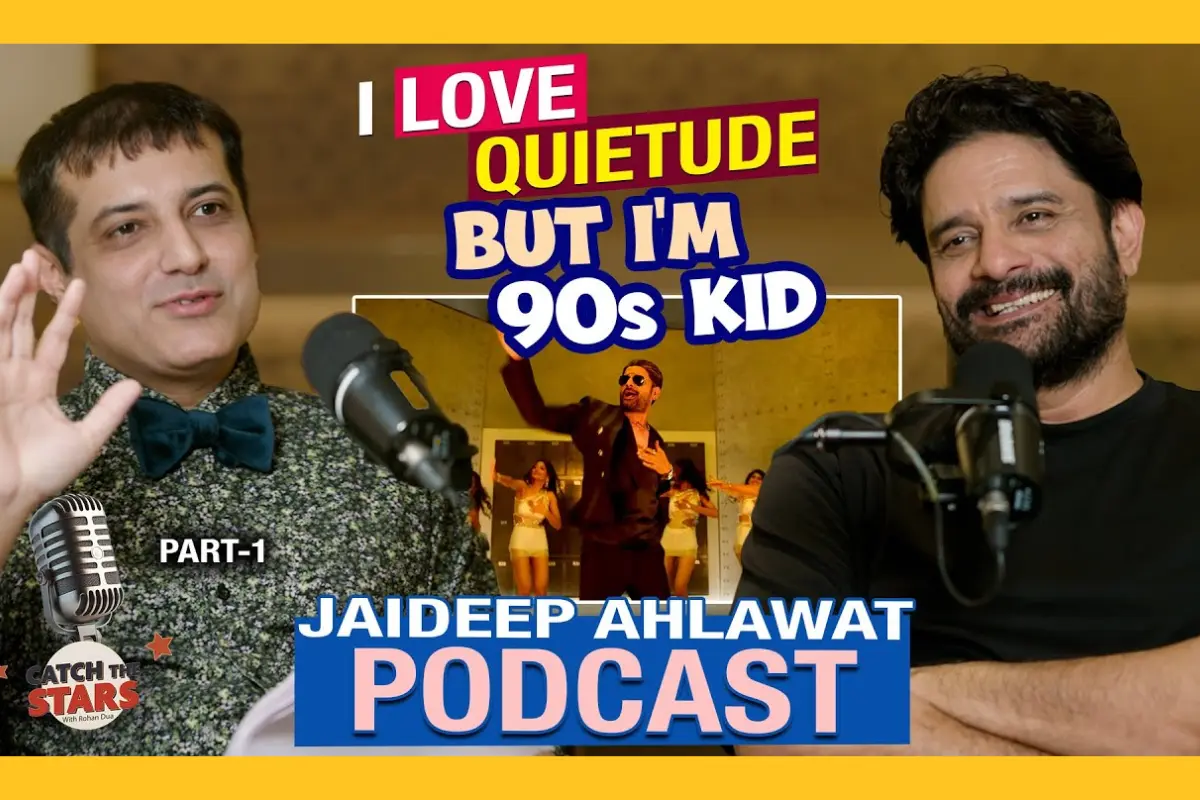






Marking five years of Paatal Lok, actor Jaideep Ahlawat joins Rohan Dua on The New Indian’s Catch The Stars to decode the writing, humour, guilt, morality, and emotional weight behind Hathiram Chaudhary—one of Indian OTT’s most defining characters.

Q: Five years of Paatal Lok. Why do you think Hathiram Chaudhary connected so deeply with people?
Jaideep Ahlawat:
Because Hathiram is not a hero—he’s a human being. He is a policeman, a father, a husband, a frustrated ordinary man who goes to work every day hoping something good will happen.
He wants respect, wants to feel useful, but keeps losing every day. That frustration, that anger, that defeat—everyone has felt it somewhere in life.
Q: The show balances dark tension with unexpected humour. Was that written or discovered on set?
Jaideep Ahlawat:
It was written. Beautifully written.
When something is well-written, you don’t need to add much. Even humour comes from irritation, exhaustion, or annoyance—like small everyday reactions. The comedy is not forced; it comes from truth.
Q: One iconic dialogue fans love is, “C for…?” Why do such small moments stay?
Jaideep Ahlawat:
Because they are ordinary moments inside a big investigation.
Life doesn’t stop just because something serious is happening. Phones ring, food comes, people irritate you. That’s reality—and those moments make the character alive.
Q: Ansari’s arc and his last call are among the most emotional moments. How did you approach that?
Jaideep Ahlawat:
That scene is about guilt.
The guilt is not just that Ansari died—it’s that the phone was in Hathiram’s hand, and he didn’t pick it up. That choice stays with him forever. That’s why it hurts so much. Both Meghna and Hathiram share that guilt in different ways.
Q: The father-son relationship also hits hard. Was that personal for you?
Jaideep Ahlawat:
Yes, because Hathiram doesn’t know how to express love.
He loves his son deeply but doesn’t have the language for it. His way of saying “I love you” is irritation, shouting, silence. Many fathers are like that.
Q: There’s a powerful scene about accepting a friend’s sexuality. What does that moment represent?
Jaideep Ahlawat:
It shows Hathiram’s moral clarity.
He may not understand everything, but he knows one thing—if you believe something is right, then it is right. He doesn’t care what the world thinks. That honesty defines him.
Q: The Yudhishthir-and-the-dog reference struck a chord. Why is that symbolism important?
Jaideep Ahlawat:
It’s a very famous story. Yudhishthir refuses to go ahead without the dog. Later, the dog turns out to be Dharmraj.
For me, it represents loyalty and morality—standing by what you believe in, even if you have to walk alone. That idea fits Paatal Lok perfectly.
Q: Season 2 felt more complex and darker. Did that affect you as an actor?
Jaideep Ahlawat:
Yes. Human behaviour has no limits.
You realise that a human being can be anything. Earlier we didn’t believe such extremes were possible—then history proves us wrong. Season 2 reflects that unsettling truth.
Q: You’ve received praise from real police officers. What did that mean to you?
Jaideep Ahlawat:
That was the biggest compliment.
A senior officer told me he hadn’t seen a better portrayal after Ardh Satya. For someone who has lived that life, to say that—it means everything.
Q: Physically, the show looks exhausting—running, heat, uniforms. How tough was it?
Jaideep Ahlawat:
Very tough.
Chitrakoot heat—40 to 43 degrees—running in police uniform, shooting long scenes. Sometimes the pressure of an “important scene” itself becomes the biggest challenge. You have to remind yourself to relax and trust the moment.
Q: Finally, who is Hathiram when he removes the uniform?
Jaideep Ahlawat:
Then he is just Hathiram—not a police officer.
A man making tea, getting irritated, loving his family in his own broken way. The uniform adds responsibility, but beneath it, he is just like us. And that’s why people see themselves in him.