


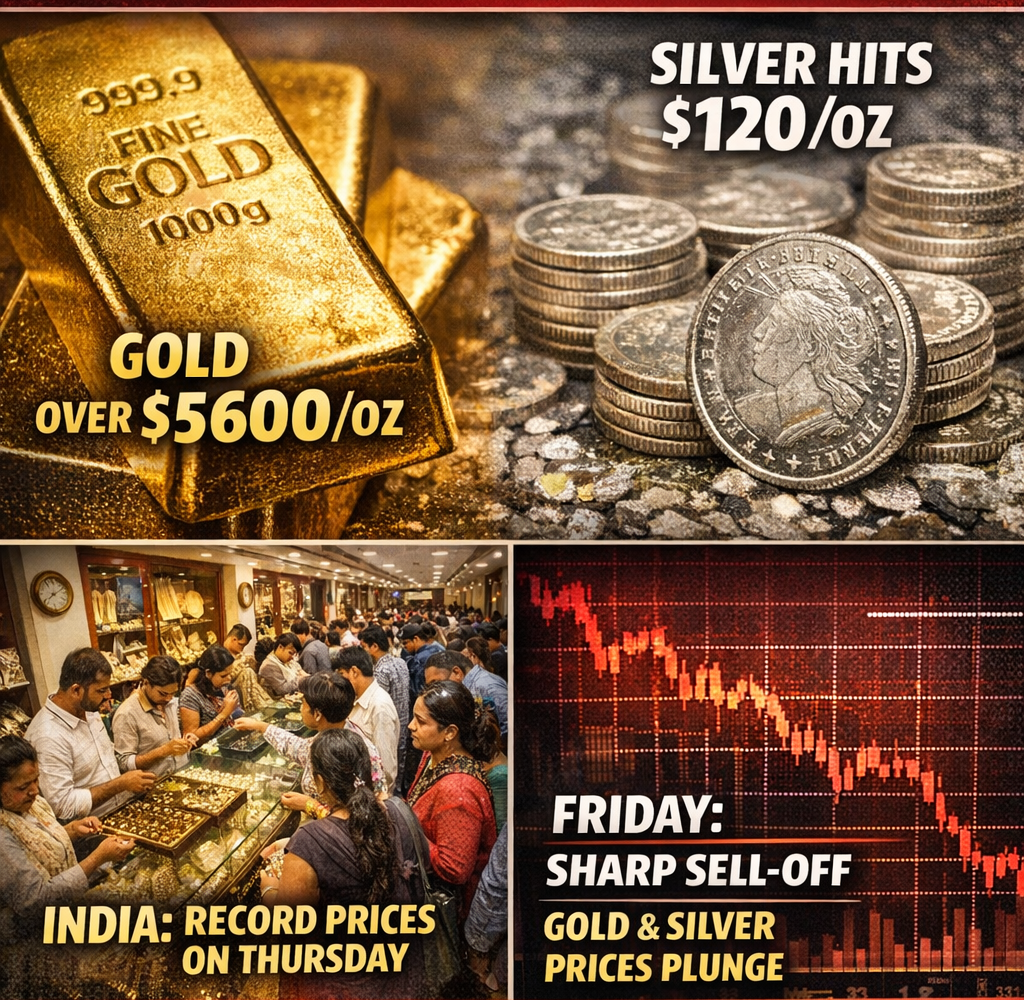







New Delhi: Gold and silver markets witnessed one of the most dramatic weeks in modern financial history as prices of both precious metals smashed global records on Thursday, before sharply retreating on Friday, sending shockwaves through markets worldwide and directly impacting India.
On Thursday, global gold prices surged to an all-time high of over $5,600 per ounce, a level never seen before since gold was freed from the gold standard more than five decades ago. Silver outdid even gold’s performance, briefly crossing $120 per ounce, marking its highest price ever and capping a blistering rally that had gathered pace through January.
The record-breaking surge was immediately reflected in India. On the Multi Commodity Exchange (MCX), gold prices shot up close to ₹1.78 lakh per 10 grams, while silver breached the psychologically significant ₹4 lakh per kilogram mark in futures trading as well as physical markets across major cities.
Jewellers, traders and investors were caught off guard by the speed and scale of the rally. Many bullion dealers described Thursday as one of the most volatile sessions they had witnessed in decades.
The historic surge was driven by a combination of global uncertainty and financial anxiety. Investors across the world rushed into gold and silver as safe-haven assets, amid rising geopolitical tensions, concerns over global debt levels, and doubts about the long-term stability of major currencies.
Central banks, particularly in emerging economies, have been steadily increasing gold purchases to reduce dependence on the US dollar. At the same time, expectations of future interest rate cuts in the United States weakened the dollar, making gold and silver more attractive.
Silver’s rally was further fuelled by strong industrial demand, especially from sectors such as solar energy, electronics and artificial intelligence-related manufacturing, where silver is a critical input. This dual role — as both a precious metal and an industrial commodity — made silver especially vulnerable to sharp price spikes.
Speculative trading and algorithm-driven buying added fuel to the rally, pushing prices to extreme levels within a short span. However, the euphoria did not last long.
On Friday, markets saw a sharp reversal as traders rushed to book profits after Thursday’s record highs. Globally, gold prices fell by several percentage points from their peak, while silver saw even steeper intraday declines.
The impact in India was immediate. On the MCX, gold futures fell by over 1 per cent, dropping to around ₹1.67–1.68 lakh per 10 grams by the end of the session. Silver prices dropped sharply, falling by ₹15,000–₹20,000 per kilogram from Thursday’s highs, trading in the range of ₹3.8–3.9 lakh per kg.
Bullion traders said the correction was inevitable after such a rapid rise. “The market simply overheated. What we saw on Friday was classic profit booking,” said a Mumbai-based commodities dealer.
For Indian consumers, the extreme volatility brought mixed reactions. Jewellery buyers largely stayed away from the market, waiting for prices to stabilise. Many jewellers reported postponed purchases ahead of the upcoming wedding season.
Investors, meanwhile, were reminded of the risks of chasing record prices. Financial advisors cautioned against panic buying, urging investors to view gold and silver as long-term hedges rather than short-term bets.
Despite Friday’s correction, both metals remain far above their levels at the start of the year, underlining the depth of global uncertainty driving investors toward hard assets.