


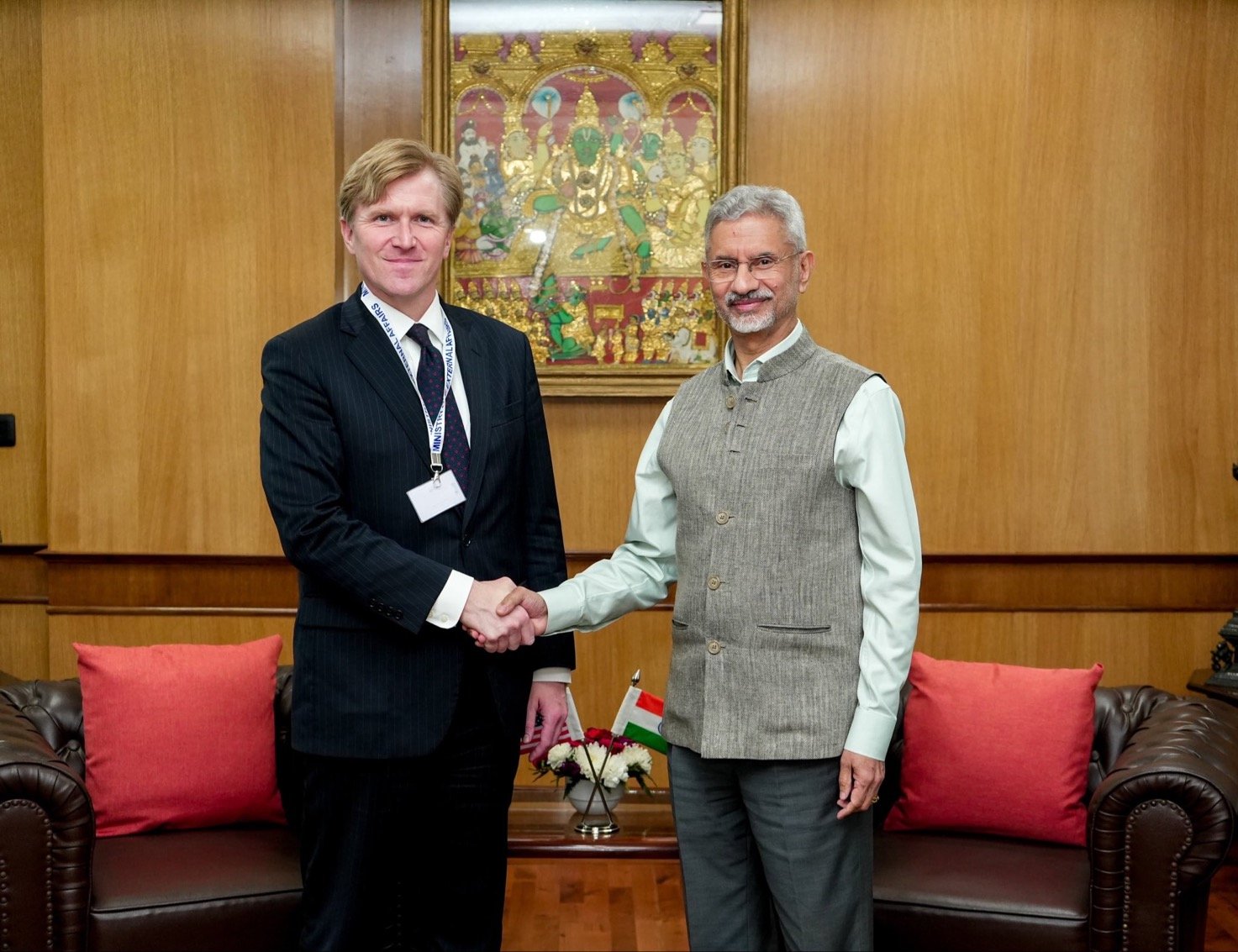






New Delhi: The United States and India on Thursday moved to deepen defense and strategic cooperation during a high-level visit by Elbridge Colby, with both sides emphasizing a shared interest in maintaining a stable balance of power in the Indo-Pacific, according to an official US Department of War readout.

Colby concluded his visit to India after holding talks with senior Indian officials, including External Affairs Minister Subrahmanyam Jaishankar and Foreign Secretary Vikram Misri. He also co-chaired a meeting of the US-India Defense Policy Group with Defense Secretary Rajesh Kumar Singh, in discussions aimed at advancing key pillars of bilateral military cooperation.
The visit, amid the ongoing war between US-Israel and Iran, focused on implementing the framework for the US-India Major Defense Partnership signed in October 2025 by US Defense Secretary Pete Hegseth and Indian Defense Minister Rajnath Singh. The agreement calls for expanding operational coordination, intelligence sharing, and collaboration in defense technology and industrial production.
In a statement, Pentagon spokesman Sean Parnell said the meetings were aimed at advancing priorities outlined in the 2026 US National Defense Strategy and President Donald Trump’s “Peace through Strength” agenda.
Colby also met with US Ambassador to India Sergio Gor during his trip, which included policy consultations on South and Central Asia.
Speaking at a New Delhi event hosted by the Ananta Centre, Colby described India as an “indispensable” partner in shaping the future of the Indo-Pacific, citing its geographic position, growing economic weight, and military capabilities.
“The Indo-Pacific has become the central theater of global politics, economics and security,” Colby said, adding that no single country could maintain stability in the region alone. Instead, he said, a durable balance of power would depend on cooperation among “capable states” such as India and the United States.
Colby framed the relationship as one rooted in overlapping national interests rather than formal alliances, emphasizing what he described as a pragmatic and “realist” approach to foreign policy. He noted that Washington respects India’s tradition of strategic autonomy and does not expect uniform alignment on all issues.
India’s own foreign policy approach, articulated by Jaishankar as “Bharat First” and “the India Way,” aligns closely with US thinking, Colby said, particularly in prioritizing national interests and a results-oriented approach to global affairs.
Officials on both sides highlighted recent growth in defense ties, including more complex joint military exercises, deeper intelligence-sharing arrangements, and expanding cooperation in advanced technologies. Areas identified for further collaboration include maritime domain awareness, anti-submarine warfare, resilient logistics, and long-range precision systems.
Colby also underscored the importance of defense industrial cooperation, pointing to opportunities for joint production and development. While acknowledging US interest in expanding defense sales to India, he said Washington supports New Delhi’s efforts to strengthen its domestic defense manufacturing base.
“A strong domestic industrial base enhances sovereignty and resilience,” Colby said, adding that closer industrial ties could benefit both countries while reinforcing regional security.
Despite the growing convergence, Colby acknowledged that differences between the two countries would persist, noting that their histories, strategic cultures, and priorities do not always align. However, he said such differences need not hinder cooperation, describing flexibility as a strength of the partnership.
The visit comes amid shifting geopolitical dynamics in Asia, where rising competition and evolving security challenges have heightened the importance of regional partnerships.
Colby said the United States sees India as a “central” player in ensuring long-term stability in the Indo-Pacific, describing it as a “waxing power” whose rise could help anchor a favorable balance in the region.

He added that Washington’s goal is to build a partnership between “two great republics” capable of sustaining peace and stability through cooperation grounded in shared interests. “If successful, the Indo-Pacific will be defined by equilibrium, where sovereign nations can prosper and chart their own course,” Colby said.