








NEW DELHI: Punjab is witnessing a quiet yet powerful transformation inside its classrooms—one that doesn’t rely solely on textbooks or traditional teaching methods. It’s a transformation where a girl in Malerkotla learns to protect herself from online predators, a boy in Pathankot understands why his grandmother’s bank OTP must stay private, and an entire generation grows up not with fear, but with digital awareness.

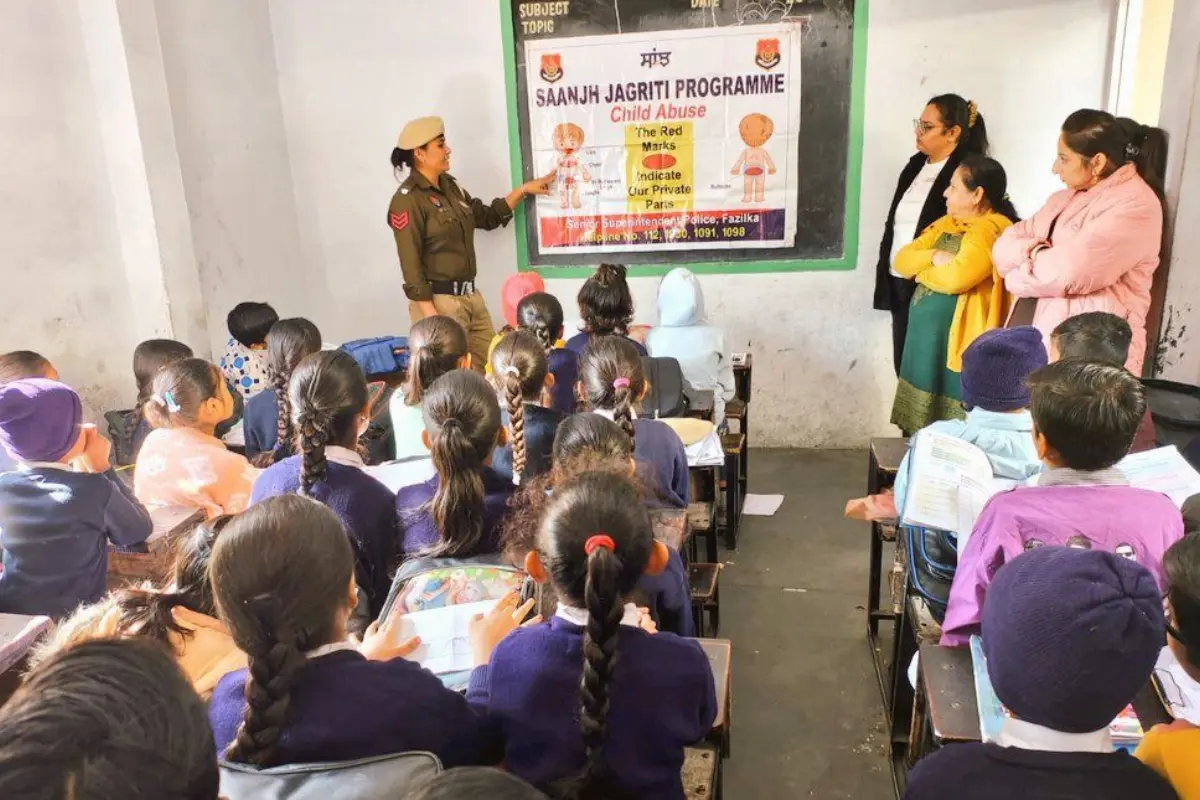
Under the leadership of Chief Minister Bhagwant Mann, the Punjab Police has expanded its role far beyond conventional law enforcement. Through the ‘Saanjh’ initiative, the police force has become a partner, guide, and guardian to Punjab’s children, ensuring they step into the digital era safely and confidently.
Cyber Jaago: From Policing to Preventive Education
The ‘Cyber Jaago’ campaign by the Punjab Police’s Cyber Crime Division marks a major shift from reactive policing to preventive, community-centric education. Its first workshop trained 75 teachers, with the mission to eventually cover all 3,968 government high schools in the state.
This initiative is critical at a time when 76% of children aged 14–16 use smartphones, often without understanding the risks. With rising cases of cyberbullying, identity theft, financial fraud, and online sexual exploitation, the Mann government has prioritised early digital literacy and child protection as a core governance responsibility.
Saanjh: Connecting Police and Public
The strength of the Mann government’s approach lies in its belief in collaboration. ‘Saanjh’—which means partnership—has built one of India’s largest community policing networks:
-
District Community Police Resource Centres
-
114 Sub-Division Community Policing Centres
-
363 Police Station Outreach Centres
Every week, Punjab Police personnel visit schools not merely as uniformed officers but as mentors, answering questions, guiding students, and building trust.
Special DGP V. Neerja, heading the Cyber Crime Division, explains that with the explosion of digital content, “children are facing both new opportunities and new dangers.” COVID-19 only accelerated this digital shift, often leaving parents unable to understand or monitor online risks. The Mann government responded by initiating teacher training, focusing on cyber hygiene, AI-related threats, and child safety.
A Social Movement Wrapped in Technology and Empathy
Beyond cyber safety, the Saanjh initiative embraces broader social concerns. Through Shakti Helpdesk and school awareness seminars in districts like SBS Nagar and Sri Muktsar Sahib, Punjab Police sensitises students about:
-
Good touch vs bad touch
-
Child exploitation
-
Drug abuse
-
Emergency helplines (112 & 1098)
The PP Saanjh mobile app further empowers citizens by digitising services such as FIR access and police verifications, blending modern efficiency with grassroots human engagement.
Beyond Policing: Empowering Families Through Children
What students learn doesn’t stay in classrooms—it travels home.
A 14-year-old trained in recognising UPI scams can protect elderly family members from fraud.
A girl aware of her digital rights becomes a pillar of support for her peers.
This ripple effect is the true strength of the Mann government’s vision: nurturing cyber-aware communities through empowered children.
Democratic Policing Under CM Bhagwant Mann
Each Saanjh centre functions as an autonomous registered society with active police-public committees. This bottom-up model ensures community voices shape policing priorities, making the system more responsive and transparent.
The initiative reflects a broader shift in Punjab’s policing culture—from enforcing to empowering, from authority to accessibility. Under the AAP government, police officers are increasingly viewed not as distant figures of power but as partners in wellbeing.
A Model for India
Punjab’s Saanjh initiative stands today as a national example of how modern policing can coexist with community values. The Mann government has shown that real security is built not through fear or heavy-handed measures, but through awareness, prevention, and collaboration.
In a state known for its spirit of collective strength—saanjhe chulhe, the shared stove symbolising unity—this initiative carries forward the legacy of community responsibility into the digital age.

As Punjab walks confidently into the future, its children are more informed, more alert, and more empowered—guided by a police force that truly stands as Saanjh, a partner in their safety and growth.