


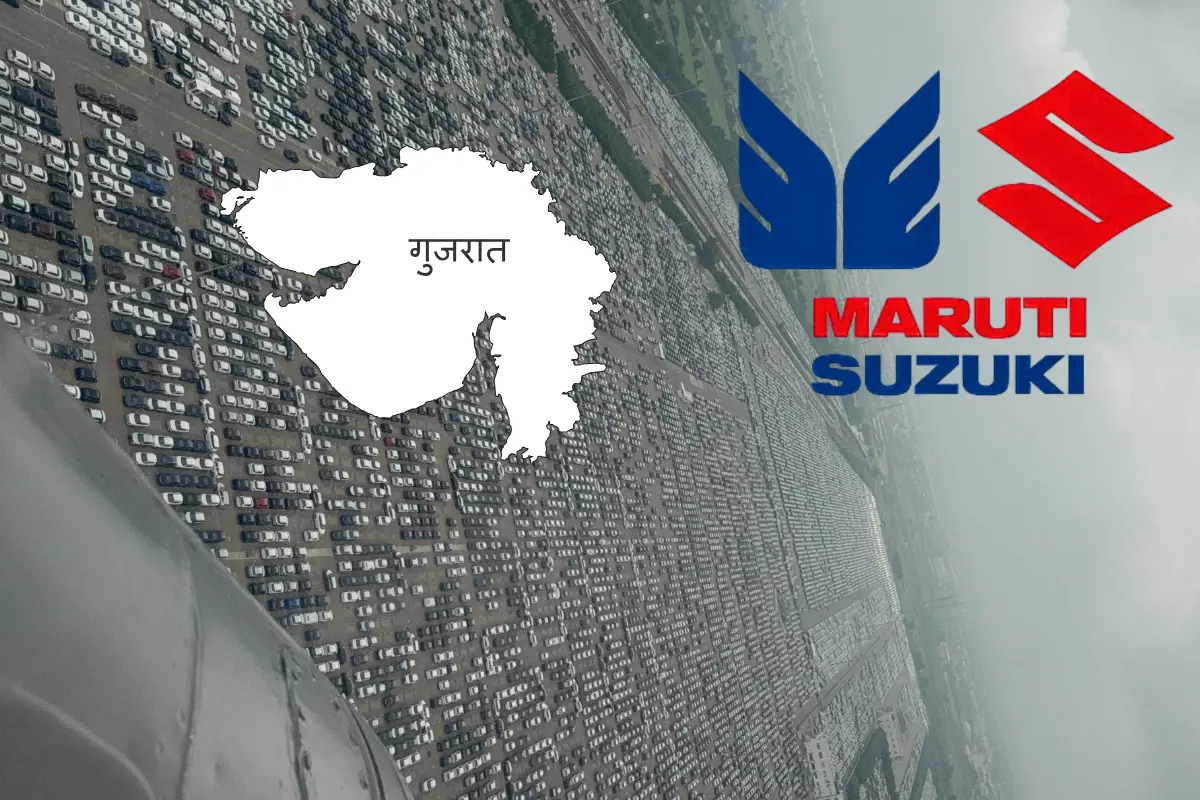






NEW DELHI: At Hansalpur, Gujarat, lies one of India’s most significant manufacturing hubs, Maruti Suzuki’s state-of-the-art plant. With an annual production capacity of 750,000 cars, this facility is a cornerstone of India’s automobile sector and a testament to the country’s “Make in India, Make for the World” vision.

The stockyard, spread across hundreds of acres, showcases just a fraction of the plant’s output. What appears to be a sea of vehicles neatly lined up in rows is merely 2–3% of the company’s annual production.
Each car here represents not just a product but India’s growing capability to manufacture at scale for domestic and global markets.
Commissioned in 2017, the Gujarat plant is fully owned by Suzuki Motor Corporation and supplies cars exclusively to Maruti Suzuki India Limited. Models such as the Baleno, Swift, Dzire, and Fronx are rolled out here, many of which are exported to over 100 countries.
In fact, Gujarat is at the heart of Maruti Suzuki’s global export strategy, making India the third-largest exporter of passenger vehicles in the world in 2023–24.
India’s automobile industry contributes nearly 7% to the national GDP and employs over 37 million people directly and indirectly, according to government data.
With production hubs like this, Gujarat has emerged as a leader in manufacturing, hosting not only Maruti Suzuki but also other major automakers and component suppliers.
The plant’s scale underscores how India has transitioned from being just a domestic auto market to a global manufacturing hub.
For every car lined up in the Gujarat stockyard, many more are already on their way to Africa, Latin America, Europe, and Asia—carrying the stamp of India’s industrial strength.

What you see here, therefore, is more than parked cars. It is a glimpse of India’s rise as a global manufacturing powerhouse.