


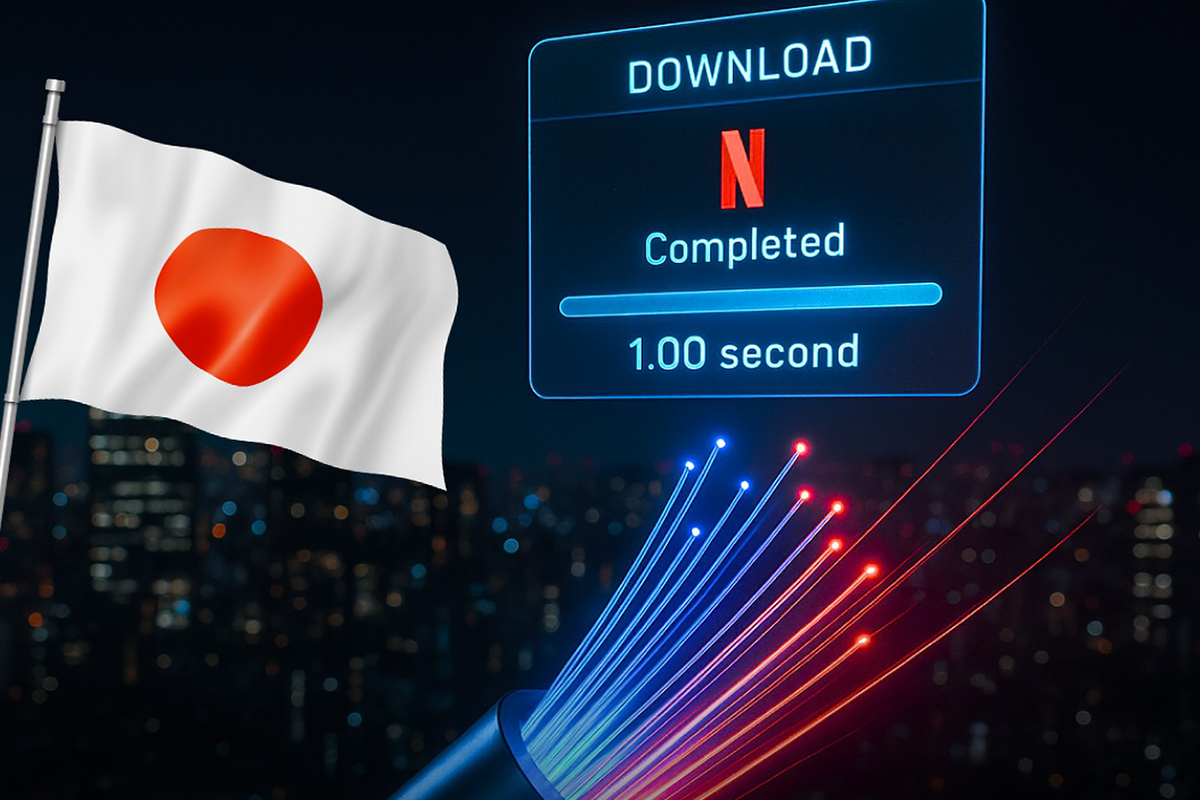






NEW DELHI: Japan has shattered the world record for internet speed, achieving a staggering 1.02 petabits per second (Pbps) — fast enough to download the entire Netflix library in just one second. This groundbreaking feat, accomplished by Japanese researchers using advanced 19-core optical fiber over 1,808 kilometers, showcases the nation’s dominance in cutting-edge telecommunications technology.

Record-Breaking Achievements in Internet Speed
Japanese researchers have repeatedly stunned the world with their feats in data transmission speed. In a landmark achievement, engineers clocked internet speeds of 1.02 petabits per second (Pbps) across 1,808 kilometers using a 19-core optical fiber. In another breakthrough, 402 terabits per second (Tbps) were achieved using standard optical fiber.
Although these speeds remain within the realm of research and are not yet commercially available, they point toward a future where massive data loads — such as entire streaming libraries downloaded in a second — become technically possible. The implications are significant for high-demand applications such as 6G, AI processing, cloud computing, and scientific simulations.
ALSO READ: Lord’s Test Day 1: Nitish Reddy Strikes Twice, England 83/2 at Lunch
Real-World Internet Speeds: A Global Benchmark
Fixed Broadband
Japan’s internet ecosystem is dominated by fiber-optic connections, contributing to its globally competitive broadband performance. As of early 2024:
- Median fixed download speed: 185.71 Mbps, a 23.7% increase from the previous year
- Mean download speed: 212 Mbps, according to publicly available data
- Plans typically range from 100 Mbps to 1 Gbps, with 10 Gbps services available in urban centers
- So-net emerged as the fastest fixed-line ISP, with a median download speed of 306.08 Mbps in the first half of 2024
Mobile Internet
Japan’s mobile network is equally robust, supported by widespread 4G LTE coverage and rapid 5G rollout:
- Median mobile download speed: 46.28 Mbps, up 13.1% year-on-year
- Rakuten Mobile led the 5G race with a median download speed of 119.75 Mbps
- Typical 5G experiences range between 100–300 Mbps, with peak speeds much higher depending on location and device
What’s Driving Japan’s High-Speed Internet?
- Advanced Fiber Optic Infrastructure: Over 80% of broadband connections in Japan use fiber-to-the-home (FTTH). This success stems from early government initiatives and decades of infrastructure investment, ensuring near-universal coverage — even in rural areas.
- Fierce Market Competition: Leading telecom players such as NTT DoCoMo, KDDI (au), SoftBank, and Rakuten Mobile compete aggressively, pushing the boundaries on speed, pricing, and innovation.
- Cutting-Edge Research and Development: Japan is at the forefront of optical communication research, exploring techniques like multi-band wavelength division multiplexing (WDM) and new amplifier technologies, aimed at scaling bandwidth to meet future demand.
City-Specific Performance
Internet performance varies across cities:
- Fixed Broadband:
- Saitama: Median download speed of 231.81 Mbps
- Osaka: Average download speed of 91.7 Mbps
- Tokyo: Among the top in fixed-line services, driven by So-net’s performance
- Mobile Internet:
- Nagoya: Fastest median mobile download speed at 66.53 Mbps
- Osaka and Kobe: Close behind
- Tokyo: Surprisingly lower at 40.62 Mbps, possibly due to high network load
Challenges Ahead and the Road to 6G
Despite extraordinary lab results, commercializing ultra-fast internet remains complex. Costs are high, and consumer-grade hardware is not yet equipped to handle such bandwidth.
However, Japan’s government is actively working to bridge this gap. Initiatives like the “Digital Garden City Nation” aim to ensure high-speed internet access even in the country’s most remote areas. Policymakers are also considering universal service obligations for fiber networks to eliminate the digital divide.
Looking ahead, Japan is investing heavily in 6G technologies and next-gen optical networks, reinforcing its commitment to staying ahead in the global race for connectivity.
From scientific milestones to accessible high-speed broadband, Japan exemplifies a balanced approach to internet excellence — marrying innovation with inclusivity. As the world races toward a data-driven future, Japan stands ready, not just as a participant, but as a leader setting the pace.