


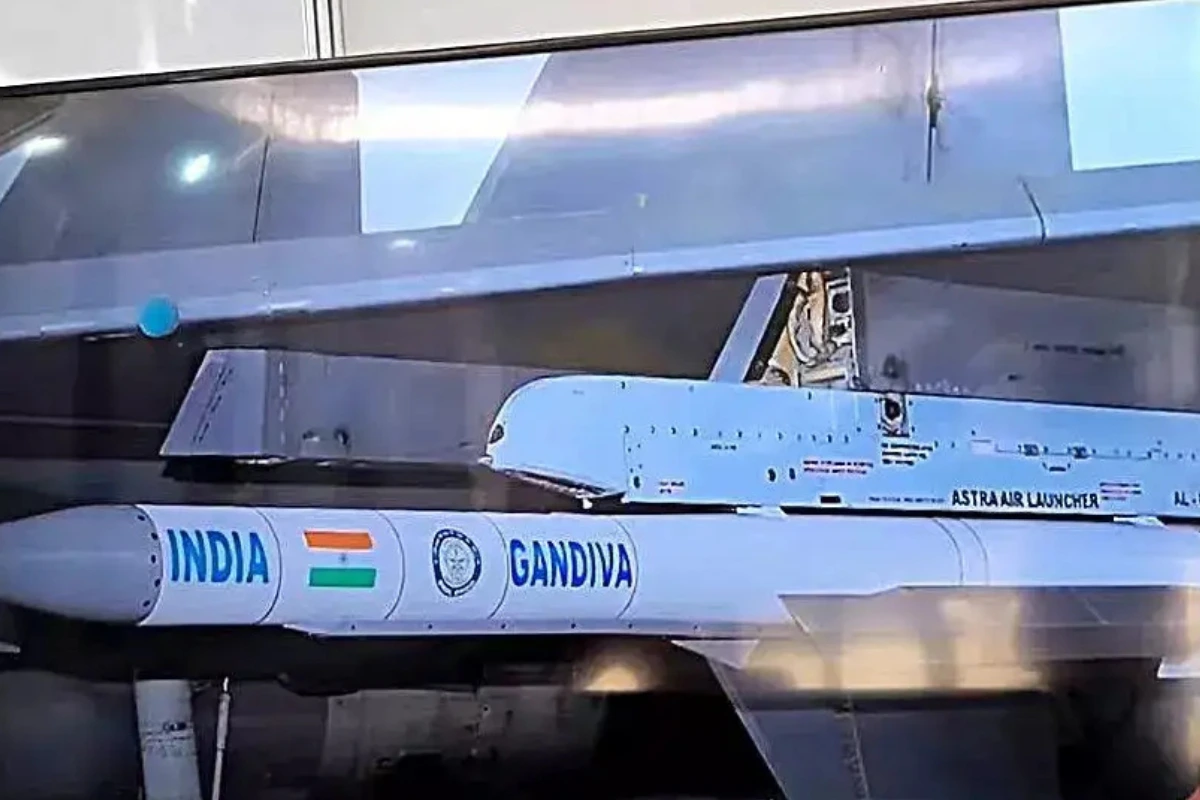






NEW DELHI: India’s Defence Research and Development Organisation (DRDO) is nearing completion of its most advanced air-to-air missile yet — the Astra Mk-III, codenamed ‘GANDIVA’. Designed to counter next-generation aerial threats including stealth fighters like China’s Chengdu J-20, this ramjet-powered Beyond Visual Range Air-to-Air Missile (BVRAAM) marks a significant leap in India’s aerial combat capabilities.

Key Features of Gandiva (Astra Mk-III):
Range: Up to 340 km (at 20 km launch altitude)
Propulsion: Solid Fuel Ducted Ramjet (SFDR) engine
Seeker: Under-development Active Electronically Scanned Array (AESA) seeker (transitioning from GaAs to GaN)
Speed: Supersonic — expected operational envelope up to Mach 4.5
Role: High-value aerial target engagement — including stealth aircraft, AWACS, bombers, and refuelers
The missile has undergone successful ground tests and is currently in the captive-carry flight trial phase aboard the Indian Air Force’s Su-30MKI fighters.
Sources in DRDO confirmed that the propulsion system—developed under the SFDR program—has passed multiple developmental tests at high speeds, sustaining controlled combustion throughout long-duration flights.
This ensures Gandiva’s “no-escape zone” is significantly wider than traditional solid-rocket-powered BVRAAMs.
View this post on Instagram
Why Gandiva Is a Gamechanger
The most significant leap is the use of ramjet propulsion, allowing for sustained thrust throughout flight, unlike conventional rocket motors that lose speed after burnout.
This enables Gandiva to pursue fast-moving, maneuvering targets deep into contested airspace.
Additionally, the AESA seeker under development—initially GaAs-based, transitioning to GaN-based architecture—promises enhanced resistance to electronic countermeasures (ECM), superior angular resolution, and better tracking of low radar cross-section (RCS) platforms such as the J-20 stealth fighter.
View this post on Instagram
Comparison with Global Peers
Missile Range (approx.) Propulsion Seeker Type
Astra Mk-III (India) 340 km Ramjet (SFDR) AESA (GaN-based in dev.)
Meteor (Europe) 150–200 km Ramjet Active radar
PL-15 (China) ~300 km Dual-pulse rocket AESA
AIM-260 JATM (USA) Classified (~300+ km est.) Solid rocket AESA
Strategic Importance in Asia-Pacific
The Gandiva’s design clearly reflects the geopolitical priorities of India.
With China rapidly advancing its stealth fleet, including the J-20 and upcoming FC-31 variants, India’s countermeasure needs to ensure deterrence and credible retaliatory capability. The Gandiva missile directly addresses this need.
It will complement the existing Astra Mk-I (currently in service) and Mk-II (under user trials) and is expected to be a core part of India’s air dominance doctrine in the coming decade.
DRDO and IAF sources estimate that the first live-fire trial from an Su-30MKI will take place by early 2026, with full-scale production and operational induction targeted by 2030–31.
HAL and BDL are expected to be key partners in the missile’s serial production once cleared for deployment.
ALSO READ: Fuel cut-off in both engines behind AI 171 crash; no pilot error but 4 MEL items under lens: AAIB
What’s Next
Final seeker integration tests
Supersonic flight envelope validation
Multi-platform compatibility (including AMCA, Tejas Mk-2)

India’s Astra Mk-III “Gandiva” is not just another missile—it’s a strategic deterrent in the skies, crafted for an era of stealth warfare and high-speed aerial battles. As DRDO edges closer to trial launch, Gandiva symbolizes India’s push to not just defend, but dominate, in the air.