


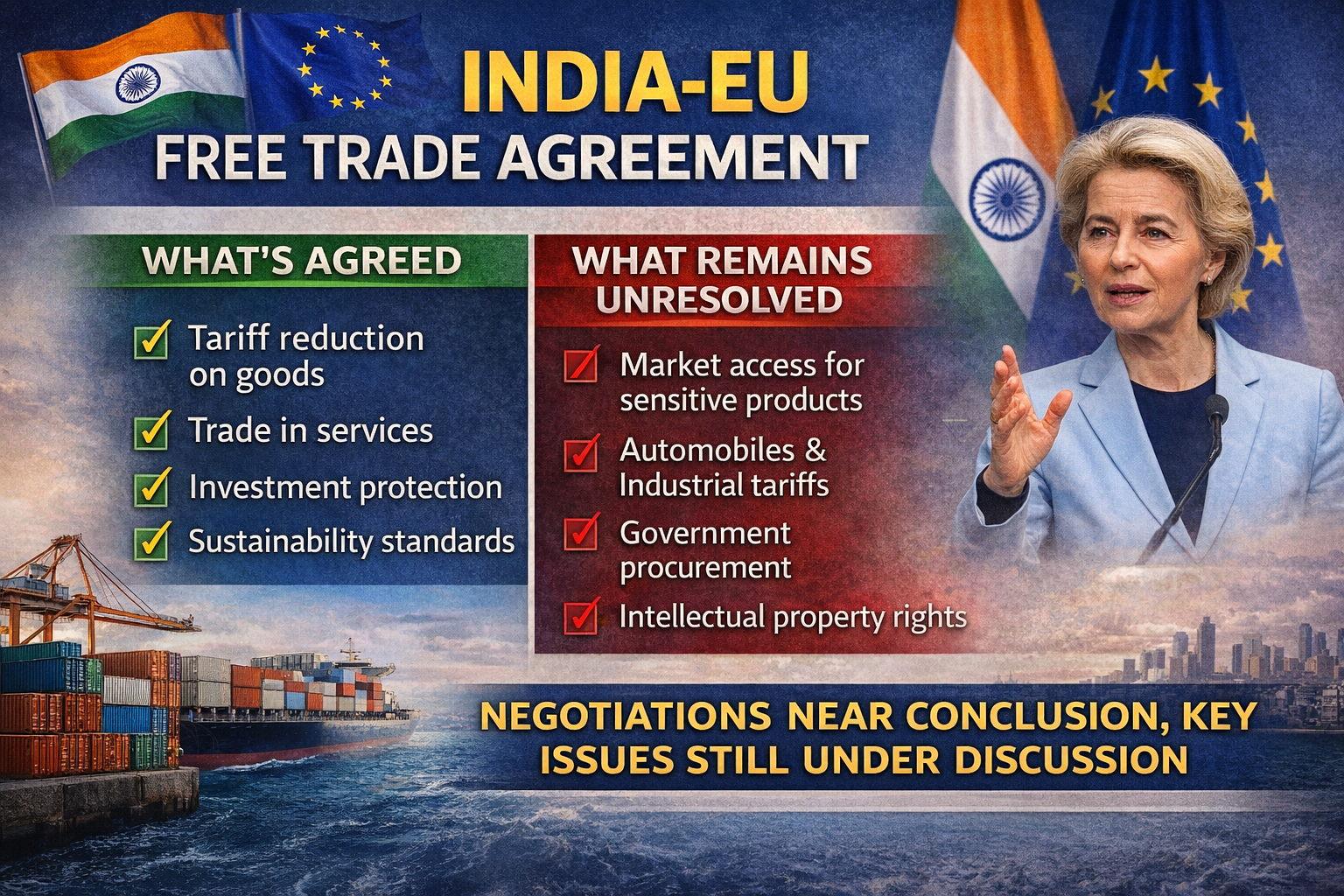






New Delhi: India and the European Union on Monday finalized a landmark Free Trade Agreement (FTA) at the 16th India-EU Summit. The deal is poised to double bilateral trade from its current €120 billion in goods and €59.7 billion in services to over €250 billion within a decade, according to official projections.
Prime Minister Narendra Modi, European Commission President Ursula von der Leyen, and European Council President António Costa hailed the pact as a bulwark against global economic fragmentation, amid escalating U.S. tariff threats.

Ursula von der Leyen is on her State Visit to India from January 25 to 27, 2026. She is joined by European Council President António Costa. Both the leaders were Chief Guests at India’s 77th Republic Day celebrations on January 26.

The India-EU agreement, concluded after 21 rounds of negotiations relaunched in 2022, eliminates or reduces tariffs on over 90% of traded goods in a phased manner over seven to ten years, while excluding sensitive sectors like agriculture and dairy.
Key specifics include India slashing import duties on European cars from up to 110% to 40% initially, with further reductions tied to local manufacturing commitments, boosting EU auto giants like Volkswagen and Mercedes.
Tariffs on EU machinery, wines, spirits, and chocolates will drop significantly—wine duties from 150% to 50-100%, and hard alcohol from 150% to phased lower rates—opening India’s market to premium European products.
In return, the EU will ease barriers for Indian exports, including textiles, jewelry, pharmaceuticals, and engineering goods, which faced hurdles under the now-withdrawn Generalised System of Preferences (GSP) scheme.
Duties on Indian textiles could fall from 12% to zero, potentially lifting exports by 30-40% and creating up to 10 million jobs in labor-intensive sectors. Services liberalization covers IT, telecom, finance, and professional mobility, with mutual recognition of qualifications to facilitate skilled worker exchanges.
The deal also includes robust chapters on investment protection (€140.1 billion in EU FDI in India as of 2023), intellectual property, sustainable development (with carbon border adjustment mechanism carve-outs), digital trade, and dispute settlement aligned with WTO norms.
Officials estimate 1-2% annual GDP growth for India and enhanced supply-chain resilience, countering U.S. levies like the 50% tariffs on Indian goods amid Russian oil purchases.
PM Modi described it as the “mother of all deals,” stating it will “bring major opportunities” and represent “25% of global GDP.” Von der Leyen called it the “biggest of all deals,” emphasizing diversification and shared values. Costa noted its role in deepening security ties.
Ratification is expected by late 2026, with interim tariff cuts starting soon. This FTA, larger than India’s recent EFTA pact, positions both economies for mutual growth in a volatile world.