


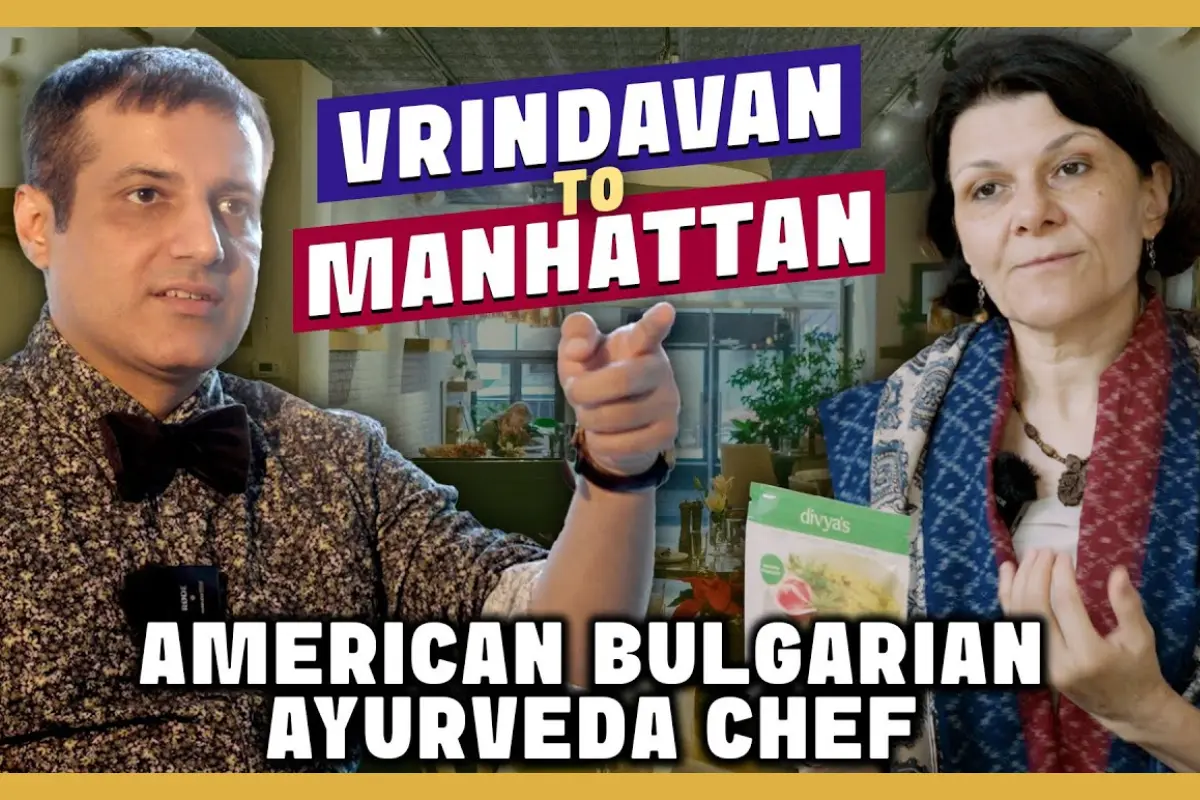






From communist Bulgaria to Vrindavan, and finally to New York City, Divya Alter’s life is a rare confluence of spirituality, healing, and entrepreneurship.

Founder of the acclaimed Ayurvedic restaurant Divya’s Kitchen, Alter speaks to Rohan Dua about growing up atheist, discovering bhakti yoga, overcoming autoimmune illness through Ayurveda, and her dream of feeding a billion people.
Q: Divya, take us back to the beginning. How did this journey really start for you?
Divya Alter:
I grew up in communist Bulgaria, where for the first 18 years of my life I was raised as an atheist. Religion was discouraged, even forbidden. People were literally spying on students to see if they went to church.
But when I was about 17, despite being a very good student, I felt something was missing. I had this deep spiritual urge. I read Siddhartha by Hermann Hesse, and that opened a door for me into ancient Indian philosophy. That was the turning point.
Q: Your spiritual path eventually took you to India. What was that experience like?
Divya Alter:
Before going to India, I discovered an underground yoga ashram in my town. It was just a one-bedroom apartment, nothing fancy. But the moment I stepped inside, there was incense, there was the aroma of cooked suji halva, and I felt something I can only describe as a past-life memory.
That’s where I began learning bhakti yoga. My first service as an intern was chopping vegetables and washing pots. That’s how my culinary training began—through service.
Later, I lived in India for five years, mostly in Vrindavan. That period shaped everything—my spirituality, my understanding of food, and my purpose.
Q: You often say food saved your life. Can you explain that?
Divya Alter:
About 15 years ago, I was extremely sick. I had an autoimmune disease, over 50 allergies, no strength, and could barely digest food. Food had actually become my enemy.
That’s when I met my Ayurveda teacher, Vaidya Ramakant Mishra, and his main student, Dr. Marian Taitobam. Vaidya Mishra always said, “Let’s fix your food and your lifestyle first. Then we’ll see if you need medicine.”
Through Ayurveda, I learned how food can truly be medicine. Not just healthy, but delicious and deeply healing. That experience changed my life—and my mission.
Q: Is that what eventually led to Divya’s Kitchen?
Divya Alter:
Absolutely. Once I experienced healing through food, I decided to dedicate my life to helping others heal the same way. Divya’s Kitchen is not just a restaurant—it’s an Ayurvedic ecosystem.
When we opened about 10 years ago, we wanted people to experience balance, nourishment, and joy through food. Ayurveda is universal. It’s not Indian food—it’s food aligned with nature.
Q: Your menu uses Sanskrit names and Ayurvedic concepts like Vata, Pitta, and Kapha. Why was that important to you?
Divya Alter:
I’ve always been drawn to Sanskrit. I studied it even before going to India, and deepened my studies in Vrindavan at the Vrindavan Institute for Higher Education.
Sanskrit is the mother of all languages. Many words can’t be translated into just one English word. Since we are an Ayurvedic restaurant, we wanted people—especially those new to Ayurveda—to feel curious and connected. Using dosha names was also a way to make the experience playful and educational.
My husband helped refine the menu titles. He’s a native English speaker and very sensitive to how language is perceived.
Q: You and your husband come from very different cultural backgrounds. How does that dynamic work in running a restaurant?
Divya Alter:
When we first started, we did everything—literally every job—so we could understand what our staff goes through. I handle the creative side: recipes, cooking philosophy, training chefs, and being the face of the restaurant.
My husband handles the business side—operations, hiring, development. He’s also our main taster. If he doesn’t love a dish, it doesn’t go on the menu.
Q: During the pandemic, you expanded into packaged foods. How did that happen?
Divya Alter:
During the COVID lockdown, I created four different khichdi products and two dal mixes. Each one supports different doshas, seasons, and digestive needs.
We started with prototypes in the basement of our restaurant. Today, our products are available in 50 Whole Foods stores across the tri-state area. We’re preparing to expand further, including the West Coast and eventually international distribution.
But we don’t rush expansion. Ayurveda teaches balance—even in business.
Q: You served a special drink during the interview. What is it?
Divya Alter:
I call it the Ayurvedic Gatorade. It has all six tastes—sweet (mishri), salty, sour (lime), bitter, pungent (toasted cumin), and astringent. It includes water, mint, lime juice, a pinch of salt, and cumin powder.
It’s incredibly hydrating and supportive for digestion.
Q: What kind of feedback matters most to you?
Divya Alter:
All feedback matters, especially critical feedback. If someone is dissatisfied, we personally reach out. We’re here to serve, not to chase fame.
Interestingly, the most critical feedback comes from Indian customers—and I appreciate that deeply. They keep us honest.
Q: Do you see Divya’s Kitchen coming to India someday? Perhaps Vrindavan?
Divya Alter:
I don’t know what the future holds. But my bigger dream is to reduce food waste, make nutritious food accessible to people in need, and create educational spaces where people reconnect with food—from seed to table.
If that journey takes me back to Vrindavan someday, I would welcome it with humility.
Q: You recited a Sanskrit shloka during the interview. What role does the Gita play in your life today?
Divya Alter:
The Bhagavad Gita teaches surrender—not as weakness, but as clarity. Letting go of unnecessary identification—nationality, profession, labels—and acting from the level of the soul.
I believe most conflicts begin at the level of body and mind. When we meet each other soul-to-soul, compassion becomes natural.
Q: One final question—what is your ultimate dream?

Divya Alter:
My dream is to feed a billion people in this lifetime. And by having conversations like this, you’re helping make that possible.