


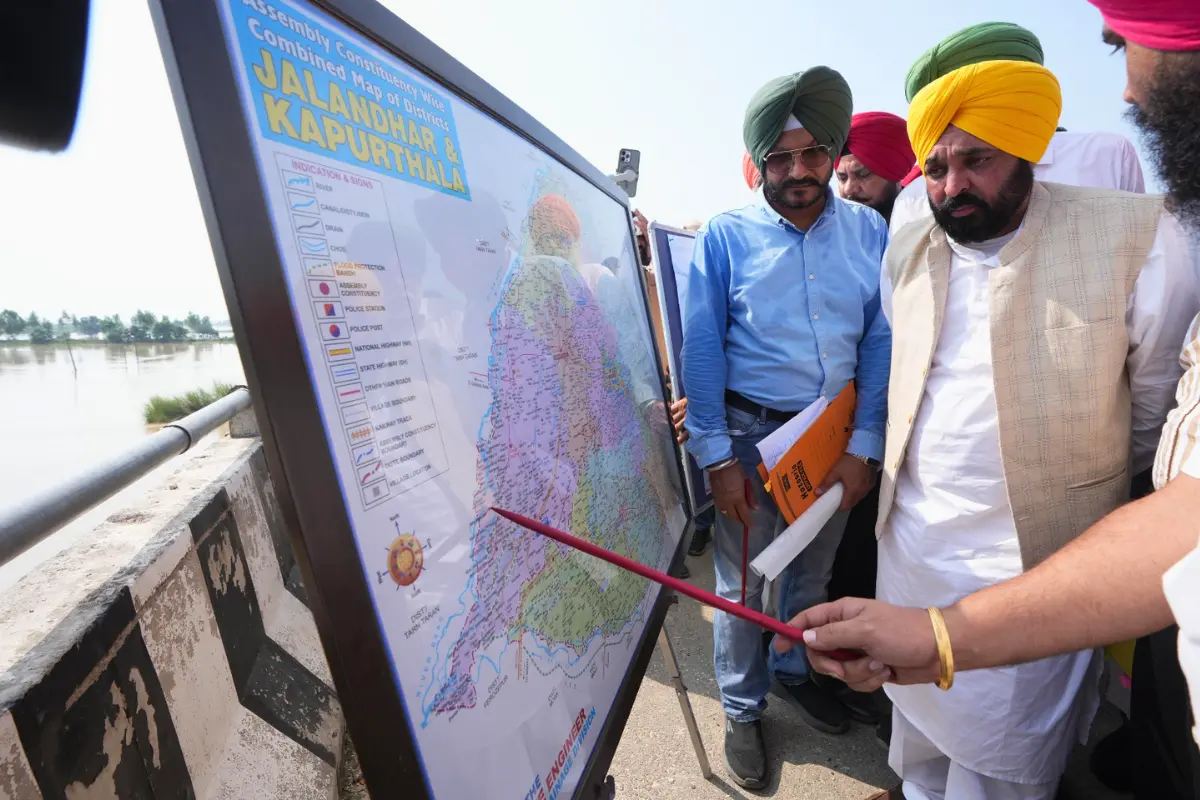






NEW DELHI: As India marked Democracy Day, Punjab Chief Minister Bhagwant Mann chose to celebrate it not in offices or ceremonial functions, but in the flood-hit villages of the state. Walking through waterlogged streets and muddy lanes, Mann stood shoulder to shoulder with affected families, setting a rare example of what democratic leadership means in practice.

Unlike the customary “aerial surveys” by leaders, Mann went among the people, listening to their grievances directly. “I am not the Chief Minister, I am the Minister of Grief,” he said during one of his visits—words that resonated deeply with Punjabis.
The Mann government deployed all cabinet ministers to Amritsar and border villages, not for symbolic visits but to work on the ground. Relief camps, medical facilities, and cleanliness drives were run with the active involvement of ministers, MLAs, and local leaders.
Democracy Day in Punjab was marked not by speeches, but by action. With wartime-level planning, the government rolled out India’s largest crop compensation package—₹20,000 per acre to farmers, ₹4 lakh to families who lost lives, and ₹1 lakh immediate relief for every flood-hit village.
Relief efforts became a people’s movement. Volunteers, community leaders, and residents themselves took charge in over 2,300 villages, setting up food distribution points, medical camps, and sanitation drives. Ordinary citizens became partners in governance, blurring the line between state and society.
However, the Punjab government also contrasted its response with the silence of the Centre. Chief Minister Mann pointed out that while Punjab turned a crisis into an example of living democracy, Prime Minister Narendra Modi remained absent, neither visiting flood-hit areas nor addressing the state’s plight. Critics note that while the PM often takes positions on international crises, his lack of response to Punjab’s suffering has raised questions about the Centre’s priorities.
At its heart, democracy is about being “of the people, for the people, and by the people.” In Punjab’s crisis, this principle was put into practice. The government’s partnership with citizens—whether through direct relief, health campaigns, or agricultural compensation—transformed disaster response into an exercise in democratic accountability.
As floodwaters slowly recede, Punjab has demonstrated that democracy is not an annual ritual but a continuous commitment. The story of these floods will not only be about destruction but also about resilience—of a state government and its people standing together, refusing to abandon each other.

The Mann government’s actions during this crisis may well be remembered as a defining moment in Punjab’s democratic journey—where leadership meant empathy, service, and presence on the ground.