


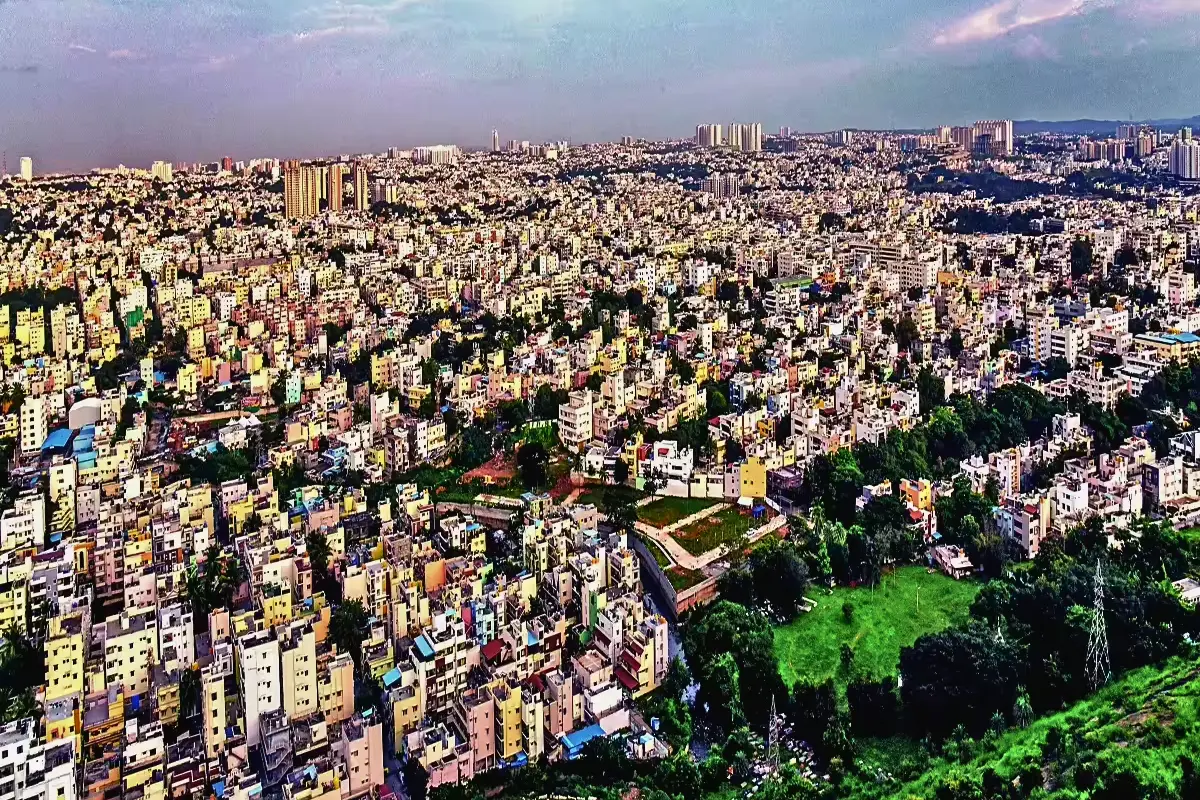






Bengaluru: Once known as India’s “Garden City,” Bengaluru is now confronting an ecological tipping point as decades of rapid, unplanned urbanisation have slashed its green cover from nearly 70% in the 1970s to under 7% today.

New analysis shows that this drastic loss has intensified the city’s Urban Heat Island effect, with neighbourhoods such as Marathahalli, Koramangala, KR Puram and Hebbal recording surface temperatures 2–5°C higher than older, tree-rich areas.
The findings, presented in a policy review on tree-felling regulations and climate planning, reveal significant gaps in governance, coordination and environmental planning across the city.
At the heart of Bengaluru’s ecological challenge lies a structural flaw: trees are considered only after road designs, metro alignments or infrastructure blueprints are finalised.
While the Karnataka Preservation of Trees Act, 1976 outlines a clear framework requiring permissions, inspections and compensatory afforestation, its implementation remains inconsistent. Public notices are often uploaded late, tree censuses are incomplete, and compensatory planting frequently happens in distant locations with low survival rates, offering no local cooling benefit.
Climate evidence shows the consequences clearly. ATREE’s 2023 heat-stress mapping identified 28 hotspots across Bengaluru, each strongly correlated with low canopy density. Streets with continuous tree cover can lower surface temperatures by up to 10°C, yet the city lacks a climate-led approach to urban design.
Meanwhile, governance lapses continue: the High Court has reprimanded agencies in cases ranging from Jayamahal to Hebbal for bypassing mandatory procedures, and public objections have stalled major proposals like the Steel Flyover, which threatened more than 800 trees.
This environmental strain compounds existing socio-economic inequities. Low-income wards face higher heat exposure, according to CSTEP modelling, which shows cooling-energy demand rising 6–8% for every 1°C increase. Outdoor workers—delivery riders, vendors, waste collectors and traffic police—are disproportionately impacted, turning tree loss into a public health and economic justice issue.
The report recommends sweeping reforms: integrating ecological assessments into the DPR stage, mandating ward-level compensatory planting, creating a transparent tree dashboard, updating road standards to protect root zones, and establishing an Urban Ecology & Climate Unit within BBMP.
It urges treating trees as essential climate infrastructure, not cosmetic additions.

Bengaluru’s challenge, the review concludes, is not to halt development but to design it intelligently. As the city continues to expand, reinterpreting trees as core components of climate resilience may determine whether Bengaluru remains liveable in the decades ahead.