


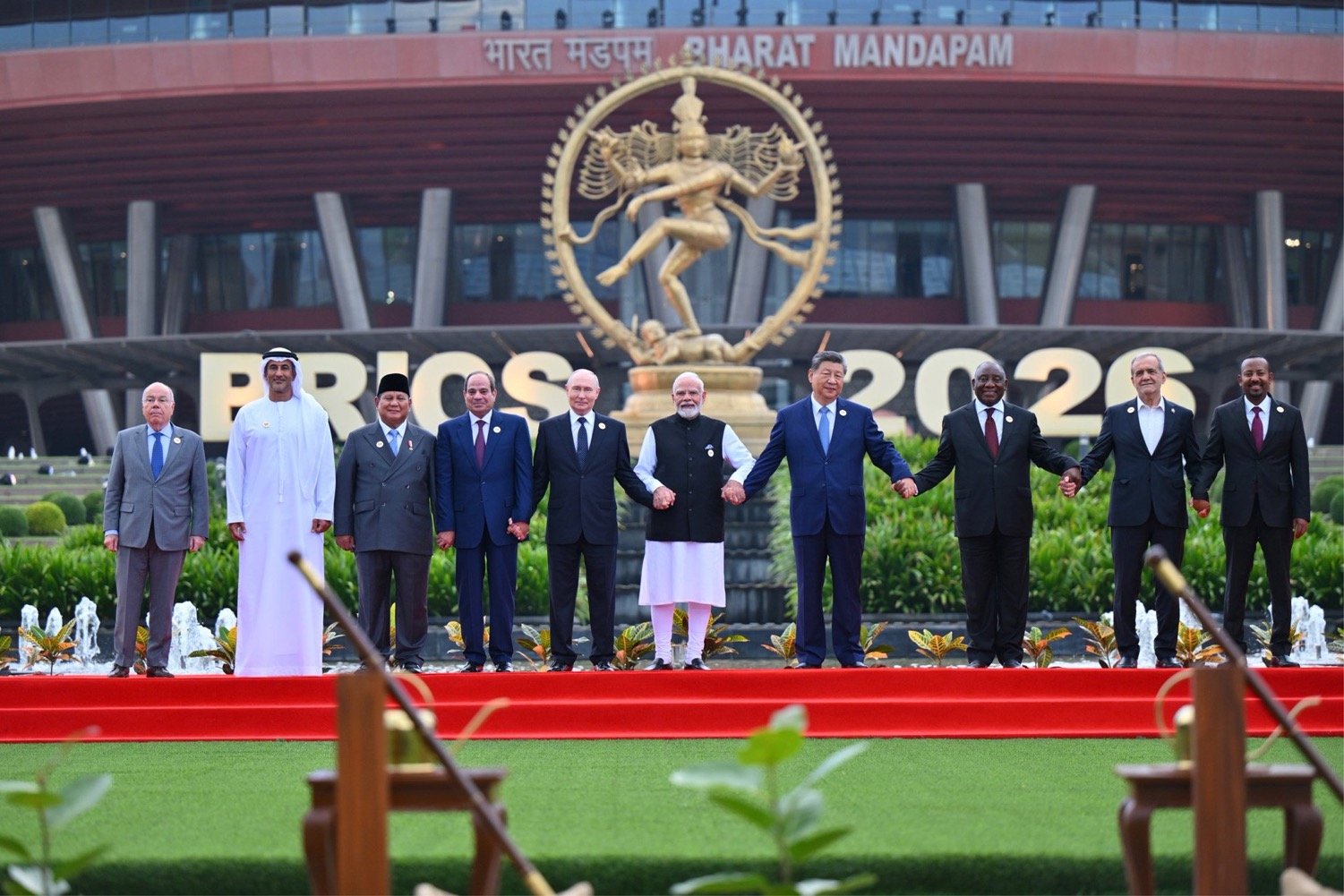


New Delhi: BRICS leaders on Saturday adopted the New Delhi Declaration at the end of their 18th summit, pledging deeper cooperation and renewing calls for sweeping reforms of the United Nations, international financial institutions and the World Trade Organization.

Hosted by Indian Prime Minister Narendra Modi in the national capital city, the summit brought together Chinese President Xi Jinping, Russian President Vladimir Putin, South African President Cyril Ramaphosa, Iranian President Masoud Pezeshkian, Indonesian President Prabowo Subianto, Egyptian President Abdel Fattah el-Sisi, Ethiopian Prime Minister Abiy Ahmed and UAE Crown Prince Sheikh Khaled bin Mohamed bin Zayed Al Nahyan, among others. Brazil was represented by Foreign Minister Mauro Vieira.
Under the theme “Building for Resilience, Innovation, Cooperation and Sustainability”, the declaration, issued after two days of talks hosted by India, reaffirmed the group’s commitment to mutual respect, sovereign equality, solidarity and consensus. Leaders said the expanded BRICS would strengthen work across political and security, economic and financial, and cultural and people-to-people pillars to promote a fairer international order and inclusive growth.
The declaration noted that more than 400 meetings had been held across 30 Indian cities during India’s 2026 chairship, advancing collective resilience, innovation-driven growth and sustainable development.
On global governance, the leaders marked the 20th anniversary of BRICS by calling for a more representative, democratic and accountable multilateral system centred on the United Nations Charter. They demanded greater participation of emerging markets and developing countries, especially from Africa, Asia, Latin America and the Caribbean, in decision-making bodies. The declaration stressed equitable geographical representation in UN secretariats and senior posts, and noted that no woman has ever served as UN secretary-general.
China and Russia, as permanent Security Council members, reiterated support for Brazil and India’s aspirations to play greater roles in the UN, including the Security Council. Leaders backed comprehensive council reform to amplify the voice of the Global South and recognised African aspirations reflected in the Ezulwini Consensus.
They reaffirmed the urgent need to reform the Bretton Woods institutions so that the voice and representation of emerging markets and developing economies match their weight in the global economy. The declaration urged prompt implementation of the 16th IMF General Review of Quotas and meaningful realignment under the 17th review, while protecting the shares of the poorest members. Similar calls were made for World Bank shareholding reform and a fully functioning two-tier WTO dispute settlement system. Unilateral tariffs, non-tariff barriers and coercive economic measures inconsistent with WTO rules and international law were strongly criticised.
On peace and security, the leaders expressed deep concern over ongoing conflicts and rising military spending that diverted resources from development. They condemned the April 22, 2025, terrorist attack in Jammu and Kashmir that killed 26 people and reaffirmed zero tolerance for terrorism in all forms, rejecting any association of terrorism with religion or nationality.
The declaration called for an immediate permanent ceasefire in Sudan, an inclusive Syrian-led political process, and full implementation of relevant UN resolutions on Gaza, including unhindered humanitarian access and an end to forced displacement.
The BRICS nations also rejected any alteration of the legal status of occupied Jerusalem and supported a two-state solution based on the 1967 borders with East Jerusalem as the capital of a sovereign Palestinian state. The economic blockade of Cuba was again condemned.
In the economic sphere, leaders highlighted food security, energy transitions that respect national circumstances, and cooperation on critical minerals, artificial intelligence, digital public infrastructure and disaster-resilient systems. They welcomed progress on a potential BRICS grain trading platform, cross-border payment mechanisms using local currencies, and support for micro, small and medium enterprises. Health cooperation was expanded through new early-warning systems, traditional medicine working groups and mental-health networks. Science, technology and innovation ties were strengthened, including through the BRICS STI Framework Programme’s tenth anniversary and new research infrastructure initiatives.
The declaration welcomed the contribution of partner countries and the BRICS Plus outreach dialogue. Leaders committed to advancing the 2030 Agenda for Sustainable Development, tackling inequality and ensuring that multipolarity expands opportunities for the Global South.
India’s hosting of the summit and its chairship year were widely commended for injecting practical momentum into the partnership. The New Delhi Declaration positioned the expanded BRICS as a continuing voice for more equitable global institutions and pragmatic cooperation on the challenges facing emerging and developing economies.
The New Delhi summit carries particular significance as BRICS marks two decades since its founding and operates in an expanded format that now includes Egypt, Ethiopia, Iran, the United Arab Emirates and Indonesia alongside the original members. Held amid heightened geopolitical tensions, including conflict in the Middle East, the gathering tested the bloc’s ability to forge consensus among diverse members.

The unanimous adoption of the declaration, the high-level attendance including Xi Jinping’s first visit to India in seven years, and the focus on amplifying the Global South’s voice in global institutions underscore BRICS’ growing role as a platform for emerging economies seeking a more multipolar order. India’s chairship successfully steered practical cooperation while navigating internal differences, positioning the group to advance reforms and resilience in an uncertain international environment.

