


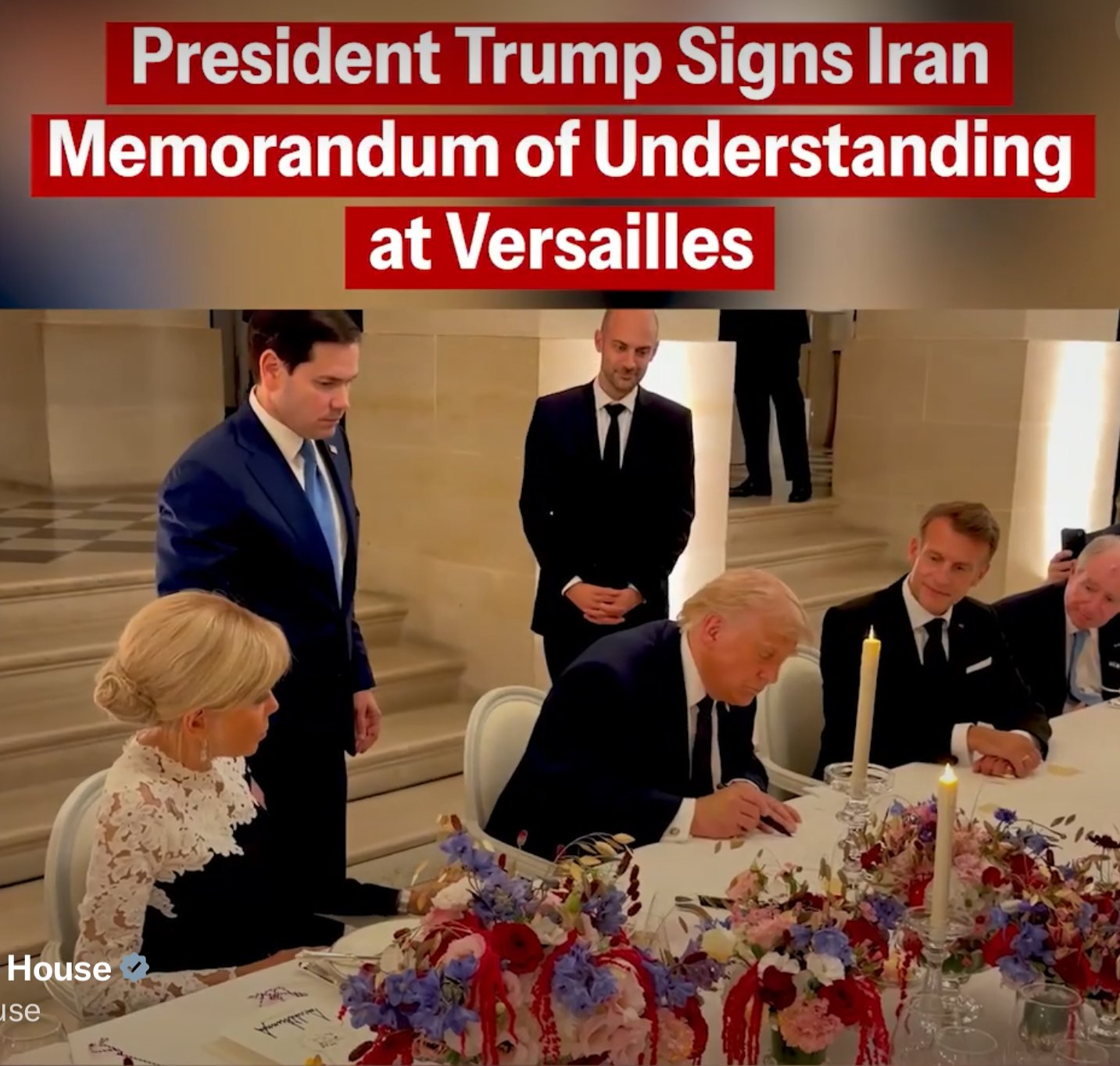






New Delhi: U.S. President Donald Trump on Wednesday signed a ceremonial copy of a Memorandum of Understanding (MoU) with Iran at the Palace of Versailles after the accord had already been finalized through electronic signatures exchanged remotely between Washington and Tehran.

The memorandum, signed electronically by Trump and Iranian President Masoud Pezeshkian, extends a ceasefire between the two countries and opens a 60-day negotiating period aimed at reaching a broader agreement on Iran’s nuclear programme, sanctions relief and regional security. Pezeshkian did not travel to France and was not present at the Versailles event.
The White House said the agreement took effect after both presidents signed the text electronically. Trump later signed a physical copy during a dinner hosted by French President Emmanuel Macron on the sidelines of the Group of Seven summit.
The accord marks the first formal agreement signed by the presidents of the United States and Iran since the 1979 Islamic Revolution.
The memorandum, brokered with support from Pakistan and Gulf states, establishes a framework for future negotiations but stops short of resolving the most contentious issues between the two countries.
According to U.S. and Iranian officials, the agreement provides for the immediate continuation of a ceasefire, the reopening of the Strait of Hormuz to commercial shipping and the start of negotiations over Iran’s nuclear activities and the phased easing of sanctions.
Trump said the memorandum explicitly states that Iran “will not have a nuclear weapon.” The U.S. president has said the text of the agreement will be released publicly after additional procedural steps are completed.
The agreement does not require Iran immediately to dismantle its nuclear infrastructure, nor does it address Tehran’s ballistic missile programme or its relationships with allied armed groups across the Middle East.
Those issues are expected to be discussed during negotiations scheduled to continue over the next two months. Trump cautioned that the agreement remained preliminary.
Speaking to reporters during the G7 summit, he said the memorandum was “not final” and warned that the United States could resume military action if Iran failed to comply with its commitments. Iranian officials also stressed that implementation would determine whether the process succeeds.
Mohammad Bagher Ghalibaf, Iran’s parliament speaker and a senior figure in the negotiations, said the agreement demonstrated that Iran had withstood U.S. pressure. “The agreement is a record of U.S. failure,” Ghalibaf said on Iranian state television.
The deal received a cautious welcome from G7 leaders, who called for continued diplomacy and urged both sides to honour their commitments.
The next phase of talks is expected to focus on verification mechanisms, the future role of the International Atomic Energy Agency and the sequencing of sanctions relief.
Energy markets initially reacted positively to news of the accord, with oil prices falling on expectations that shipping through the Strait of Hormuz would gradually return to normal.
The waterway handles roughly a fifth of global oil consumption and had become a focal point of market concerns during the conflict.
The agreement also carries political significance for Trump, who withdrew the United States from the 2015 Iran nuclear deal during his first term and later launched military operations against Iranian targets during the latest crisis.
For Iran, the memorandum offers a pathway toward sanctions relief and the restoration of oil exports, though Tehran has said any long-term agreement must preserve its right to maintain a civilian nuclear programme.
Whether the memorandum evolves into a durable peace accord will depend on the outcome of negotiations over the coming weeks.

For now, the electronic signatures exchanged between Washington and Tehran have halted direct hostilities, while the ceremony at Versailles provided a symbolic backdrop for a diplomatic breakthrough that remains fragile.