


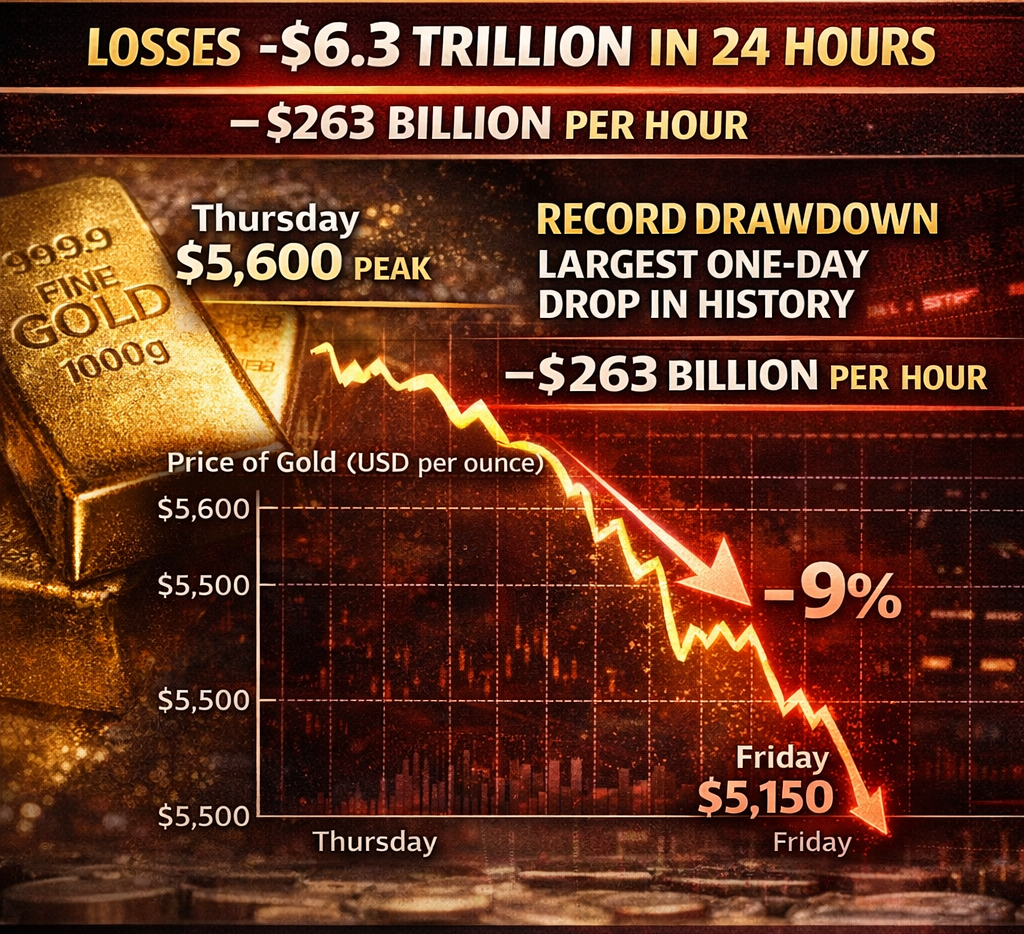






New Delhi: Gold suffered its largest ever single-day loss in global market value on Friday, wiping out an estimated $6.3 trillion in 24 hours, following a dramatic reversal after reaching record highs a day earlier.

The scale of the decline — equivalent to roughly $263 billion an hour over a full day — marks the most severe drawdown since gold began trading freely after the collapse of the gold standard in the early 1970s. The fall brought an abrupt end to one of the most intense rallies ever seen in precious metals markets.
The sell-off came immediately after gold surged past $5,600 an ounce on Thursday, driven by heavy demand for safe-haven assets amid geopolitical tensions, concerns over global debt levels and unease about the stability of major currencies.
Friday’s sharp fall reflected a rapid change in market sentiment. After days of steep gains, investors moved swiftly to lock in profits, leading to widespread selling across global bullion markets.
The reversal was accelerated by technical trading dynamics. As prices slipped below key thresholds, automated trading systems and leveraged positions were forced to unwind, adding to downward pressure. The speed of the decline was intensified by thin liquidity following the earlier surge.
At the same time, the US dollar strengthened, reducing the appeal of gold for international buyers. Gold, which does not generate interest, also faced pressure as expectations firmed that major central banks — particularly the US Federal Reserve — may keep interest rates higher for longer than previously anticipated.
Gold’s rapid rise earlier in the week had been fuelled by multiple forces: sustained central bank purchases, strong investor demand for protection against inflation, and fears of financial fragmentation in a more uncertain geopolitical environment.
However, the pace of buying meant that large volumes of speculative capital entered the market in a short period. When prices began to fall, those same positions amplified losses, turning a correction into a historic collapse in market value.
Silver, which had climbed above $120 an ounce on Thursday, also fell sharply on Friday, reinforcing the sense that the precious metals rally had become overstretched.
The fallout was felt strongly in India, one of the world’s largest gold markets. Domestic prices fell sharply on Friday after touching record highs earlier in the week, leading many jewellers to pause transactions. Consumers, who had already been deterred by soaring prices, largely stayed on the sidelines.
Despite the magnitude of the fall, gold prices remain well above their levels at the start of the year. Analysts note that the longer-term drivers behind gold demand — including central bank diversification and global economic uncertainty — have not disappeared.

Nevertheless, Friday’s collapse stands as a reminder that even assets long viewed as safe havens can experience extreme volatility when markets move too far, too fast.