


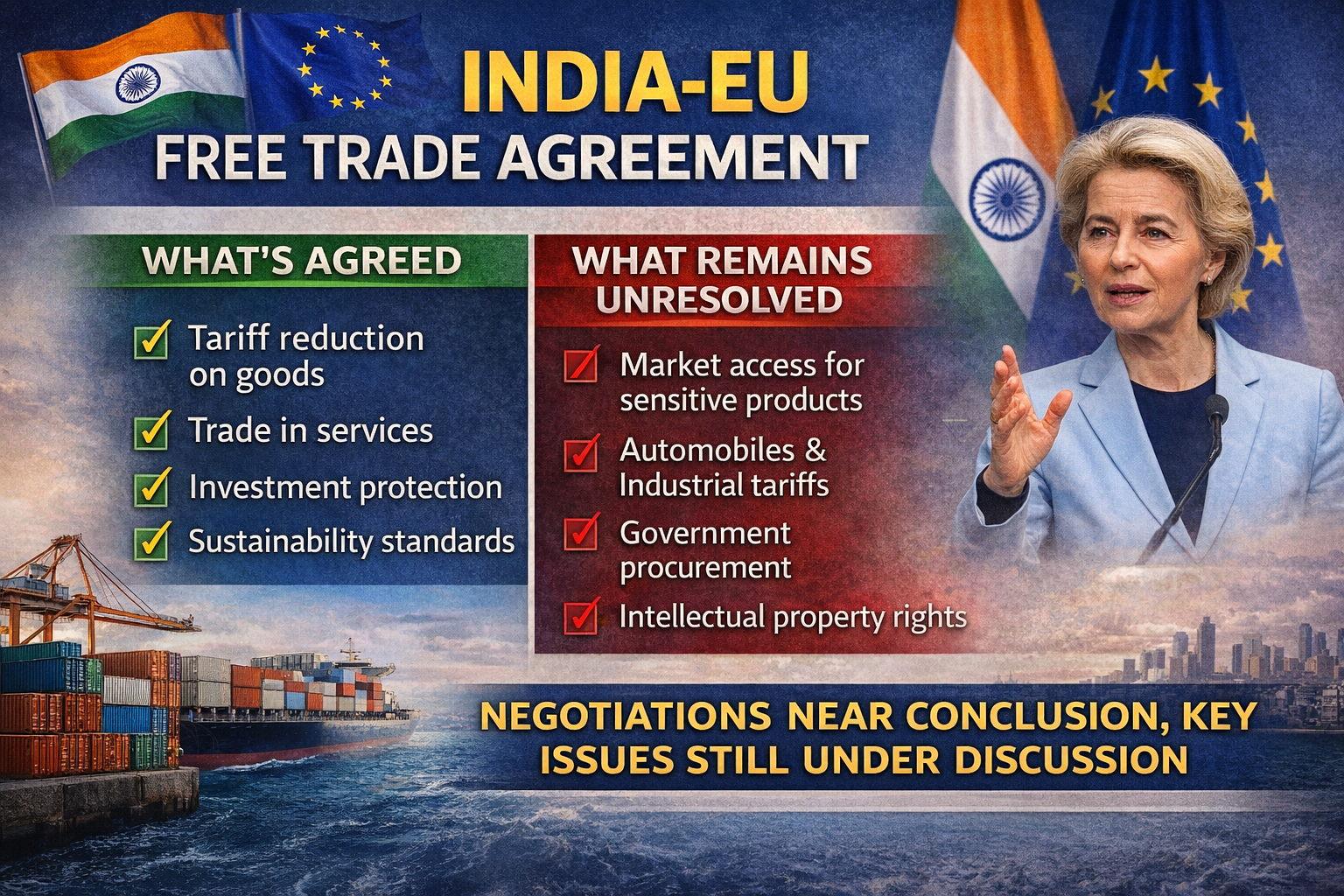






New Delhi: European Commission President Ursula von der Leyen arrived in New Delhi on Saturday for high-level talks with Prime Minister Narendra Modi, as India and the European Union move closer to concluding a long-pending Free Trade Agreement (FTA) that both sides have described as a strategic priority.

The visit comes amid indications from New Delhi and Brussels that negotiations on the India-EU FTA, formally known as the Trade and Investment Agreement, are in their final stage. According to official statements from the European Commission, the discussions during von der Leyen’s visit will focus on trade, defence cooperation, climate action, technology, and mobility.
In a statement issued ahead of her visit, von der Leyen said the India-EU partnership is “one of the most important relationships of this decade” and emphasized that the proposed trade agreement would strengthen economic resilience on both sides. “A free trade agreement between the EU and India would be a game-changer for our businesses and our shared prosperity,” the Commission said in its official release.
The Indian government has also signalled strong political backing for the agreement. The Ministry of Commerce and Industry stated earlier this week that India and the EU are working toward a “balanced, ambitious, and mutually beneficial” FTA that addresses market access, tariffs, services, and regulatory cooperation. The ministry reiterated that India’s approach is guided by the principle of protecting sensitive sectors while expanding export opportunities.
Negotiations on the India-EU FTA were relaunched in 2022 after a gap of nearly nine years. Since then, both sides have completed multiple negotiating rounds, with officials confirming progress on goods, services, investment protection, and sustainable development chapters. The EU is currently India’s largest trading partner, with bilateral trade in goods exceeding €120 billion annually, according to European Commission data.
During her visit, von der Leyen is also expected to co-chair meetings of the India-EU Trade and Technology Council, a platform aimed at deepening cooperation in digital technologies, clean energy, semiconductors, and supply chains. The European Commission said this framework complements the trade talks by aligning economic and strategic interests.
Addressing the broader partnership, Prime Minister Modi has previously described the India-EU relationship as being anchored in “shared democratic values and a commitment to a rules-based international order.” Official Indian statements have emphasized that closer economic ties with the EU support India’s goal of diversifying trade partnerships and strengthening domestic manufacturing.
While neither side has announced a formal signing date, officials in New Delhi and Brussels have indicated that a political announcement on the conclusion of negotiations could follow once outstanding technical issues are resolved. The European Commission has maintained that any final agreement will require approval by EU member states and the European Parliament.

Von der Leyen’s visit underscores the growing strategic convergence between India and the EU at a time of global trade uncertainty, with both sides publicly affirming that the proposed FTA is central to their long-term economic and geopolitical partnership.