


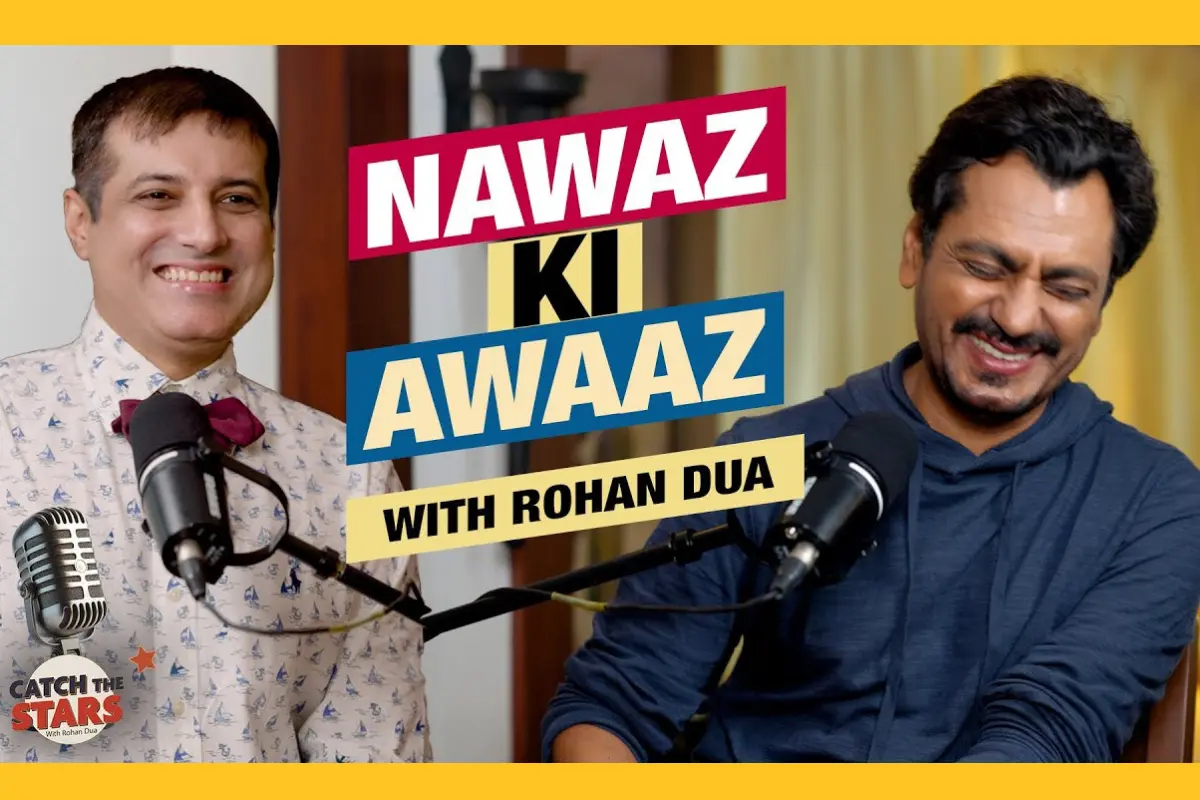






In a candid conversation on Catch The Stars with Rohan Dua on The New Indian, Actor Nawazuddin Siddiqui opens up about his insecurities, journey from a chemist’s job to cinema, iconic roles, personal values, and the performances that shaped his career.

Q: Nawaz, you once spoke about having a complex about your complexion. Was it really that intense? Did you use fairness creams?
Nawazuddin Siddiqui:
Yes, a lot. In the beginning, I definitely had an inferiority complex about my complexion. Sometimes on Saturdays, we used to go to the market and buy fake Fair and Lovely creams. We used to apply them regularly.
The problem was that the cream never merged with the skin. After a while, I used to look completely white. Even I didn’t know what I was doing. People would look at me and ask, “What did you do to your face?”
We didn’t even know the spelling properly. Instead of “Fair and Lovely,” we thought it was “Flair and Lovely.” We believed it made you fair instantly. We applied it and stood in front of girls thinking it worked.
This was back in my village Budhana.
Q: So this was before your theatre and film journey began?
Nawazuddin Siddiqui:
Yes, much before that.
Q: You studied BSc Chemistry (Honours) and even worked as a chemist. How did acting enter your life?
Nawazuddin Siddiqui:
After completing my studies, I was working in Baroda as a chief chemist in a petrochemical factory. But I didn’t feel connected to that life.
During that time, some friends introduced me to theatre. I started watching plays, and something changed inside me. I realised I wouldn’t be able to do a regular job anymore because acting was too interesting.
The chemistry between actors and the audience, the energy, the waves—you never get bored. Every day you play a new character, face new challenges.
I started doing Gujarati theatre. Then someone suggested Hindi theatre, so I went to Lucknow, gave auditions, got selected, and later joined the National School of Drama. I studied there for three years.
After that, I struggled in Delhi for three more years, earned some money, gathered courage, and finally came to Bombay.
Q: You once joked that people think you look poor, but you actually come from a rich family. What did you mean by that?
Nawazuddin Siddiqui:
People judge based on appearances. They think someone who looks like me must be poor, and someone who looks polished must be rich.
But in reality, some of the richest people in India look just like us. Films create a different imagination. Casting works differently in cinema.
Q: People often compare you to Al Pacino or Irrfan Khan. How do you see such comparisons?
Nawazuddin Siddiqui:
I don’t think about it much. Earlier, when we watched Hollywood films, actors like Al Pacino or Richard Gere represented great acting.
If people feel something similar with my work, that’s fine, but I don’t live in those thoughts.
Q: Films like Lunchbox, Talaash, Gangs of Wasseypur, Sacred Games, Raman Raghav, Manto—do you revisit those performances?
Nawazuddin Siddiqui:
No. I have moved forward.
Even if I have done films like Gangs, Sacred Games, Raman Raghav, or Manto, I don’t want to live in their memories or glory. You should move on.
Q: What inspired your character in The Lunchbox?
Nawazuddin Siddiqui:
The character was inspired by a friend of mine—my room partner. I observed him closely and copied him.
When the film released, he messaged me saying, “I saw Lunchbox. Thank you.” He also got angry because people started telling him he had already done that role in real life.
But yes, I copied the right person.
Q: Let’s talk about Talaash. How was it working with Aamir Khan?
Nawazuddin Siddiqui:
I had already worked with him in Sarfarosh—just one scene. Later, I worked with him as a producer in Peepli Live.
During Talaash, when I reminded him about Sarfarosh, he remembered and even told others about it. He’s very warm and friendly.
Q: You played an intelligence officer in Talaash. Did you research real officers?
Nawazuddin Siddiqui:
No, not at all.
The director explained the character, and that was enough. I remembered my cousin from my village—his attitude was similar. I recalled that and imbibed it into the character.
Once the spine of the character is set, everything flows naturally.
Q: Any memorable moments from the Durga Puja shoot in Kolkata?
Nawazuddin Siddiqui:
It was a real crowd. Half were crew members, half were actual people.
While running, I bumped into a woman who abused me in Bengali. I didn’t understand the words, but the way she said it felt very sweet. That moment stayed with me.
Q: Manjhi: The Mountain Man is one of your most intense roles. What stayed with you?
Nawazuddin Siddiqui:
Dashrath Manjhi’s stubbornness and love for his wife.
I broke the mountain with a real hammer to feel what he must have felt. My ankle got twisted; I was hospitalised. They used to carry me in a palanquin up the mountain.
His love was so deep that he didn’t care about his physical pain.
Q: The mud love-making scene with Radhika Apte was very raw. Was it difficult?
Nawazuddin Siddiqui:
It’s never difficult working with Radhika.
But yes, it was winter. We were covered in mud, holding our breath, then bathing in freezing water. I was in terrible condition that night.
Q: The political satire in Manjhi—was it exaggerated?
Nawazuddin Siddiqui:
I don’t know if it really happened, but the scene was a strong satire. It reflected how politicians talk about removing poverty.
Q: Chand Nawab in Bajrangi Bhaijaan became iconic. Did you know about him earlier?
Nawazuddin Siddiqui:
No. I saw his video two or three days before the shoot.
The entire scene was shot in one take because I had memorised everything properly.
Q: How was it working with Salman Khan and Kareena Kapoor?
Nawazuddin Siddiqui:
It was great. Very fun.
I call Salman “Bhai,” like everyone else. I’ve been to his house many times. Sohail Bhai and Arbaaz Bhai have visited my place too.
Q: Kashmir plays an important role in Bajrangi Bhaijaan. How did you feel there?
Nawazuddin Siddiqui:
Kashmir is heaven. It’s beautiful.
Incidents like attacks hurt everyone. When something like that happens, the entire country feels the pain together.
Q: Growing up, what influenced your values and love for acting?
Nawazuddin Siddiqui:
Ramlila.
I used to return home at 2 a.m. after watching it. My father never stopped me. He believed Ramlila teaches values, morals, and ideals.
That’s probably why I wanted to act. I even played characters like Sugreev and Vanar Sena in Ramlila.
Q: Have you ever been to Ayodhya?
Nawazuddin Siddiqui:
No, I haven’t. But I will go someday.