


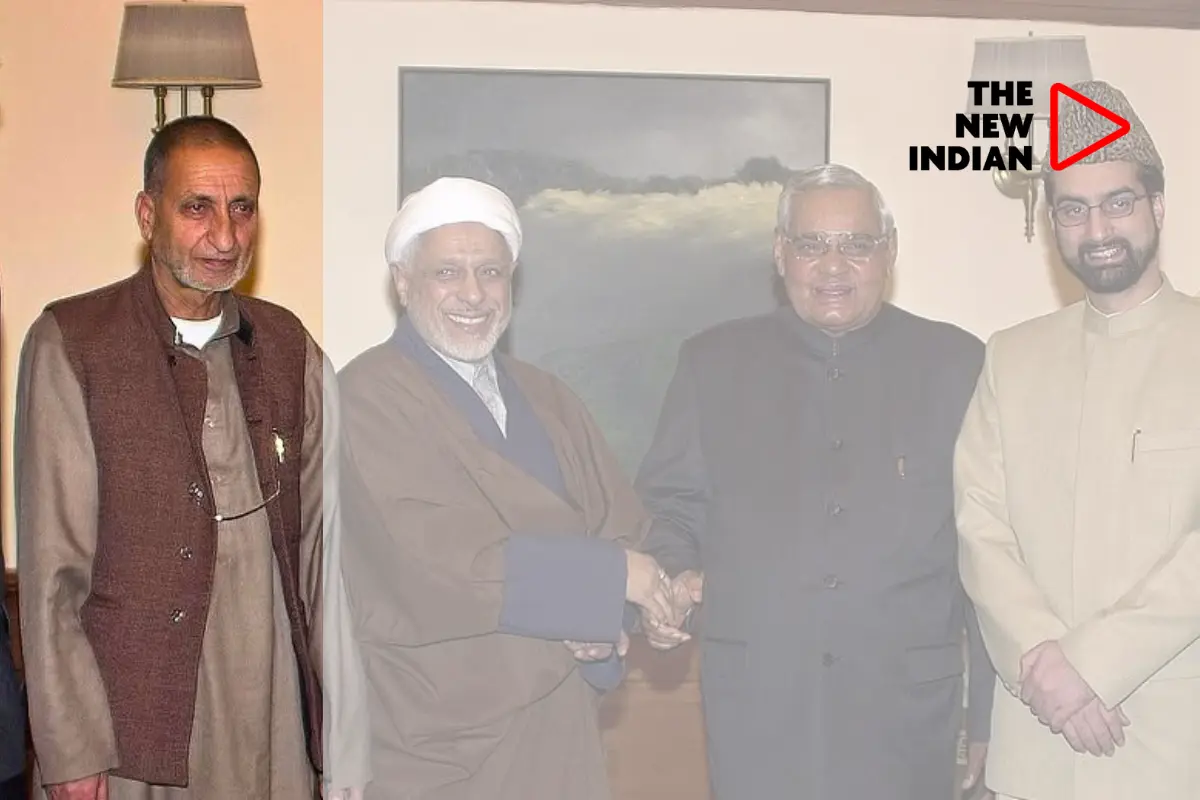






Abdul Ghani Bhat could almost have been the leading figure in a Greek tragedy. Almost—for his life and death fell just short of the tragic norm, although there was a great deal of pathos in both; for close to three decades now, he was a prisoner in a cage that was, as is the case with any tragic flaw, largely of his own making.

Although he did not meet a gory death, he did just escape a gruesome end many years ago. For, someone happened to notice something hanging below his car as he prepared to leave a small public meeting long years ago. It was a bomb.
Bhat, who died last week aged 90, was in the vanguard of Kashmiri separatism from 1986 until the Hurriyat Conference petered out over the past 15 or so years. He was chairman of the Hurriyat Conference for several years, and had founded the Muslim United Front (MUF), which contested the 1987 state assembly elections.
Ailing for some time, he died quietly on 17 September, and was buried even more quietly in the dead of night. But the quicksilver wit and political savvy that had kept him at the forefront of separatist politics had remained sprightly even in his last months, as he rested in his Botengu village home.
No doubt he had many regrets. Surely, not the least of those regrets would have been the death of his brother at the hands of terrorists, an assassination which he viewed as a warning to him. No doubt he would also have regretted the fact that his naming a prominent colleague in the Hurriyat Conference for being behind his brother’s murder hardly caused a ripple in the maelstrom of violence.
‘Professor’ (as Bhat was generally known, having taught at Sopore Degree College until the mid-80s) had been trapped for decades by circumstances, unable to find a dignified way out of a labyrinth which he had helped to construct.
Indeed, it is the way many Kashmiris might feel, deep in their hearts.
Home of separatism
By the time he perhaps felt caged—at least by the late ‘90s—the tide of time had come a long way since, way back in 1986, he had hosted a meeting of various sorts of separatists at the same Botengu pastoral residence where he died. He had recently been sacked back then from his lecturer’s job by the then Governor, the dynamic Mr Jagmohan.
That meeting was held on 13 July that year, which governments of Jammu and Kashmir had for long observed as the anniversary of a rebellion against the Dogra maharaja in 1931. After much discussion, a nebulous grouping called the Muslim United Front was formed at that meeting.
The J&K chapter of Jamaat-e-Islami was its most prominent pillar, and so it became a fresh space for counter-manoeuvres in the ongoing tussle between J-e-I’s rival leaders, Amir-e-Jamaat GM Bhat and Syed Ali Shah Geelani, who believed that intrigue had deprived him of the post of Amir.
‘Professor’ was an associate (not a full member) of J-e-I. In less than a decade, he surely came to regret giving Geelani the prominence outside J-e-I which the latter obtained through MUF.
Abdul Ghani Lone joined MUF soon after that Botengu meeting, and the rivalry between Geelani and Lone (and their respective parties’ cadres) ensured that MUF lost most of the seats in north Kashmir when the grouping contested the 1987 elections. (It is widely believed that the results from some constituencies in Srinagar and south Kashmir were rigged.)
A couple of years after that 1986 meeting, Yasin Malik, one of the youngest of those who attended that meeting in Botengu, would be among the early band of Kashmir’s terrorists, trained and armed by Pakistan.
But, after a meeting with visitors from Pakistan in Kathmandu in January 1990, Geelani sent his colleague Yusuf Shah to take over the fledgling Hizb ul-Mujahideen and turn it really into the sword arm of Jamaat-e-Islami—and decimate Malik’s JKLF and a host of other terrorist outfits over the next three years.
Calling himself Syed Salahuddin since then, Yusuf Shah still lives in Pakistan, also a has-been. After Burhan Wani revived the hitherto fading Hizb from 2010 to 2016, it has slumped again, replaced by the more lethal outfits that are responsible for horrifying bloodshed such as at Pahalgam on 22 April this year.
Key Hurriyat figure
When foreign powers decided to set up a political front to represent the Kashmiri separatist movement, the All Parties Hurriyat Conference was established in 1993. ‘Professor’ joined Geelani, and Lone in its all-powerful Executive, alongside the young Mirwaiz and Maulana Abbas Ansari, who had been named MUF’s convenor at that Botengu meeting.
Yasin and Shabir Shah joined them (Shabir only for a while) after they were released in 1995.
Geelani called the shots, backed by the guns of Hizb, which ruled the terrorist roost by ‘93, after it had decimated other Kashmiri outfits. The ISI had only just begun to send in Pakistanis and Afghans under the banners of Lashkar-e-Toiba and Harkat ul-Mujahideen respectively since December ‘92.
Lone was the only one who could stand up to Geelani, and it was up to the politically consummate Bhat to keep the balance. To prevent Lone from becoming chairman, Geelani put Bhat forward as chair. But when Bhat defied Geelani to induct Lone’s son Bilal into the Executive after Lone was assassinated (on the twelfth anniversary of the senior Mirwaiz’s assassination), Geelani split from the Hurriyat.
‘Professor’ then replaced Lone as the chief strategist—if that isn’t too big a word for moves that got nowhere—during the Hurriyat’s meetings with national and other leaders, including prime ministers Vajpayee and Manmohan Singh.

The latter meeting took place almost exactly 20 years before Bhat’s death. Those two decades have seen steady decline—in the Hurriyat, in the credibility of the gamut of Kashmiri leaders, and Bhat’s own health.