


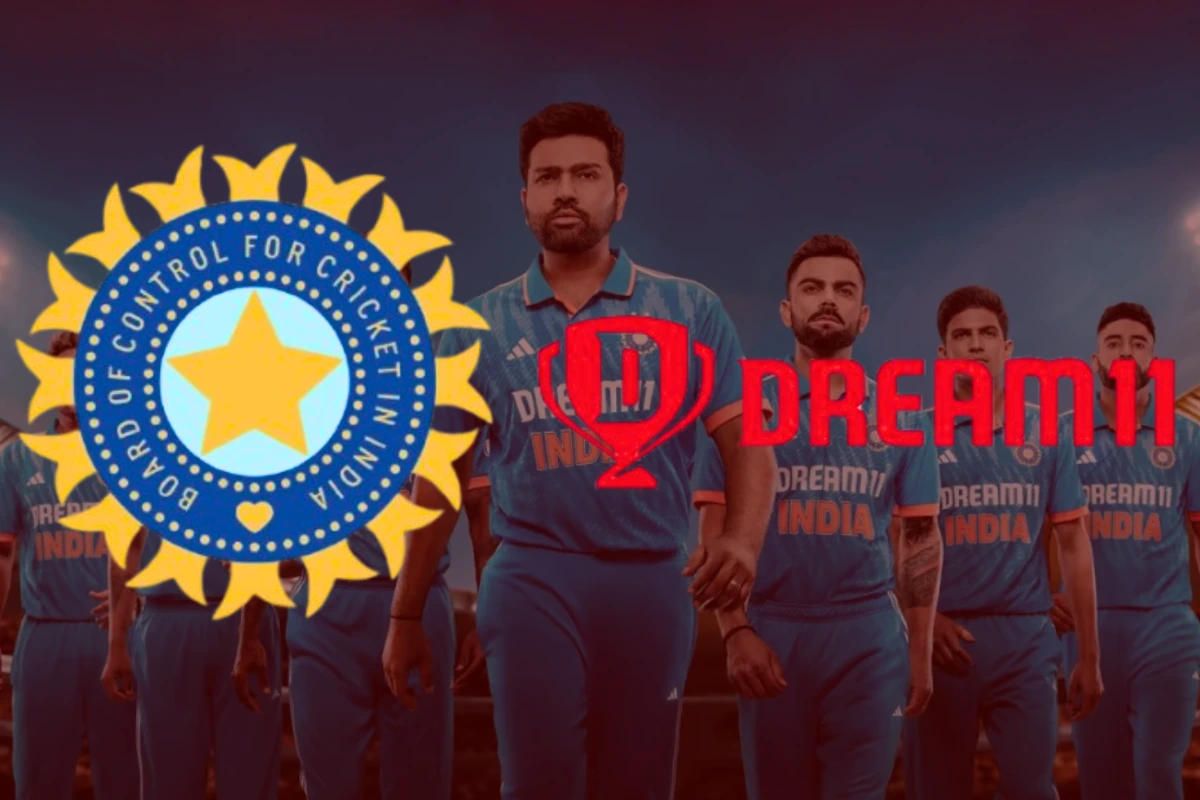






NEW DELHI: The Board of Control for Cricket in India (BCCI) has suffered a significant financial and commercial setback after fantasy sports giant Dream11 formally conveyed its inability to continue as Team India’s lead jersey sponsor. The decision comes in the wake of the newly enacted Promotion and Regulation of Online Gaming Bill, 2025, which bans all real-money gaming (RMG) platforms in India and prohibits their advertising and sponsorships.

The development ends a high-profile sponsorship deal that had positioned Dream11’s logo on the Indian cricket team’s jerseys across formats. The abrupt termination has left the cricket board looking for a replacement sponsor ahead of India’s busy international calendar, including the upcoming Asia Cup in September.
The Sponsorship Deal and Its Sudden Collapse
Dream11 had signed a three-year sponsorship agreement with BCCI in July 2023, valued at approximately ₹358 crore (USD 44 million). The company stepped in as the lead sponsor after edtech major BYJU’S pulled out of its deal. Under the contract, Dream11 was expected to continue as Team India’s jersey sponsor until 2026.
However, the passage of the Online Gaming Bill, 2025, has rendered the deal untenable. The legislation defines “online money games” as any game in which players deposit money with the possibility of winning more money based on outcomes. It bans both the operation and promotion of such platforms, with strict criminal penalties for violators.
According to the bill, companies or individuals running real-money games face up to three years in prison or fines of ₹1 crore, while advertisers, promoters, or sponsors of banned games can face up to two years in prison or fines of ₹50 lakh.
This blanket ban has hit fantasy sports firms like Dream11 directly, forcing them to withdraw not only from sponsorships but also from running their core paid-contest businesses in India.
BCCI’s Position: Compliance Over Conflict
The BCCI, which has historically partnered with several gaming and fantasy platforms, has taken a clear stance that it will not be associated with entities that are now outlawed under Indian law.
BCCI Secretary Devajit Saikia underscored the board’s compliance-first approach:
“The BCCI will not violate any of the laws enforced in the country. That’s very clear.”
He acknowledged the impact of the new regulations, adding:
“Under the new legislation, it will be difficult for BCCI to continue with Dream11 or any other identical gaming companies. So, there is a roadblock and I don’t think BCCI will be able to continue with Dream11 now. We are deliberating on an alternative course of action at this stage.”
In an official statement, the BCCI confirmed the sponsorship discontinuation, making its position unambiguous:
“BCCI and Dream11 are discontinuing their relationship after the Promotion and Regulation of Online Gaming Bill, 2025, was passed. BCCI will ensure not to indulge with any such organisations in future.”
Contractual Safeguards for Dream11
According to industry insiders, the Dream11-BCCI contract contained watertight clauses protecting both parties in case of a “change in law”. This means Dream11’s exit will not attract penalties, as the ban makes it legally impossible to fulfill the contract.
“These are watertight agreements and cannot be exited unilaterally. It will have to be a mutual decision since the law of the land doesn’t permit advertising of banned games.”
This provision explains why the BCCI has accepted the termination without seeking damages from the fantasy sports major.
Ripple Effect Across Cricket Sponsorship and Gaming
The exit of Dream11 is not an isolated incident. The entire Indian cricket sponsorship ecosystem is likely to be reshaped in the aftermath of the ban.
- My11Circle, another real-money fantasy platform, has a ₹625 crore IPL fantasy rights deal running until 2028. With the new bill in place, this deal also faces serious uncertainty.
- Other fantasy platforms have suspended their paid contests and are now attempting to transition toward “free-to-play” formats in order to retain some user base.
- Celebrity endorsements and advertising campaigns involving fantasy sports apps have been quietly pulled from media platforms to avoid legal exposure.
- Users of RMG apps are being advised to withdraw their wallet balances, with companies issuing FAQs and customer advisories on refunds.
For BCCI, the immediate consequence is financial. The loss of a ₹358 crore sponsorship deal leaves a gap in its commercial revenues. The board will now have to invite fresh bids for jersey sponsorship from non-gaming categories such as banking, finance, telecom, FMCG, automotive, or consumer technology companies.
Timing and Urgency
The timing of the sponsorship crisis could not be worse. With the Asia Cup scheduled to begin in early September 2025, Team India is due to unveil its new kit in the coming weeks. Unless a replacement sponsor is found swiftly, India’s jerseys could feature only the kit manufacturer’s logo (Adidas) without a front-of-shirt sponsor.
While BCCI has not revealed a timeline for finalizing a new sponsor, officials have hinted that the process of inviting fresh bids has already been initiated.
Wider Legal and Policy Implications
The Promotion and Regulation of Online Gaming Bill, 2025, while aimed at curbing addiction and financial risks associated with RMG apps, has also triggered wider debates around its constitutionality. Legal experts point out that Indian courts have historically differentiated between “games of skill” (protected under law) and “games of chance” (gambling, which can be banned).
Fantasy sports firms like Dream11 have long argued that their products fall under the “games of skill” category. However, the new law makes no such distinction, applying a blanket ban on money-based online games.
Industry bodies have hinted at possible judicial challenges to the law in the coming months. Until then, however, compliance is non-negotiable, and partnerships like BCCI-Dream11 have no legal standing.
The termination of Dream11’s sponsorship marks a watershed moment in the intersection of Indian cricket and the online gaming industry. For the BCCI, it is a major commercial blow that forces an urgent search for new revenue partners. For Dream11 and other fantasy platforms, it represents a regulatory storm that has upended their business models overnight.
As India prepares for a packed cricketing season, the familiar Dream11 logo on the national team’s jerseys will be conspicuously absent — a visible reminder of how swiftly policy changes can reshape the country’s most lucrative sporting ecosystem.