








NEW YORK (US): Against the backdrop of the 80th United Nations General Assembly and Climate Week NYC, more than 300 education leaders, policymakers, youth activists, and sustainability champions from 45 countries gathered for the 9th NYC Green School Conference 2025.

The two-day summit, held on September 23–24 at 570 Lexington Avenue, marked a milestone in positioning education as a catalyst for climate resilience, peace, and equity.
Organized by Green Mentors, a New York–based nonprofit with consultative status to the UN ECOSOC, and co-hosted by a coalition of global partners including UNESCO-IESALC, HESI of UN DESA, UN SDSN, Columbia Climate School, University of Colorado Boulder, and the Global Alliance for a Sustainable Planet, the conference embraced the theme: “Greening Education for Pupils, Planet, and Prosperity.”
The New Indian’s Executive Editor Rohan Dua was a guest speaker and moderator for a discussion on sustainability in the film industry. He chaired a session alongside Harry Winer, Director of Sustainability at NYU’s Kanbar Institute of Film & Television, Heidi Kindberg, Vice President of Sustainability at HBO and Warner Bros. Discovery, and young filmmaker Raef Tanner.
A Cultural Opening: The Voice of the Planet
The gathering began with a moving performance titled “Voice of the Planet,” by visually impaired artists Vasundhara Ratruri and Anusha Manjunath.
Their music, a celebration of resilience and unity, created an atmosphere of shared purpose that resonated throughout the conference.
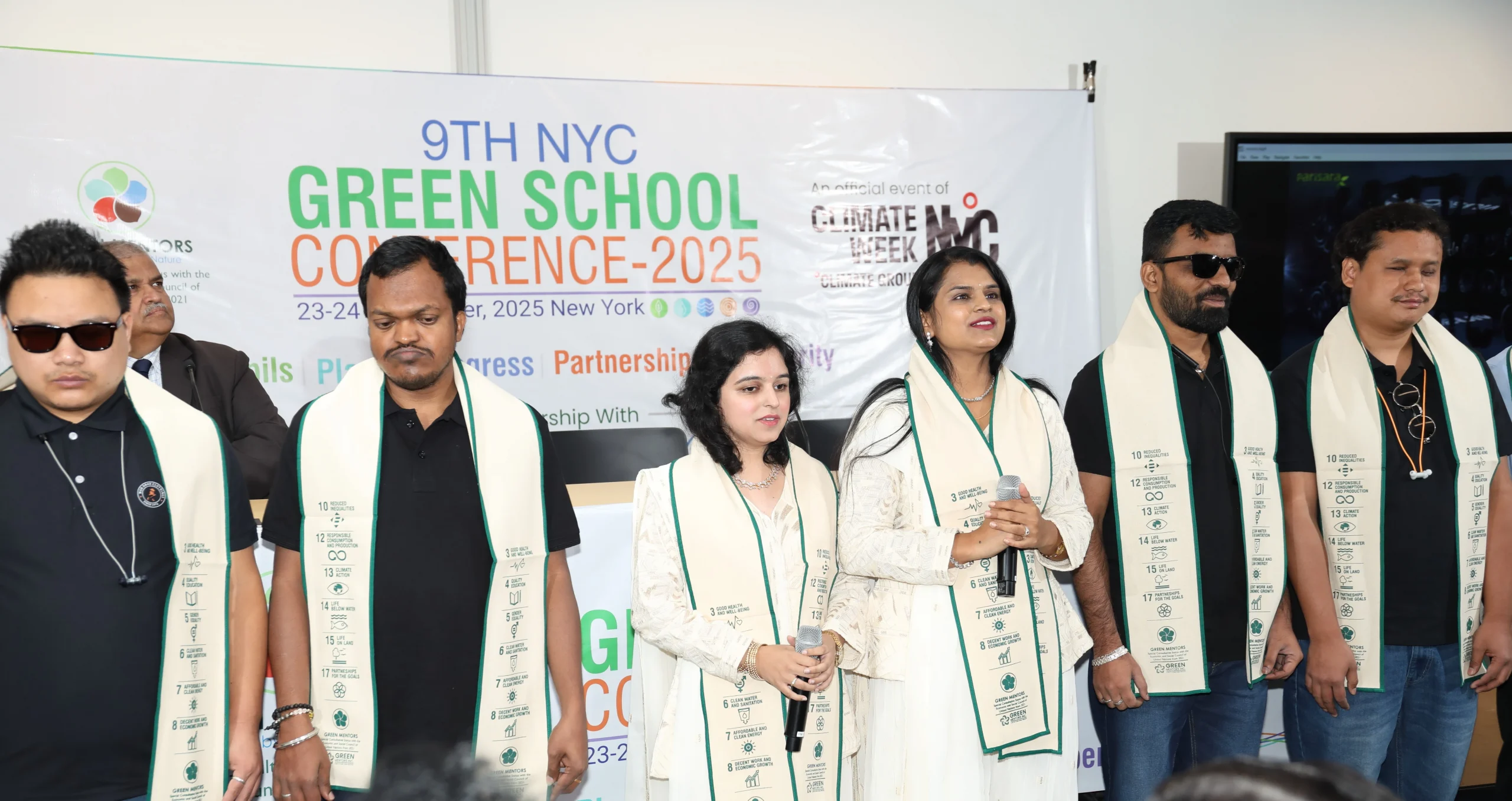
In his welcome address, Dr. Virendra Rawat, Founder of Green Mentors, underscored the central message of the summit: “Education is not merely attaining knowledge—it is a climate solution.”
He urged delegates to embrace the responsibility of transforming schools and universities into engines of sustainability.
Global Leaders Call for Climate-Conscious Education

The Opening Plenary featured prominent voices from sustainability and education. Among them were Satya S. Tripathi of the Global Alliance for a Sustainable Planet, Prof. Patrick Paul Walsh of UN SDSN, Dr. Radhika Iyengar of Columbia University, and Assemblywoman Emérita Torres of New York.

Andrew Mayock, former U.S. Federal Chief Sustainability Officer and now Vice Chancellor for Sustainability at the University of Colorado Boulder, delivered the keynote.
He called on higher education institutions to lead with “climate purpose” and highlighted the urgency of embedding climate literacy into the fabric of learning.
Turning Ideas into Action: Partnerships and Policies
Over two days, sessions highlighted how education can become a diplomatic bridge to global sustainability, weaving together policies, partnerships, and pedagogy.
-
UN DESA-HESI unveiled a new Partnership Framework to enhance higher education’s contribution to the UN Sustainable Development Goals (SDGs).
-
UNESCO-IESALC introduced the South-South University Cooperation Network (SUCN), fostering collaboration across the Global South for climate learning and action.
-
University of Colorado Boulder, in collaboration with the Carnegie Foundation and American Council on Education, launched the Elective Classification for Sustainability—a mechanism designed to embed climate literacy across curricula in higher education.
Panels and discussions brought together policymakers such as New York’s Emérita Torres and Massachusetts’ Tram Nguyen, corporate voices like Johanna Jobin of Takeda, and grassroots leaders who presented real-world solutions such as nationwide schoolyard greening initiatives.

Other notable contributions included Cmde S. R. Sridhar (Retd.) of IIIT-Bangalore showcasing India’s campus greening strategies, and Rohan Dua of The New Indian challenging academia to produce “Green Graduates” ready to drive the future economy.
Bridging Sectors: From Schools to Media
The conference stood out for its cross-sectoral approach. Sustainability was explored not only through academic frameworks but also via creative industries and civic engagement.
Harry Winer, Heidi Kindberg, and Raef Tanner championed sustainable filmmaking and media education, emphasizing the role of storytelling in shaping a culture of environmental stewardship.
At the community level, Danielle Denk of the Trust for Public Land announced a bold initiative to green schoolyards across the U.S., while educators like Robin Sidman, Adelina Tripoli, and Usha Iyer shared grassroots strategies for climate-friendly schooling.
Recognizing Global Champions of Green Education
The climax of the conference was the Global Green Awards Ceremony, which honored individuals and institutions for their pioneering efforts in sustainable education.
Awards were presented across categories including:
-
Patron of the Planet Award
-
Global Green Leadership Award 2025
-
Global Green University Award 2025
-
Global Green School Award 2025
-
Global Green Policy Maker Award 2025
-
Young Climate Leader of the Year 2025
These recognitions went beyond celebration, serving as a global call to embed sustainability into curricula, operations, innovation, and community engagement.
A Turning Point for Education
Closing the conference, Dr. Rawat declared: “When learning becomes regenerative, every student becomes a steward of the Earth. The 9th NYC Green School Conference 2025 marks a turning point—where education becomes the pivot toward planetary resilience.”
The sentiment reflected the broader ambition of the conference: to elevate education from classrooms into the realm of diplomacy, shaping policies and forging partnerships that can address humanity’s most urgent challenges—climate change, poverty, inequality, and conflict.
About Green Mentors

Founded in New York, Green Mentors is a nonprofit recognized by the UN ECOSOC and a trusted Green Education Partner of UNESCO. With its global vision, the organization works with governments, universities, and schools to reimagine learning systems as engines of climate action, equity, and sustainable innovation.