








New Delhi/Chandigarh: Punjab has taken a historic leap in reshaping India’s education system by introducing the world’s first Compulsory Business Course across all universities and colleges.

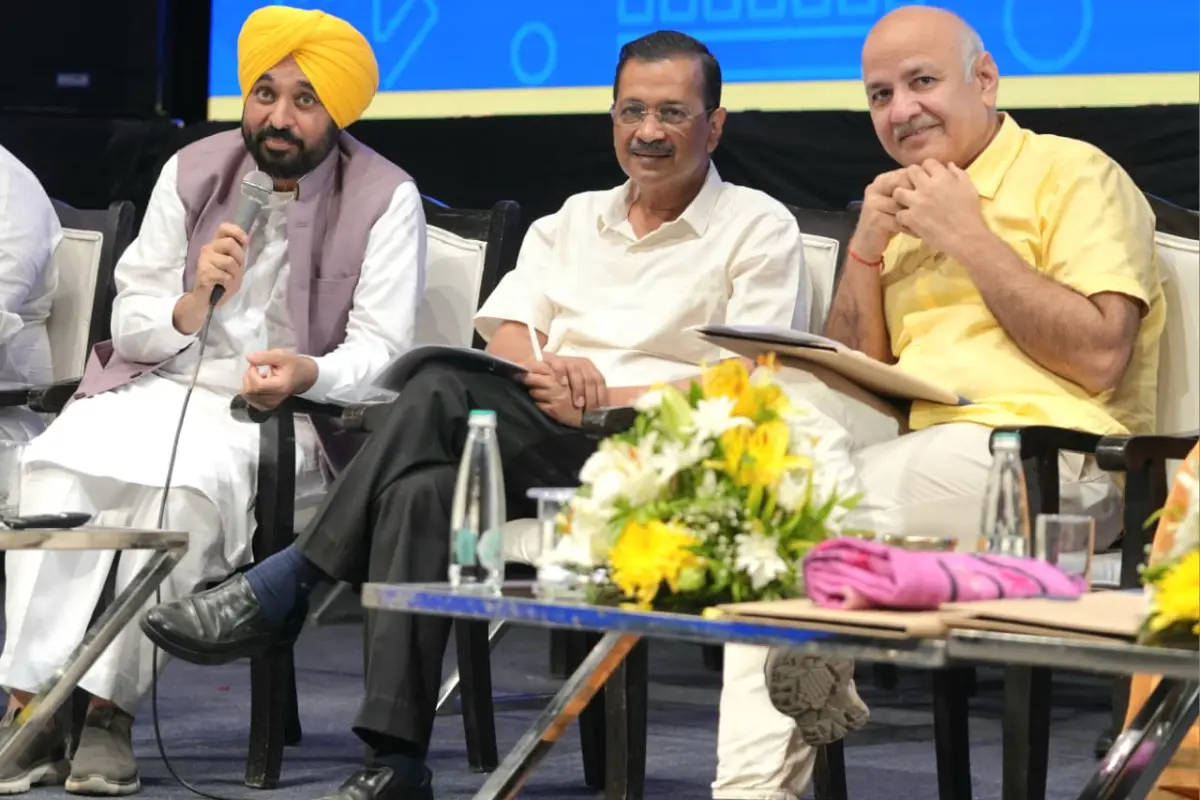
Aam Aadmi Party (AAP) National Convenor and Delhi Chief Minister Arvind Kejriwal, along with Punjab Chief Minister Bhagwant Singh Mann, senior AAP leader Manish Sisodia, and Punjab Education Minister Harjot Singh Bains, launched the new curriculum on Thursday in Chandigarh, calling it the beginning of a “new era of educational revolution.”
Breaking free from the age-old “ratta-paper” (cram-and-exam) system, the initiative aims to transform Punjab’s youth from job seekers into job creators.
Kejriwal: “This experiment can prepare India to compete with China”
Addressing students and academicians at the launch, Arvind Kejriwal said India’s existing education system has failed its youth by neither preparing them for employment nor shaping them into responsible citizens.
“A child studies for 17 years to complete graduation. But after those years, what do we expect? Gandhiji had said education must enable us to earn, to become good human beings, and to be responsible citizens. Today, our education system fails to meet even one of these goals,” Kejriwal remarked.
Kejriwal strongly criticised the legacy of Lord Macaulay’s colonial education policy, arguing that India has continued to follow a clerk-producing model designed for the British Empire. “We are still producing degree-holding clerks—B.A., M.A., B.Sc., B.Com.—who roam unemployed,” he said.
He underlined that the new entrepreneurship curriculum is designed to instill risk-taking, innovation, and creativity.
“If this experiment in Punjab succeeds and expands nationwide, it will prepare our country to compete with China. In China, every street has entrepreneurs. If this course creates a culture of entrepreneurship here, India can match that,” Kejriwal asserted.
The AAP Chief highlighted Delhi’s Business Blasters programme as the foundation of the Punjab initiative, citing success stories where students formed nearly 50,000 teams and turned innovative ideas into real projects.
Bhagwant Mann: “Punjab youth are like airplanes; government will provide launch pad”
Punjab Chief Minister Bhagwant Singh Mann hailed the move as a transformative step that will nurture creativity, innovation, and practical skills among the youth.
“Our students and youngsters are like airplanes. The Punjab Government will provide them with the launch pad to soar ahead in life,” Mann said.
The CM stressed that Punjab has no shortage of talent, noting that 45% of Boeing’s engineers are Punjabis. He said the challenge has always been providing the right platform. “Every child has a spark of ideas, but they never had the opportunity to express them. With this course, they can now turn their dreams into reality,” he added.
Mann also linked the initiative to Punjab’s economic revival, asserting that the Compulsory Business Course will play a vital role in taking Punjab’s economy “to new heights of growth and development.”
Manish Sisodia: “Punjab’s education model will be first in the world”
AAP senior leader and Punjab Prabhari Manish Sisodia called the launch “a historic day in Punjab’s education revolution.”
“This is the world’s first model where every student must graduate with both a degree and a business idea. It will make every student earn two business credits per semester. Punjab will show the world the next education revolution,” Sisodia said.
He argued that India remains a nation of job seekers, with 1.5 crore students graduating every year but only 15 lakh securing jobs, including just 2–3 lakh in government service. The new business curriculum, he said, would bridge this gap by preparing students for self-employment and entrepreneurship.
“If education is disconnected from earning, parents lose faith in it. With this model, we are ensuring livelihood is at the heart of education,” he stressed.
Breaking the rote-learning cycle
Kejriwal emphasised that the new course would end India’s dependence on rote learning. Marks will now be linked to real-life outcomes, where students earn grades based on the revenue they generate from their business ideas.
“Earn ₹1,000 and get marks. Earn ₹10,000 and get marks accordingly. This app will make marks depend on innovation and enterprise, not just exams. Earn money and earn marks — it’s wonderful,” Kejriwal explained.
Encouraging students to pursue excellence, he added, “If someone makes coffee, they should strive to produce the best coffee in the country. Punjabis are born entrepreneurs; if life starts on the moon, you’ll find a Punjabi dhaba there first.”
A model for the future
The Punjab Government said the Compulsory Business Course will initially be implemented in colleges, universities, and select ITIs, with plans to expand it across all higher education institutions by 2027–28.
Kejriwal expressed hope that the programme would not just create unicorns but also generate thousands of small successful startups that would strengthen Punjab’s economy from the grassroots.
Mann, on his part, said the government would ensure that every student—whether in cities or villages—benefits from the new model. He added that the course would also help bring back the faith of parents in Punjab’s education system, which had seen large-scale migration of students abroad due to unemployment and drug abuse.
The road ahead
The AAP leadership framed the initiative as both a revival of India’s lost educational heritage and a futuristic step towards global competitiveness. While Kejriwal drew inspiration from Gandhian principles and India’s pre-colonial gurukul system, Mann and Sisodia presented the policy as a practical roadmap to transform Punjab into an economic and innovation hub.
The Compulsory Business Course is being hailed by the AAP as the “launch pad” for India’s youth to dream, innovate, and build enterprises that could one day rival the world’s best.

As Mann summed up:
“The soil of Punjab is sacred and fertile. With this entrepreneurship course, our children will now be able to turn their dreams into reality. The time for traditional education is over — the time for innovation has begun.”