


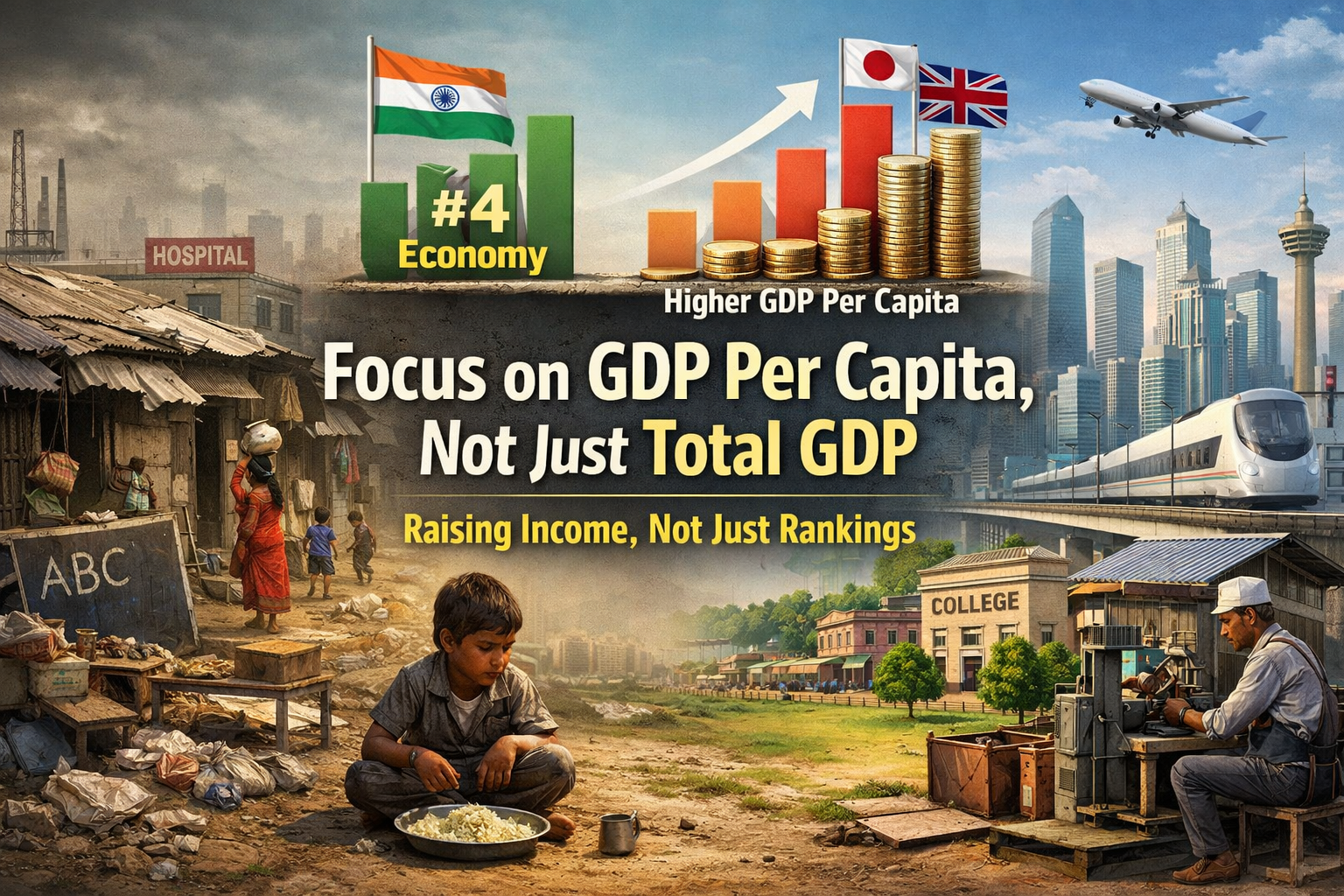






When former chief economist of IMF Geeta Gopinath highlighted India’s rapid rise in global GDP rankings at World Economic Forum in Davos, the applause was predictable—and understandable. India becoming the world’s fourth- or fifth-largest economy is no small achievement. But national self-congratulation based on aggregate size alone is not just premature; it is potentially dangerous. Economic rankings flatter the state, not the citizen. What matters to Indians is not where India stands in a global league table, but how Indians actually live.

India’s GDP arithmetic hides an uncomfortable truth: the country is large because it is populous, not because it is rich. Spread over 1.4 billion people, India’s economic output translates into a GDP per capita of roughly $2,700—nearly fifteen times lower than the UK and more than ten times lower than Japan. This single statistic explains why India does not “feel” like a top-five economy. Roads, hospitals, schools, wages, housing, sanitation, and social security all ultimately depend on income per person, not national totals.
History offers a clear lesson. Japan, South Korea, and later China did not become prosperous societies by chasing rankings; they focused relentlessly on productivity, industrial depth, and human capital. India risks making the opposite mistake—celebrating scale while neglecting substance. A services-heavy growth model, while impressive on paper, has not generated enough high-quality jobs. A large informal workforce, weak manufacturing absorption, and uneven urbanisation keep incomes depressed.
If India wants its economic rise to be meaningful, GDP per capita must become the central policy obsession. That requires a sharp pivot. First, India must massively expand labour-intensive manufacturing—textiles, electronics, food processing, green technologies—at scale, not through isolated schemes. Second, education and skills need urgent repair: fewer unemployable degrees, more vocational training, and serious investment in public universities, research, and teacher quality. Third, health spending must rise decisively. A healthier workforce is not a welfare expense; it is economic infrastructure.
Fourth, planned and sustainable urbanisation must be embraced, not feared. Productive cities drive wages, innovation, and efficiency. India needs affordable housing, mass transit, and empowered city governments to absorb its workforce into higher-productivity employment. Finally, inequality must be tackled—not just for moral reasons, but because concentrated growth limits consumption and social stability.

Geeta Gopinath’s numbers are mathematically correct, but economics is not only mathematics; it is lived reality. India should resist the temptation to confuse national pride with national progress. The true measure of success will not be when India overtakes another economy in size, but when an average Indian’s life begins to resemble that of citizens in advanced economies. Until GDP per capita rises sharply and sustainably, India’s global ranking will remain a statistical triumph—not a civilisational one.