


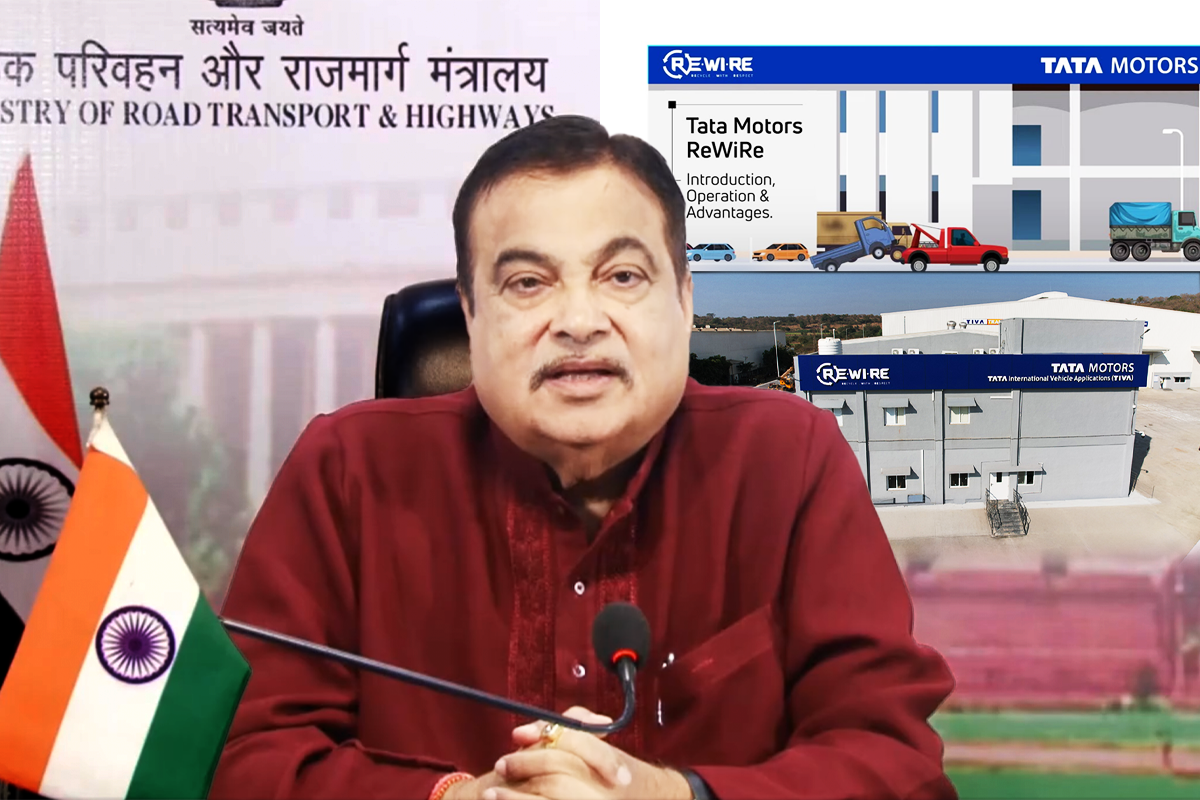






NEW DELHI: Taking a decisive step towards cleaner mobility and a circular economy, Union Minister for Road Transport and Highways Nitin Gadkari on Tuesday inaugurated Tata Motors’ Registered Vehicle Scrapping Facilities (RVSFs) in Raipur and Lucknow. Built under the company’s Re.Wi.Re – Recycle with Respect initiative, these automated centres are designed to dismantle end-of-life vehicles (ELVs) in a safe, eco-friendly, and transparent manner.

The Raipur facility has a capacity of 25,000 vehicles per year, while the Lucknow unit can process 15,000 vehicles annually. Tata Motors now operates 10 scrapping facilities across India, including those in Jaipur, Bhubaneswar, Surat, Chandigarh, Delhi NCR, Pune, Guwahati, and Kolkata.
An additional high-capacity RVSF in Ahmedabad, with the ability to handle 36,000 vehicles per year, is currently in development.
#FLASH: India’s Auto Revolution: “One old truck pollutes as much as 15 new ones,” warns@nitin_gadkari as he inaugurates @TataMotors’ scrapping units in Raipur & Lucknow.
India now has 100+ vehicle scrapping centres; 150 more in pipeline.
₹2,700 Cr investment committed.
— The New Indian (@TheNewIndian_in) June 18, 2025
Gadkari: From Pollution Control to Economic Potential
Speaking at the launch, Gadkari said the number of operational scrapping centres in India has crossed 100, with 150 more in the pipeline across 20 states. He revealed that private players have already committed ₹2,700 crore to develop scrapping and testing infrastructure.
“One old truck pollutes as much as 15 new ones. Scrapping is not just about retiring vehicles—it’s about reducing pollution, improving safety, and unlocking massive economic opportunity,” he said.
Gadkari highlighted that 1.2 lakh private vehicles and 1.3 lakh government vehicles have already been scrapped, leading to the recovery of over 1 lakh tons of scrap steel and a CO₂ reduction of 6,500 kilotons. The policy, he said, is a “perfect example of waste to wealth.”
ALSO READ: Gadkari Launches ₹3,000 FASTag Annual Pass for Private Vehicles
He also stressed that only 2.5 lakh vehicles have been scrapped so far out of over one crore eligible vehicles, adding that the Vahan portal dashboard will help scrapping centres locate and reach owners directly.
“This initiative will generate up to 70 lakh jobs, save fuel, reduce imports, and make components cheaper,” he added, calling on other automakers to follow Tata’s example.
Circular Economy in Motion
Tata’s Re.Wi.Re initiative now forms a critical part of India’s strategy to reduce dependence on imported scrap and rare earth materials. The scrapped vehicles yield reusable steel, copper, aluminium, rubber, plastic, and rare earth elements—key to lowering production costs for new vehicles and strengthening India’s manufacturing base.
India currently imports around 8 million tons of scrap annually. Strengthening domestic scrapping facilities will not only address material shortages but also reduce the carbon footprint of the automotive sector.
Training, Testing, and Future Growth
Gadkari also announced a plan to open 1,500 driving training centres across the country to meet the shortage of skilled drivers. Grants of up to ₹17 crore will be provided, including support for combined fitness testing and scrapping clusters.
“Together, government, industry, and citizens can make India a global leader in sustainable and circular auto economy,” he concluded.