


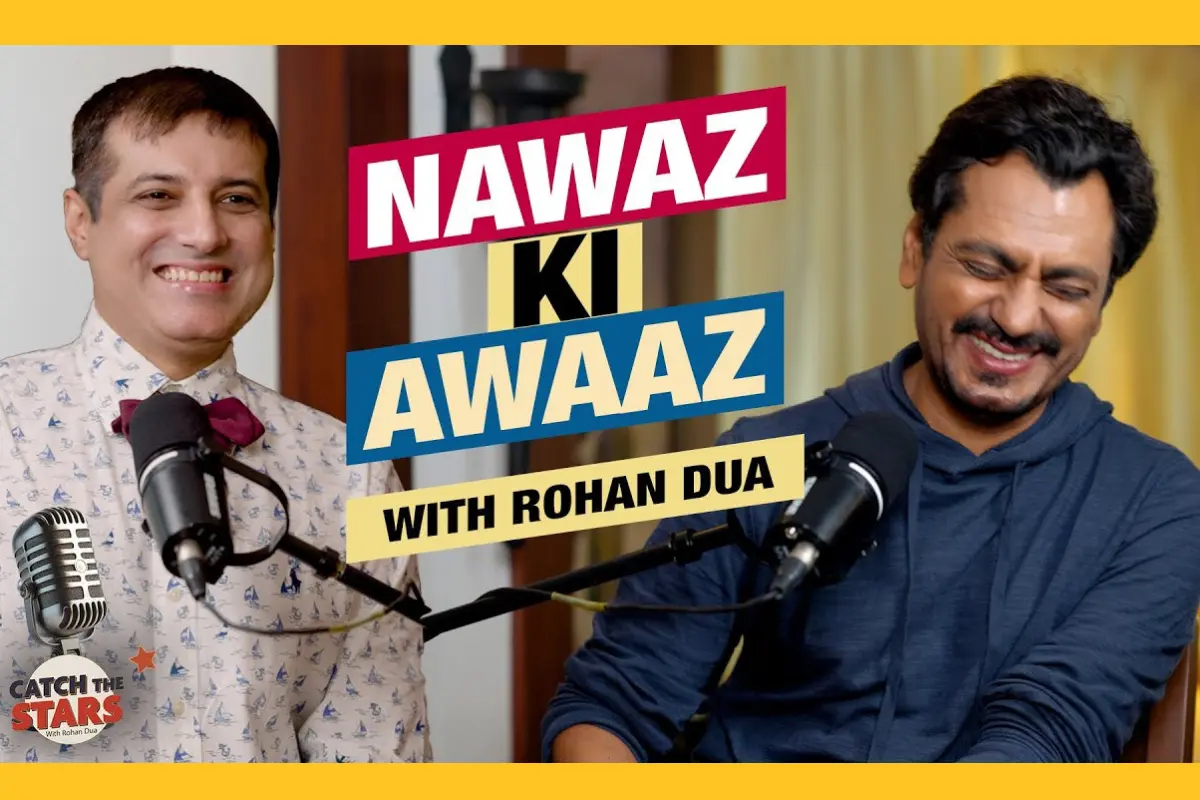






In another unfiltered episode of Catch The Stars with Rohan Dua on The New Indian, Nawazuddin Siddiqui speaks candidly to Rohan Dua about comedy versus intensity, viral slap memes, learning Marathi for cinema, the physical and emotional grind of Haddi, working with Amitabh Bachchan, and why complex characters often come at a heavy personal cost.

Q: How is your comic timing? Both on-screen and in real life?
Nawazuddin Siddiqui:
Earlier it was very good. Now it’s become a little dull. Earlier my comic timing in real life was very sharp.
Now there is a lot of stress—of kids, of the world. Stress dulls comic timing.
Q: People often think you can’t do comedy because of your intense face. Is that a misconception?
Nawazuddin Siddiqui:
Completely wrong. I have played around 100 roles in my life, and out of those, 95 were comedy plays in theatre.
If your face looks intense, people think you can’t do comedy. But comedy has a thousand forms. It’s not necessary that everyone has to do farce or slapstick. Even a straight face can be comedy—timing is everything.
Q: You mentioned Rajpal Yadav. How different was casting logic in theatre compared to films?
Nawazuddin Siddiqui:
Rajpal and I worked together in theatre for five years. We both did comedy and serious roles.
But in films, stock casting happens. Rajpal’s face looked comic, so he got comedy roles. My face looked intense, so I got serious roles. In theatre, these boxes didn’t exist.
Q: When Tiku Weds Sheru released, there was debate about age-gap romance. Did it bother you?
Nawazuddin Siddiqui:
Sir, it’s a character. I didn’t ask anyone to cast me opposite a young girl.
The script demanded that the character is older and wants to get married. Don’t connect characters personally with actors. There are many such films.
Q: You spoke about Thackeray-era language politics. Have you ever learned Marathi?
Nawazuddin Siddiqui:
Yes, I learned Marathi during a film where I performed the same scenes in both Hindi and Marathi.
Of course, it was difficult, but I learned it in the same period. Marathi is a beautiful language. No language should be forced, but all languages deserve respect.
Q: How many languages do you personally speak?
Nawazuddin Siddiqui:
I can speak three to four languages—Urdu, Hindi, and a little English. That’s all.
Q: Let’s talk about Haddi. Transforming into a transgender character looked physically exhausting. How demanding was it?
Nawazuddin Siddiqui:
It took me three hours to put on the makeup and one and a half hours to remove it.
Sometimes I had to play three characters—Harika, Haddi—and removing makeup alone took six hours. It was extremely exhausting.
Q: As a journalist, even Rohan found the flashbacks confusing. Do you agree the narrative had issues?
Nawazuddin Siddiqui:
I agree. Flashback is the weakest device in filmmaking. I personally never want flashbacks in films.
If you want to say something, say it in the present through conversations. Showing flashbacks weakens the film and even the actor doesn’t enjoy it.
Q: Did Haddi change your understanding of the transgender community?
Nawazuddin Siddiqui:
Absolutely. Their determination to feel complete is unbelievable.
I gained a lot of respect for them. They have a very strong support system, and they supported us immensely during the shoot.
Q: The viral “thappad” memes from Ghoom Ket—were those slaps real?
Nawazuddin Siddiqui:
Yes, it happened. Thak, thak, thak, thak.
Q: You worked with Amitabh Bachchan in Teen. What did you learn from him?
Nawazuddin Siddiqui:
Whenever he came on set, he was fully prepared.
I learned that when you come to shoot, you should already know your scenes completely. That level of preparation stayed with me.
Q: People say your house came only after OTT success. Is that true?
Nawazuddin Siddiqui:
No. It had already happened before that.
Q: What is your favourite place in your house today?
Nawazuddin Siddiqui:
There is a balcony upstairs. We sit there in the evening—it feels really good.