


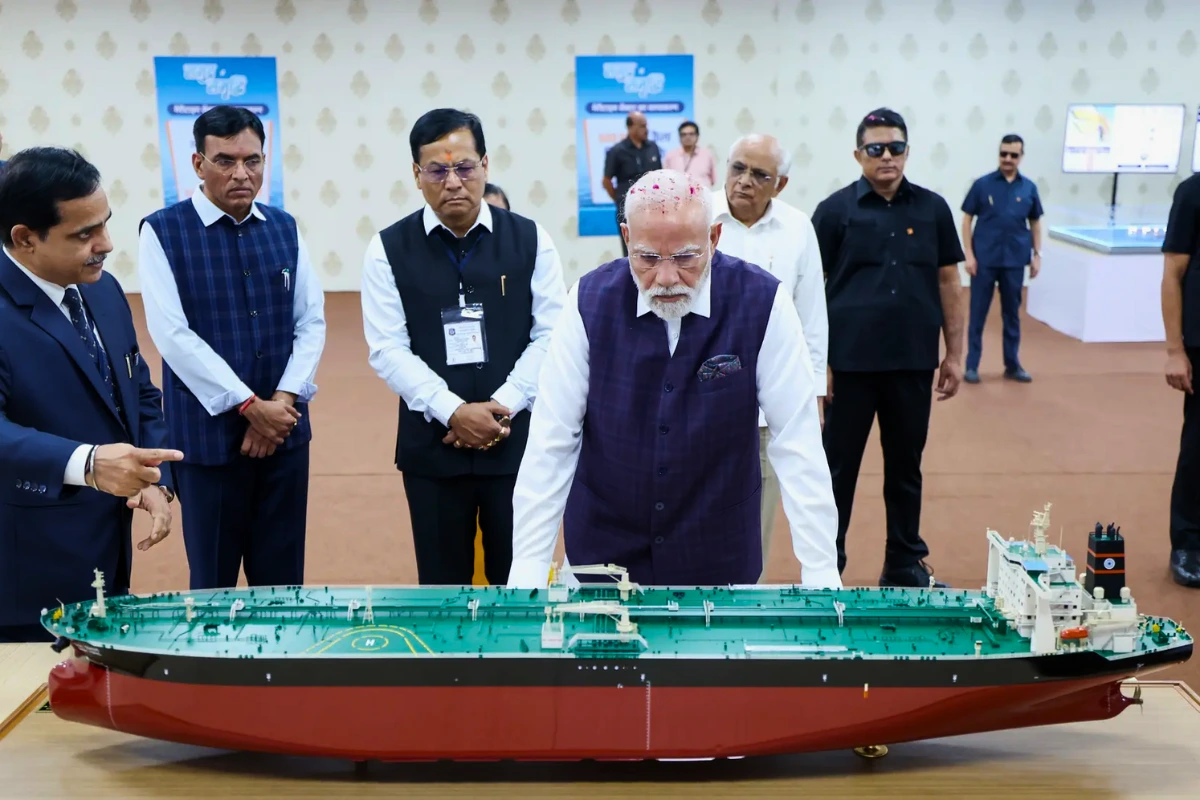






NEW DELHI: A historic milestone in India’s maritime journey was achieved on September 19, 2025, at Bhavnagar, with a high-level MoU Exchange Ceremony held on the eve of the “Samudra Se Samriddhi – Transforming India’s Maritime Sector” event addressed by Prime Minister Narendra Modi.

Twenty-seven Memoranda of Understanding (MoUs) were signed between central and state governments, public and private sector stakeholders, and international partners, collectively representing an investment potential exceeding ₹66,000 crore.
The ceremony was graced by Union Minister of Ports, Shipping and Waterways Sarbananda Sonowal, Union Minister Dr. Mansukh Mandaviya, and Minister of State Shantanu Thakur. The agreements are expected to create over 1.5 lakh direct and indirect jobs, boost ports and manufacturing, and reinforce India’s global maritime share.
Key Port and Infrastructure Developments
A landmark MoU was signed for the development of Bahuda Port, spanning more than 6,700 acres in Odisha, with a proposed capacity of 150 million tonnes per annum and an investment of ₹21,500 crore. This port is expected to catalyse port-led industrialisation, logistics parks, and manufacturing clusters in eastern India, generating around 25,000 employment opportunities.
In Bihar, the Inland Waterways Authority of India partnered with the state government for a ₹908 crore Water Metro Project in Patna, featuring energy-efficient electric ferries, modern terminals, and integration with urban multimodal transport systems across ten terminal points.
Boosting Domestic Shipbuilding and Global Partnerships
Significant steps were taken to expand India’s shipbuilding ecosystem. Cochin Shipyard Limited (CSL) signed a strategic MoU with HD Korea Shipbuilding & Offshore Engineering to construct large commercial vessels using CSL’s 310-metre Dry Dock and a new 80-acre Block Fabrication Facility worth ₹3,700 crore. Mazagon Dock Shipbuilders Limited and CSL also inked MoUs with Tamil Nadu’s guidance bodies to establish state-of-the-art shipbuilding complexes worth ₹15,000 crore, collectively generating tens of thousands of jobs.
The Shipping Corporation of India, along with IOCL, BPCL, and HPCL, signed an MoU to form a Vessel-Owning Joint Venture Company, ensuring long-term charter contracts for Indian-built ships while reducing reliance on foreign fleets.
Further MoUs focused on shipbuilding clusters across Andhra Pradesh, Odisha, Gujarat, Maharashtra, and Tamil Nadu, enabling SPVs with joint central and state investments, land transfer at nominal cost, tax incentives, and policies promoting green and carbon-neutral shipbuilding.
Industrial Collaboration and Financing
The Gujarat Maritime Board signed agreements with private partners to develop shipbuilding, repair, offshore infrastructure, and recycling yards in the Gulf of Kutch and other sites, with total investments exceeding ₹13,600 crore. Garden Reach Shipbuilders & Engineers partnered with Indian and private stakeholders for greenfield facilities and tug development in Gujarat and West Bengal.
Sagarmala Finance Corporation Limited signed MoUs with Neo Fund, NaBFID, IIFCL, and Climate Fund Managers to facilitate innovative financing for green shipbuilding, fleet modernisation, and maritime logistics, bringing together international climate-aligned fund managers and domestic finance institutions.
Heritage and Tourism Initiatives
Highlighting India’s maritime heritage, the Directorate General of Lighthouses and Lightships signed an MoU with Indian Port Rail & Roadways Corporation Ltd. to construct the world’s tallest lighthouse museum (77 metres) at the National Maritime Heritage Complex in Lothal, Gujarat, with an investment of ₹266 crore, promoting tourism alongside heritage conservation.
Ministerial Remarks
“Under the visionary leadership of Prime Minister Modi, India’s maritime sector is undergoing a historic transformation. These MoUs reflect our commitment to a strong, self-reliant, globally recognised maritime ecosystem. With ports, shipbuilding, and sustainable projects advancing rapidly, we are steering India closer to the vision of Viksit Bharat by 2047,” said Sarbananda Sonowal.

Impact
The MoUs collectively aim to strengthen India’s maritime infrastructure, create over 1.5 lakh jobs, enhance domestic manufacturing, expand shipbuilding capacity, and elevate India’s standing in global maritime trade. With a total investment of over ₹66,000 crore, these initiatives underline India’s commitment to Atmanirbhar Bharat in the maritime sector while fostering sustainable, innovative, and heritage-linked growth.