


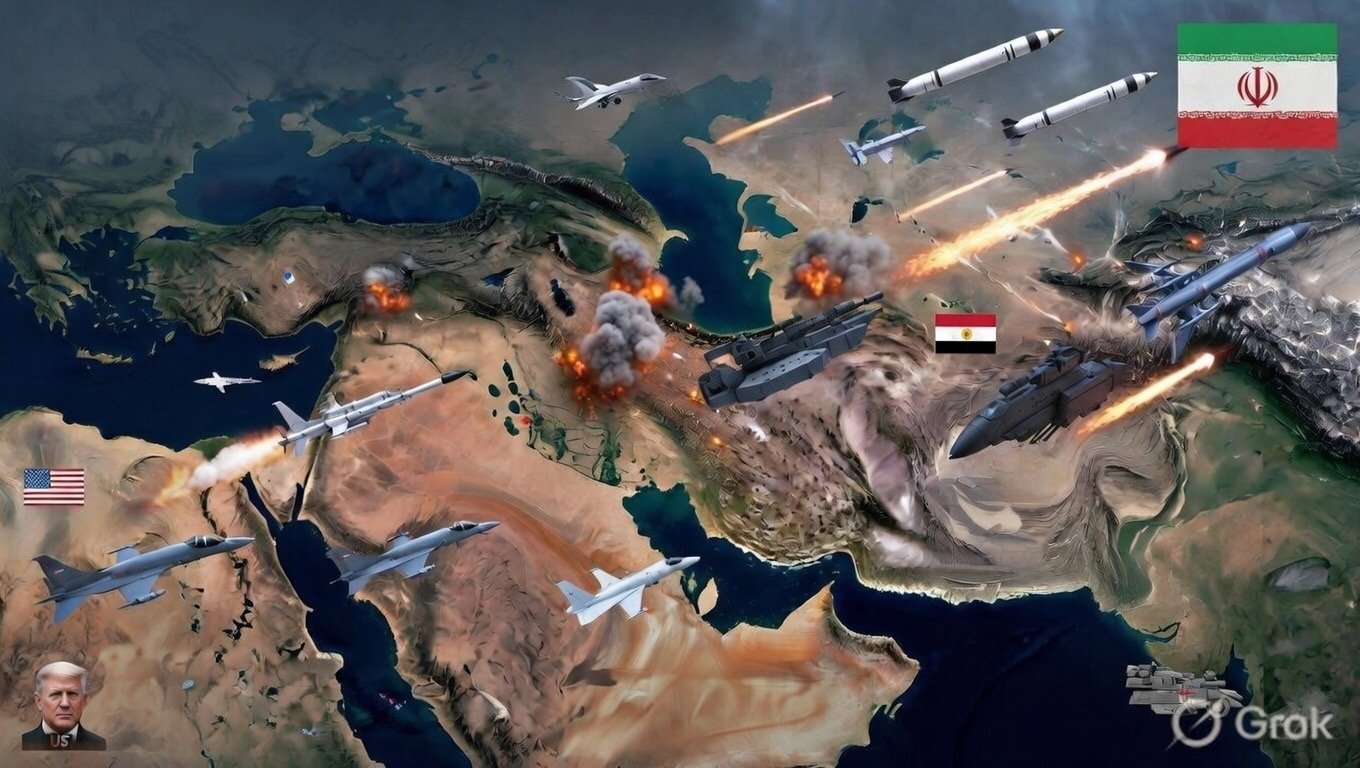






New Delhi: Iran’s Supreme Leader Ayatollah Ali Khamenei and several top officials were killed in precision airstrikes launched jointly by the United States and Israel on Saturday, triggering widespread mourning and protests in Tehran.

Iranian state media, including Press TV and the Islamic Republic News Agency (IRNA), announced Khamenei’s death early today, declaring a 40-day period of national mourning and stating he was killed at his Tehran compound during the February 28 assaults. A tearful anchor on Iranian state television confirmed the 86-year-old leader’s martyrdom, noting he was with senior advisors at the time.
US President Donald Trump confirmed the fatalities in a Truth Social post, stating Khamenei “is dead” and that “most” of Iran’s senior leadership had been eliminated. The campaign, named “Epic Fury,” targets Iran’s nuclear facilities, ballistic missile programs, naval assets, and command structures to prevent nuclear weapon development and promote regime change.
The strikes began on Saturday with coordinated U.S. and Israeli airstrikes on key Iranian sites. U.S. forces focused on ballistic missile capabilities and nuclear programs, including the Natanz and Fordow enrichment facilities, which were previously damaged in a 2025 conflict. Satellite imagery showed extensive destruction at these underground sites, with secondary explosions indicating hits on stored centrifuges and uranium stockpiles. Israel targeted leadership compounds and military airfields, with reports of over 25 waves of attacks. The operation involved hundreds of aircraft, including F-35 stealth fighters, and cruise missiles launched from U.S. warships in the Persian Gulf.
In a video address, Trump described the operation as “massive and ongoing” to “defend the American people by eliminating imminent threats from the Iranian regime, a vicious group of very hard, terrible people.” He added that the bombing would “continue, uninterrupted throughout the week or, as long as necessary to achieve our objective of PEACE THROUGHOUT THE MIDDLE EAST AND, INDEED, THE WORLD!” Directly appealing to Iranians, Trump said the country “will be yours to take. This will be probably your only chance for generations.”
Israeli Prime Minister Benjamin Netanyahu portrayed the strikes as a necessary defense against longstanding threats, stating, “For 47 years, the Ayatollahs’ regime has chanted ‘Death to Israel,’ ‘Death to America.’ It has spilled our blood, murdered many Americans, and massacred its own people.” He emphasized that the regime “must not be allowed to arm itself with nuclear weapons that would enable it to threaten all of humanity.”
Iran responded swiftly with retaliatory strikes under “Operation Truthful Promise 4,” launching ballistic missiles and drones at Israel and U.S. bases in Bahrain, Qatar, UAE, Kuwait, Jordan, and Saudi Arabia. Explosions were reported at the U.S. Navy’s 5th Fleet headquarters in Manama and Al Udeid Air Base in Qatar.
Casualties mounted rapidly. Iranian state media, citing the Red Crescent, reported at least 201 killed and over 700 injured, including 57 at a girls’ school in southern Iran. Trump warned of potential U.S. losses, stating, “The lives of courageous American heroes may be lost, and we may have casualties. That often happens in war.”
The Strait of Hormuz emerged as a flashpoint. Iran announced its closure, blocking a waterway through which 20-25% of global seaborne oil trade passes—about 20 million barrels daily, valued at $500-600 billion annually. This narrow chokepoint, 21 miles wide at its narrowest, is vital for oil from Saudi Arabia, Iraq, and others, and its disruption could spike prices to $90 per barrel or higher. Brent crude surged from $69 to $74 per barrel amid fears, with potential for further rises if mining or naval clashes occur. Airspace closures in multiple countries disrupted flights, stranding passengers and causing economic ripple effects.
Iran’s Foreign Ministry denounced the attacks as a “gross violation of Iran’s territorial integrity and national sovereignty,” noting they struck defense and civilian infrastructure during diplomatic talks. Officials declared, “The armed forces of the Islamic Republic of Iran will respond to the aggressors with authority.” They asserted, “History testifies that Iranians have never surrendered to foreign aggression and hegemony; this time too, the response of the Iranian nation will be decisive and determining and will make the aggressors regret their criminal act.” Foreign Minister Abbas Araghchi labeled the war “wholly unprovoked, illegal, and illegitimate,” adding, “Our Powerful Armed Forces are prepared for this day and will teach the aggressors the lesson they deserve.”
Global responses highlighted divisions. French President Emmanuel Macron stated, “The outbreak of war among the United States, Israel and Iran has serious consequences for peace and international security.” Russia’s Foreign Ministry called the strikes a “pre-planned and unprovoked act of armed aggression against a sovereign and independent U.N. member state.” China’s Foreign Ministry voiced concern, saying, “Iran’s sovereignty, security and territorial integrity should be respected,” and urged an immediate cessation of hostilities. A joint communique from Britain, France, and Germany condemned Iran’s regional actions, stating, “Iran must refrain from indiscriminate military strikes.”
The conflict risks a prolonged war, with uncertain outcomes for regional stability.