


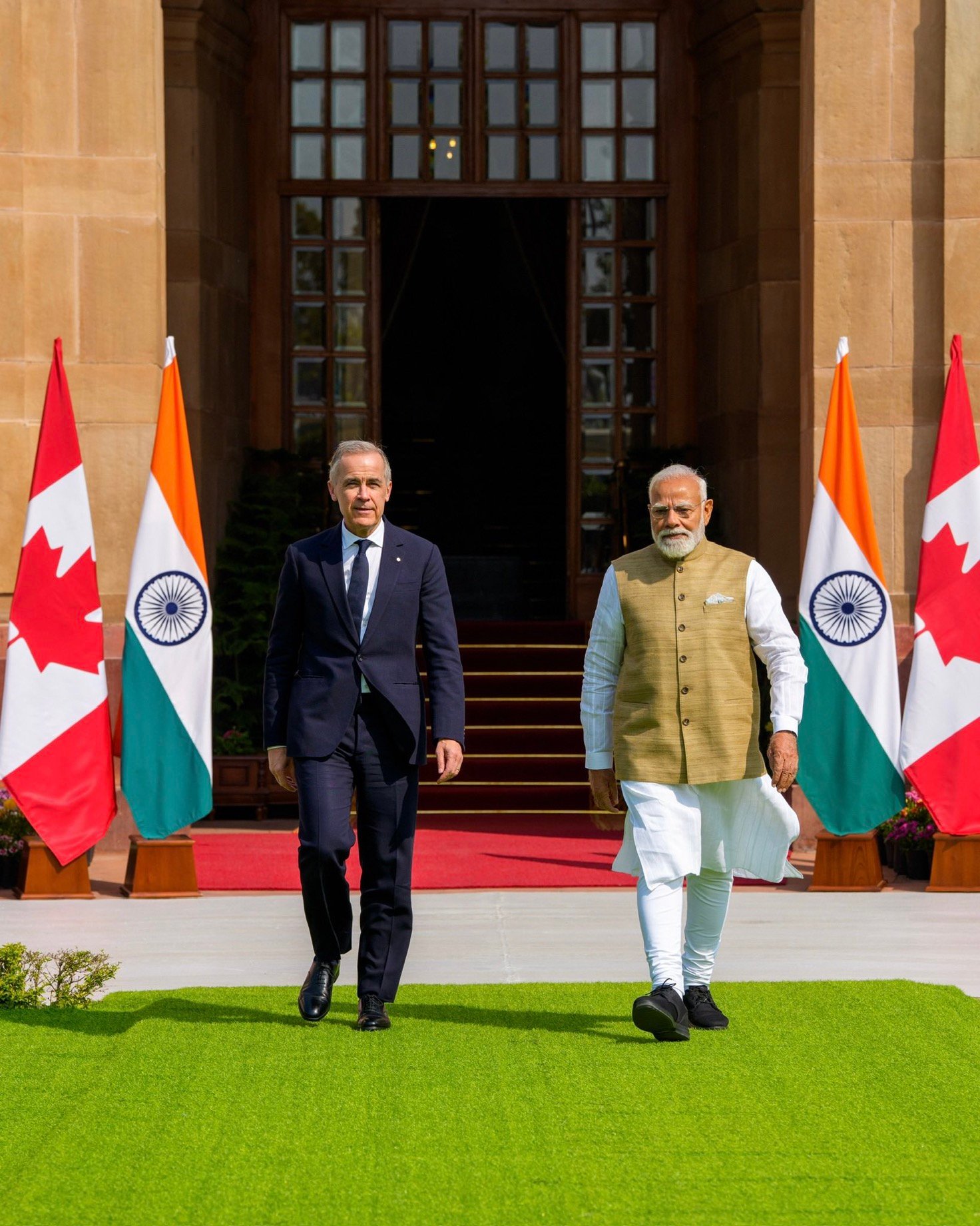






New Delhi: India and Canada took a significant step toward resetting bilateral ties Monday as Prime Minister Narendra Modi and Canadian Prime Minister Mark Carney concluded the first state visit by an Ottawa leader in eight years, agreeing to expand economic cooperation, launch trade negotiations and seal a long-term uranium supply deal.

Carney, who was in India from Feb. 27 to March 2, met Modi at Hyderabad House in New Delhi on March 2 for talks focused on strengthening economic, energy and strategic links between the two Commonwealth democracies.
In a joint press statement released by India’s Ministry of External Affairs (MEA), both leaders reaffirmed shared democratic values, deep people-to-people ties and a mutual commitment to expanding cooperation in trade, technology, energy, security and climate action.
At a joint press statement after the meeting, Modi described the outcome as laying a foundation for a “next-level partnership” and said the two sides had agreed to accelerate negotiations on a Comprehensive Economic Partnership Agreement (CEPA), with the goal of concluding it by the end of 2026.
“Our objective is to expand bilateral trade to USD 50 billion by 2030. Unlocking the full potential of our economic cooperation remains a priority,” Modi said.
The leaders also signed Terms of Reference (ToR) for CEPA negotiations, providing a roadmap and structure for talks aimed at covering goods, services, investment, digital trade and mobility, according to the MEA and Commerce Ministry releases.
In addition to the trade agenda, Modi and Carney witnessed the signing of a long-term nuclear fuel supply agreement under which Canadian firms will provide uranium to India’s civil nuclear programme. Officials said the arrangement will see the supply of millions of pounds of uranium concentrate over the next decade to support India’s expanding nuclear energy fleet and clean energy goals.
Modi, in his press remarks, emphasised that expanding cooperation in energy, critical minerals and sustainability would create “new investment and employment opportunities in both countries.”
Carney described the visit as more than a “renewal of a relationship,” but as an expansion of a valued partnership with new ambition, focus and foresight. The Canadian prime minister underscored the goals of increased trade and mutual cooperation, noting shared interests in diversified economic engagement.
The India-Canada Joint Leaders’ Statement, made public by the MEA, said the two sides would also deepen cooperation on clean energy transitions, climate resilience, health and public-private partnerships, while affirming joint efforts in multilateral fora to address global challenges including public health and climate change.
At the press event, Modi also noted Canada’s intention to join India-led initiatives such as the International Solar Alliance and the Global Biofuel Alliance, steps seen as aligning energy and climate priorities between the two nations.
While the visit did not produce a fully concluded free trade agreement, India’s foreign ministry highlighted that the CEPA ToR signing and the uranium deal have set a clear roadmap toward a comprehensive pact. Ministry officials said in a briefing that negotiations will intensify over the coming months and that both sides are committed to reaching a balanced and ambitious concluding agreement before year-end.
The MEA also noted cooperation in education, innovation, technology and defence dialogue mechanisms as part of the broader framework agreed upon during Carney’s visit.
Modi and Carney met with corporate and investment leaders from both countries at the India-Canada CEO Forum, reinforcing private sector engagement as a pillar of the renewed partnership.

The visits and agreements mark a marked improvement in bilateral ties after years of strained relations, signalling a pragmatic reset and a move toward multifaceted cooperation.