








NEW DELHI/AHMEDABAD: In its preliminary investigation report on the fatal Air India AIA 171 Gatwick-bound that crashed on June 12, India’s Aircraft Accident Investigation Bureau (AAIB) has pointed out at the fuel cut-off in both engines of Boeing 787-8 as the reason for the tragic descent, ruling out any pilot error in the incident that left 242 people dead in Ahmedabad.

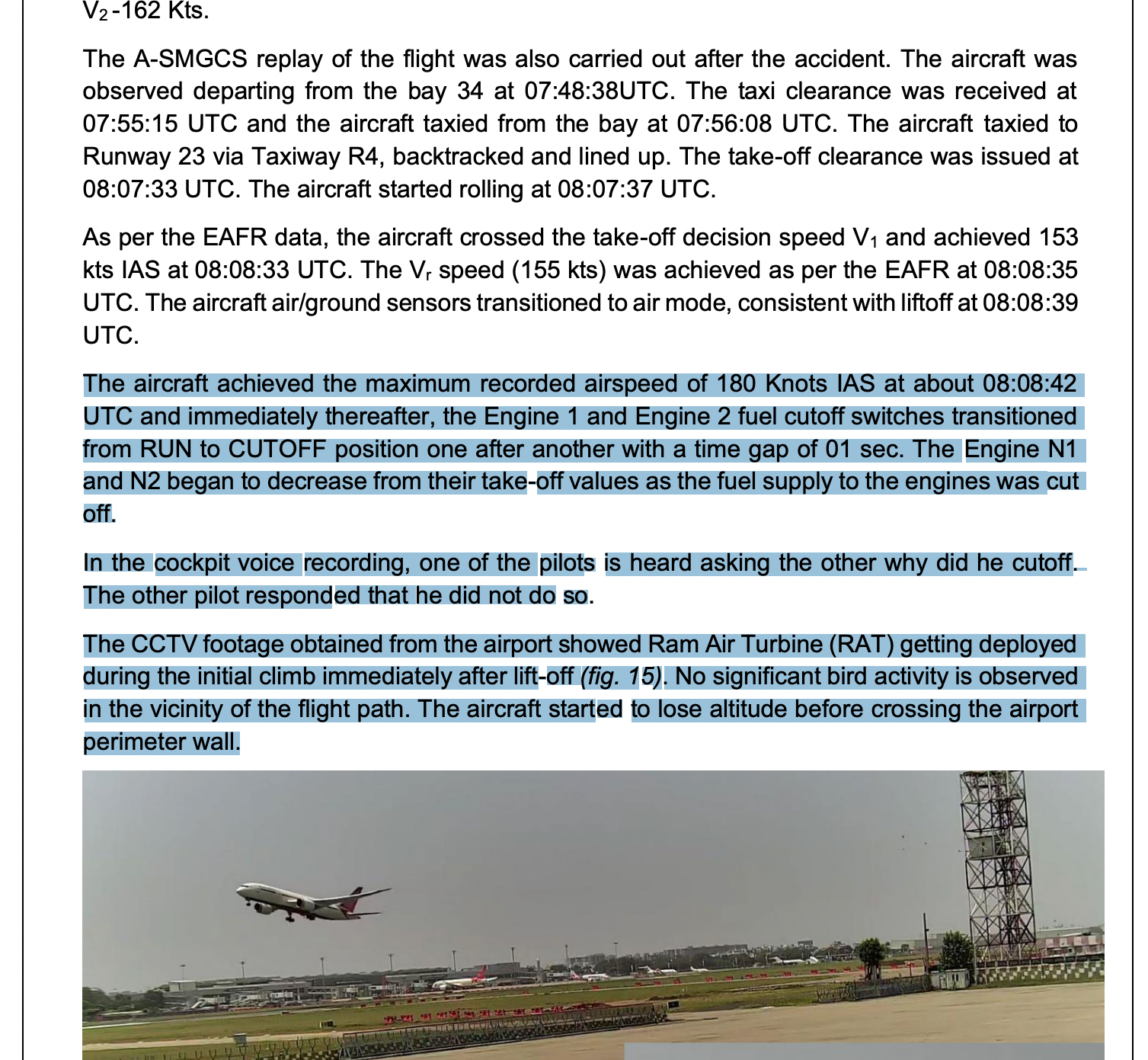
“The aircraft achieved the maximum recorded airspeed of 180 Knots IAS at about 08:08:42 UTC and immediately thereafter, the Engine 1 and Engine 2 fuel cutoff switches transitioned from RUN to CUTOFF position one after another with a time gap of 1 sec,” the AAIB report, a copy of which is with The New Indian, has said.
The report was released 30 days after the eventful tragedy struck the flight that was ferrying ex Gujarat CM Vijay Rupani along with citizens from India, UK, Portugal and Canada.
The report also said that both engines N1 and N2 began to decrease from their take-off values as the fuel supply to the engines was cut off.
A cockpit voice recording has further confirmed that “one of the pilots is heard asking the other why did he cutoff and the other pilot responded that he did not do so“, raising questions on how the fuel cut-off happen in the first place.
The report has further said that had been no defect reported pertaining to the fuel control switch since 2023 on this aircraft, even though Federal Aviation Administration (FAA) in 2018 in its, Special Airworthiness Information Bulletin (SAIB) on December 17 that year, had alerted all countries on potential disengagement of the fuel control switch locking feature.
This further raises doubt on how and why the switches malfunctioned in both engines of AI 171 on that fateful day.
“The fuel control switch design, including the locking feature, is similar on various Boeing airplane models including part number 4TL837-3D which is fitted in B787-8 AIA 171 aircraft . As per the information from Air India, the suggested inspections were not carried out as the SAIB was advisory and not mandatory. The scrutiny of maintenance records revealed that the throttle control module was replaced on this aircraft in 2019 and 2023. However, the reason for the replacement was not linked to the fuel control switch,” the report has said.
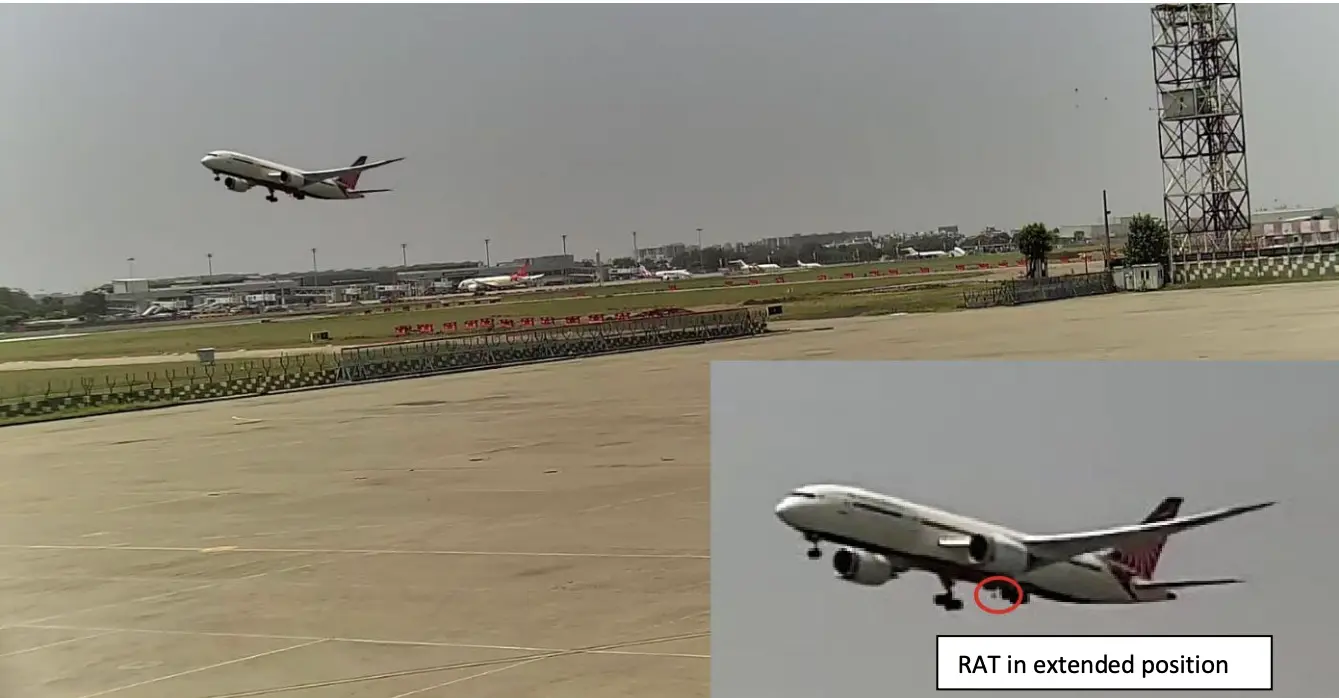
The report has said that the CCTV footage obtained from the airport showed Ram Air Turbine (RAT) was deployed during the initial climb immediately after lift-off. RAT is used to provide the hydraulic lift off.
The report has also ruled out any significant bird activity is observed in the vicinity of the flight path.
The left hand engine was installed on May 1, 2025 and the right Engine was installed on the aircraft on Mar 26, 2025.
The report has said that the last major line maintenance check as per the Aircraft Maintenance Program was complete and the next major check (D Check) was due on the aircraft in Dec 2025.
The report, however, is alarming on another counts, saying that aircraft by operated by Air India, had four CAT ‘C’ Minimum Equipment List (MEL) items.
This includes: flight deck door visual surveillance, airport map function, core network and FD printer.
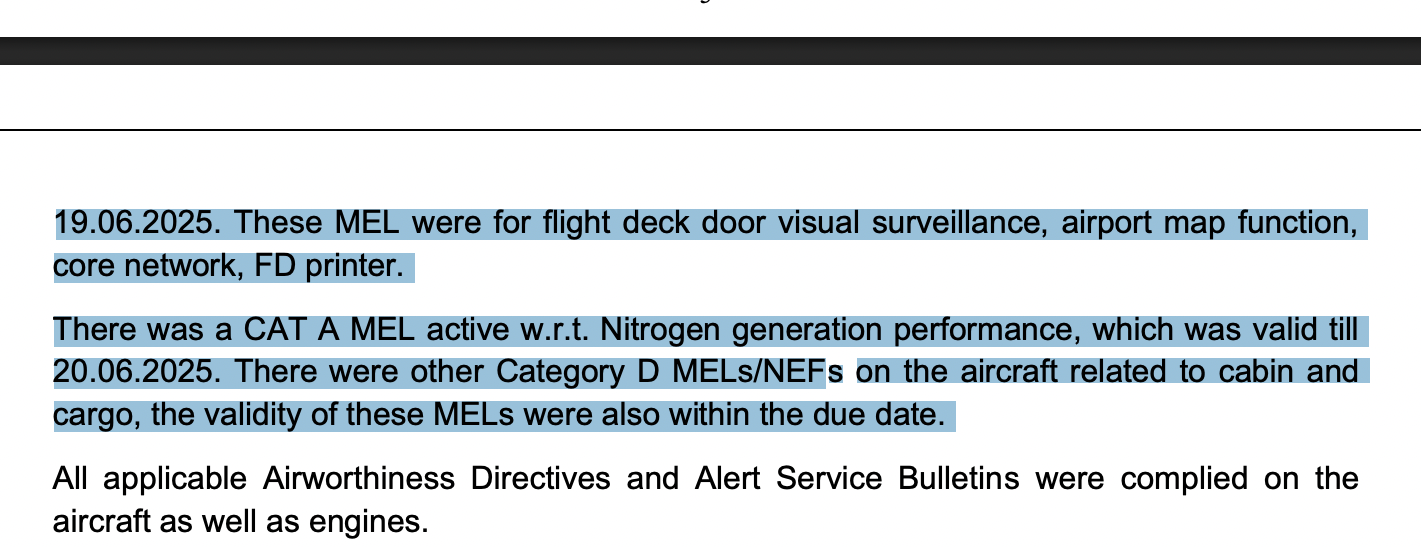
A Minimum Equipment List (MEL) outlines which aircraft equipment can be inoperative for a flight while still maintaining airworthiness, under specific conditions.
CAT C refers to a category within the MEL that defines a specific timeframe for repairing or rectifying inoperative items. Specifically, CAT C items must be repaired within 10 consecutive calendar days.
The report is mum if Air India or DGCA took the right call in flying this aircraft despite four MEL Items.
Earlier, several messages by The New Indian to Air India Wilson Cambpell, its communications Partha Ghosh and chief technical officer S K Dash have yielded little or no response.
A team comprising of representatives from Boeing, GE and FAA arrived at Ahmedabad on June 15 and participated in the investigation.
A team of officials from AAIB, UKhad also arrived at Ahmedabad and visited the site with AAIB DG.
AAIB said that complete analysis of postmortem reports of the crew and the passengers is being undertaken to corroborate aeromedical findings with the engineering appreciation, thereby not ruling not the possibility of a sabotage.
“Additional details are being gathered based on the initial leads. At this stage of investigation, there are no recommended actions to B787-8 and/or GE GEnx-1B engine operators and manufacturers,” the report has said.
The New Indian had earlier reported that ground-handling Turkish company Celebi’s staff that was absorbed by other operators is also separately under lens.