


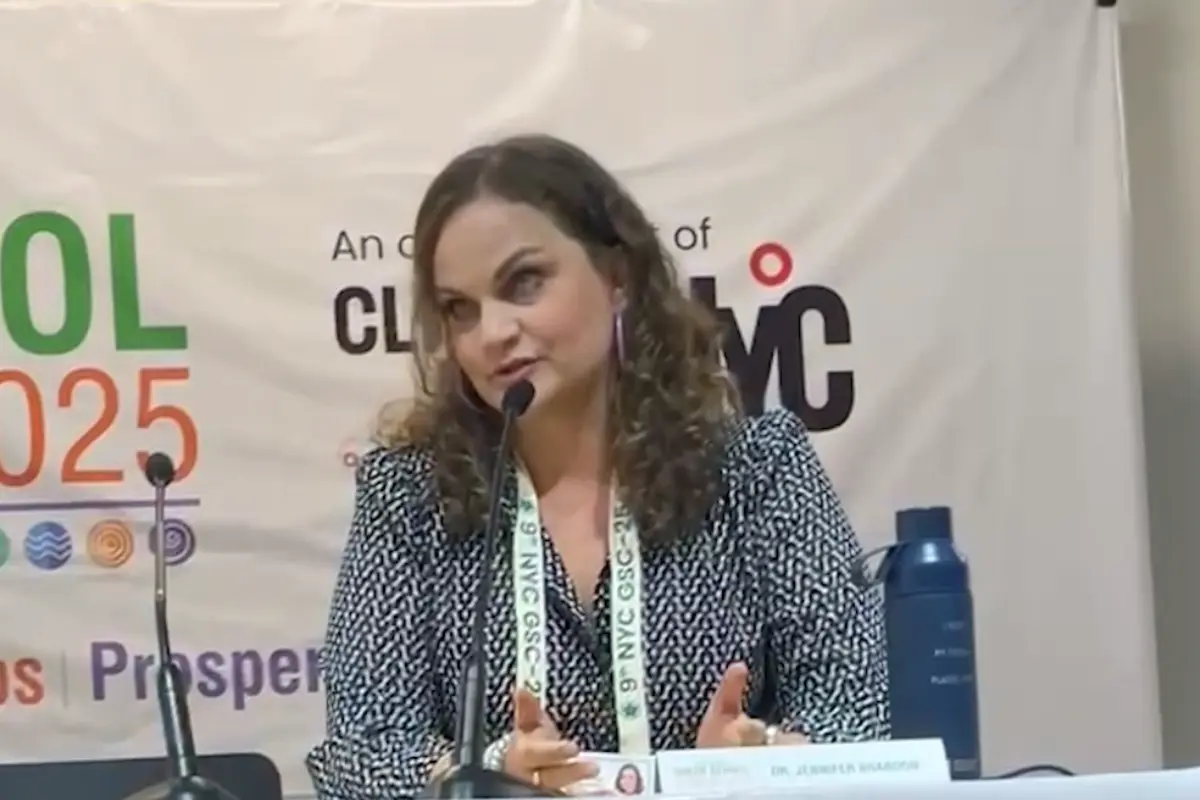






MANHATTAN (NEW YORK): At the 9th NYC Green School Conference, California-based sustainability consultant and microplastics scientist Dr. Jennifer Brandon urged educators to embrace creativity and communication in climate education, sharing her unique journey as one of the few scientists to hold a postdoctoral fellowship in science communication.

“I ended up doing my postdoc at the University of California, San Diego,” Dr. Brandon recalled.
“Across the 11 campuses of the University of California, there is only one postdoc like the one I did, which is in science communication. The reason we’re able to do it at UC San Diego is that we have our own aquarium—it’s called Birch Aquarium at Scripps. And across the 11 campuses, there are actually only two places that are open science communication centers—Birch Aquarium and the Planetarium at UC Berkeley. Besides that, the rest of the campuses are basically private research.”
Dr. Brandon was a key panelist in the session “Math to Music – The Art and Science of Greening the Curriculum,” which explored how subjects from mathematics to the arts can serve as channels for sustainability education.
Together with fellow panelists Dr. Jai Asundi (CSTEP, India), Viraf Mehta (The Browning School, New York), and Dr. Alexandra Okada (The Open University, UK), she stressed that bridging scientific accuracy with artistic expression can deepen student understanding of ecological interdependence.
“This session reminds us that sustainability isn’t confined to science classrooms,” Dr. Brandon said. “When we bring imagination, inclusivity, and emotional intelligence into teaching, we cultivate not just knowledge but green mindsets. That’s how we empower students to see themselves as part of the planet’s ecosystems.”
The interdisciplinary dialogue was part of a broader call at the conference to redesign education systems for planetary survival. Leaders emphasized that sustainability must be embedded into governance, curricula, and culture across all levels of learning.

The Math to Music panel stood out for its insistence on blending indigenous wisdom, STEAM approaches, and creativity to inspire climate-conscious learning. It encouraged educators to reimagine curricula as vibrant ecosystems—where every lesson, whether in algebra or the arts, contributes to cultivating the next generation of green thinkers.