


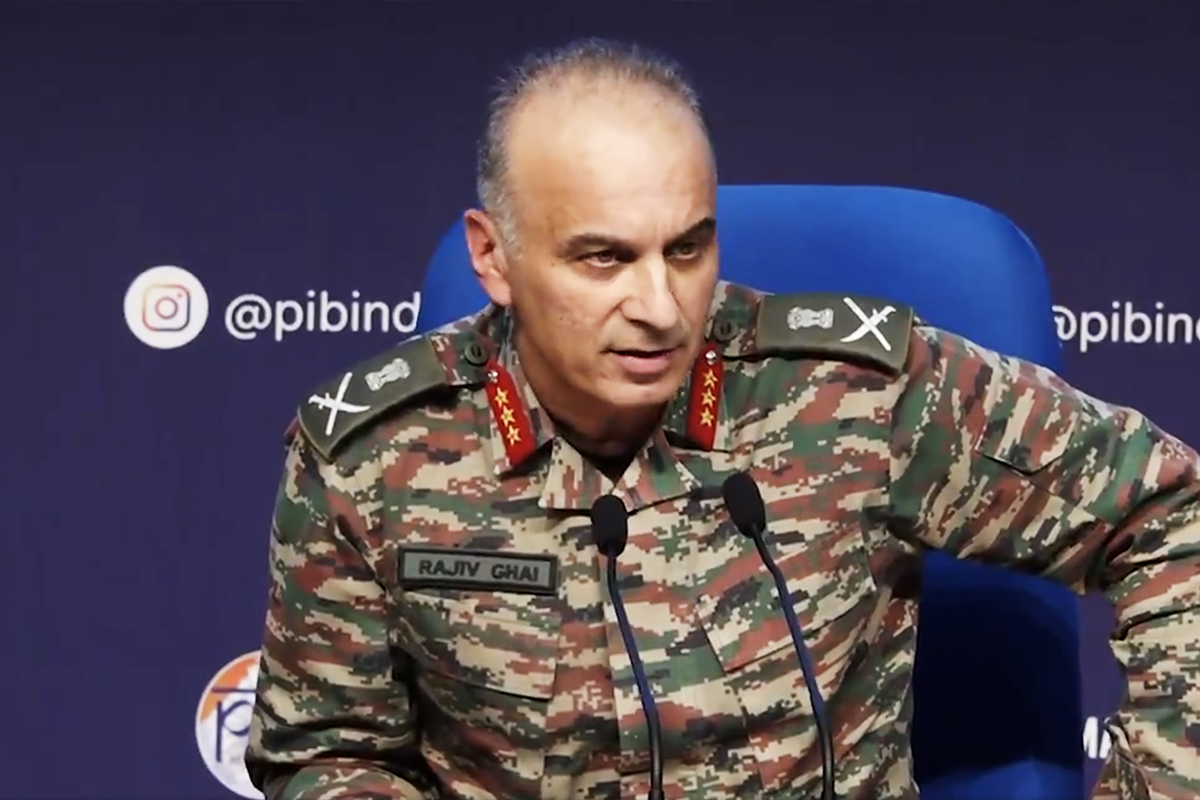






NEW DELHI: In a high-level press briefing, India’s Director General of Military Operations (DGMO), Lieutenant General Rajiv Ghai, detailed the success of Operation Sindoor, which targeted nine terror camps across Pakistan and Pakistan-occupied Jammu and Kashmir (PoJK). The operation comes after the brutal killing of 26 innocent civilians in Pahalgam on April 22, 2025, orchestrated by Pakistan-based terrorists.

Lieutenant General Rajiv Ghai’s Statement:
“You are all by now familiar with the brutality and the dastardly manner in which 26 innocent lives were prematurely terminated at Pahalgam on 22nd April. When you combine those horrific scenes and the pain of families that the nation witnessed with numerous other recent terrorist strikes on our armed forces and defenceless civilians, we knew the time had arrived to make yet another statement of our resolve as a nation.”
ALSO READ: Press Briefing: DGMO Rajiv Ghai: 100+ Terrorists Killed in OP Sindoor
Operational Strategy and Precision:
The operation was meticulously planned to neutralize terrorist infrastructure and deliver a strong message to Pakistan. The targets included major terror hubs, some in PoJK and others in Pakistan’s Punjab province. These included notorious training camps known for breeding terror, like those in Muridke, home to infamous terrorists like Ajmal Kasab and David Headley.
“We undertook a very diligent and microscopic scarring of the terror landscape across the borders… There were nine camps confirmed by various intelligence agencies, inhabited by terrorists, some of whom were responsible for past terror attacks like the Pulwama blast and the hijack of IC814,” said Lt. Gen. Ghai.
Impact of Operation Sindoor:
The strikes resulted in over 100 terrorists killed, including high-value targets like Yusuf Azhar, Abdul Malik Rauf, and Mudasir Ahmed. The precision of Indian forces, aided by the Indian Air Force (IAF) and Navy, showcased their capability to conduct operations with minimal collateral damage.
“The Indian Air Force played a major part in these strikes by engaging some of these camps. The Indian Navy provided precision munitions, ensuring that we could neutralize these camps effectively,” Lt. Gen. Ghai added.
Pakistan’s Response and Violations:
Pakistan’s response was swift, with airspace violations and drone intrusions from May 8 onwards. Pakistan launched multiple attempts to target Indian military infrastructure, which were promptly countered by Indian air defence systems. The violations escalated, leading to significant casualties on the Pakistani side, with reports of 35 to 40 soldiers lost between May 7 and 10.
Counteraction and Continued Tensions:
Despite a ceasefire agreement between India and Pakistan, violations by Pakistan continued.
“Disappointingly, and must I add expectedly, it took only a couple of hours for Pakistan’s army to violate these arrangements by cross-border and LoC firing,” Lt. Gen. Ghai said. “These violations were responded to robustly, and we have sent another hotline message highlighting these violations and our intent to respond fiercely if repeated.”
The Navy’s Role:
Vice Admiral AN Pramod outlined the critical role played by the Indian Navy, maintaining maritime domain awareness and ensuring readiness for offensive action if necessary.
“Our forces remained forward deployed in the Northern Arabian Sea in a decisive and deterrent posture with full readiness and capacity to strike at sea and land targets at a time of our choosing,” he remarked.
Air Marshal AK Bharti on Drone Attacks:
On the night of May 8, Pakistan initiated a series of drone attacks, targeting Indian airfields.
“Our air defence systems, including legacy systems like Pechora, neutralized these attacks effectively. There was no damage on the ground or to any of the intended targets,” said Air Marshal AK Bharti.
India’s Preparedness and Resolve:
As the situation continues to evolve, India’s military forces remain vigilant. The DGMO confirmed that the Chief of Army Staff has granted full authority to Indian commanders for counteraction if Pakistan persists in violating agreements.
“Our response has been measured, proportionate, non-escalatory, and responsible from day one,” Vice Admiral Pramod emphasized.

The coordinated efforts across air, land, and sea domains underline India’s commitment to safeguarding its borders and dealing decisively with terrorism.
