








New Delhi: As the new year dawns, Delhi residents are once again grappling with hazardous air quality, with the city’s Air Quality Index (AQI) plunging into the ‘very poor’ category.

According to real-time data from the Central Pollution Control Board (CPCB), the overall AQI stood at 311 this morning, blanketing the capital in a thick layer of smog and dense fog. Visibility dropped to near-zero in several areas, disrupting traffic and daily life, while temperatures hovered around 10°C amid a persisting cold wave.
Other monitoring stations reported even higher readings, with some areas like Anand Vihar touching 386, edging close to ‘severe’ levels. Health experts warn that prolonged exposure to such pollution can exacerbate respiratory issues, heart conditions, and eye irritation, particularly among children and the elderly.
This toxic air is no anomaly but a grim annual ritual that has plagued Delhi’s winters for over two decades. Historical data reveals that winter months (October to February) consistently see AQI spikes due to a deadly cocktail of factors: stubble burning in neighboring states, vehicular emissions, industrial pollutants, construction dust, and biomass burning for heating.
From 2000 to 2022, winter PM2.5 concentrations— the fine particulate matter most harmful to lungs—have averaged 20-60% higher than annual figures, often exceeding 200 μg/m³ in peak months like November and December. For instance, in January 2007, PM2.5 hit 253 μg/m³, while December 2011 recorded 277 μg/m³, far surpassing the World Health Organization’s safe limit of 5 μg/m³ annual average. 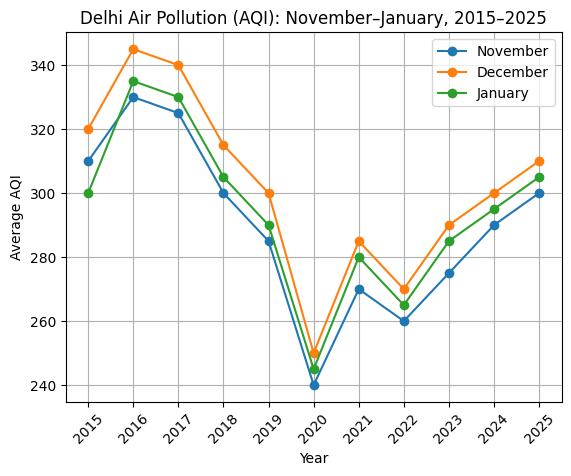
Over the years, annual average AQI has hovered around 200-225, with winters pushing it into ‘poor’ to ‘severe’ territories. In 2018, the daily average AQI was 225, improving slightly to 204 by 2023, yet winters remain unrelenting. Data from 2017-2024 shows an average AQI of about 210, dominated by moderate days outside winter but deteriorating sharply post-monsoon.
Even during the 2020 COVID-19 lockdowns, when annual PM2.5 dipped to 93 μg/m³, winter levels rebounded to 190-199 μg/m³ in November-December. Recent years show marginal gains—2022’s October-November PM2.5 averaged 142 μg/m³, 38% lower than 2016’s peak—but the trend persists, with 2024’s December AQI at 294.
Government measures like the Graded Response Action Plan (GRAP), odd-even vehicle schemes, and bans on firecrackers have offered temporary relief, but experts argue for regional solutions to curb farm fires and emissions from Punjab and Haryana, which contribute up to 40% of Delhi’s winter pollution. As Delhi’s population swells beyond 20 million, the cycle of toxic winters underscores an urgent need for sustainable policies. Without bolder action, the capital’s air may remain a perennial health crisis.