


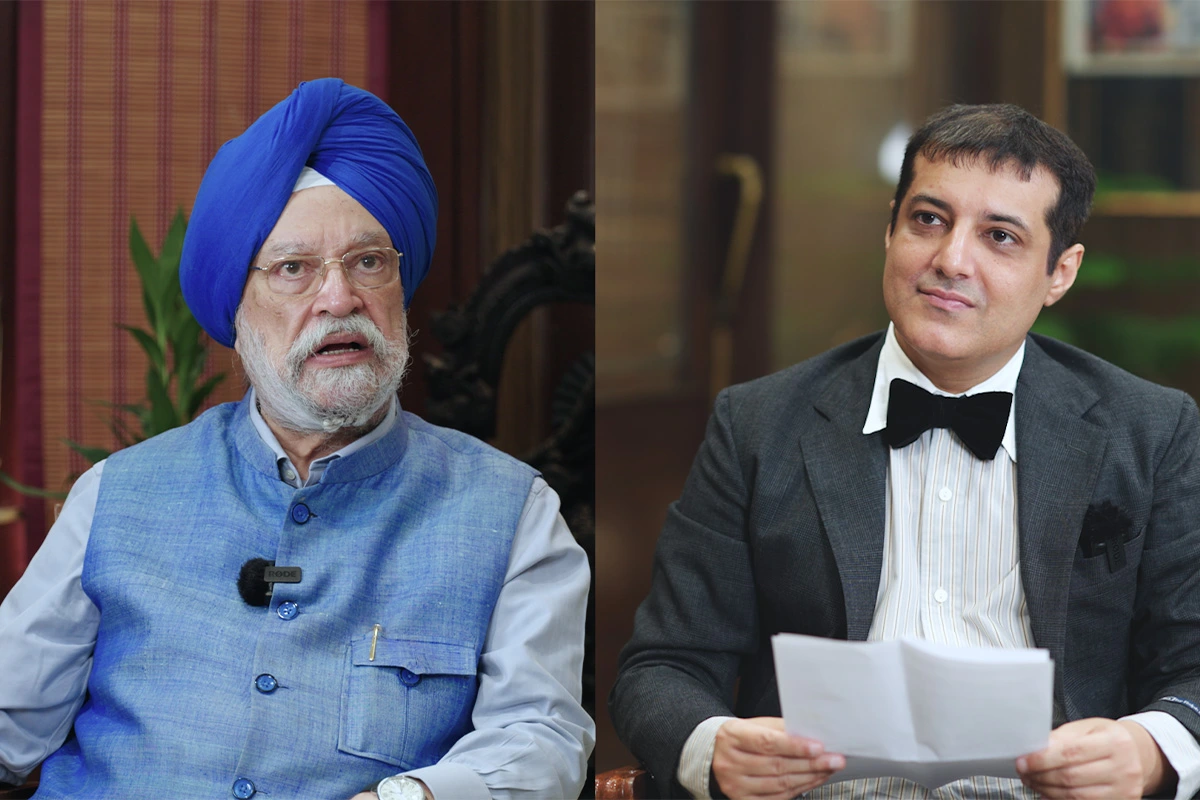






NEW DELHI: Union Petroleum and Natural Gas Minister Hardeep Singh Puri has revealed that India’s public sector oil marketing companies (OMCs) have faced massive cumulative losses exceeding ₹40,000 crore, even as the government kept domestic LPG cylinder prices in check to safeguard ordinary households from the shocks of the global energy crisis.

In an exclusive interview with The New Indian’s Executive Editor Rohan Dua, Puri broke down the complexities of fuel pricing, tracing how LPG cylinder prices—once above ₹1,000—have now come down to around ₹800, despite ongoing international volatility.
“LPG or a gas cylinder is a product refined from crude oil. Crude prices go up and down internationally. Luckily, they’re low right now. But just last year, our oil marketing companies incurred losses of ₹28,000 crore. Earlier, we had to pay them ₹22,000 crore to cover under-recoveries. This year again, they’ve lost ₹40,000 crore,” the minister said during his wide-ranging conversation with Rohan Dua.
WATCH: India Hits Jackpot| Guyana Like Oil Discovery In Andaman: Hardeep Puri| 500 Wells| Highest In 37 Yrs
Why Prices Fluctuate: A Global Matrix
Puri countered the public perception that fuel and LPG prices should instantly fall with global crude price dips. He said such demands oversimplify the real cost structures behind petroleum products.
“It’s not that simple. Apart from crude, you add freight, insurance, dollar exchange rate, the refining margin, dealer margin… Only then do you arrive at the final price for petrol or an LPG cylinder,” he explained.
The minister pointed to Saudi Contract Price (CP) as another major global factor impacting LPG costs. Elevated CP rates in recent years have forced India to explore alternate international sources for procurement to manage domestic pricing better.
Oil companies had lost Rs 28,000 crore last year to keep same LPG rate & we compensated them with Rs 22,000 cr to ensure no burden is passed on middle class. Same for petrol —
Cost of barrel = Freight + Dollar exg + Refining margin..
India Oil min Hardeep Puri to Rohan Dua pic.twitter.com/VwTIrvLNbX
— The New Indian (@TheNewIndian_in) June 21, 2025
From 14 Crore to 33 Crore Connections: Ujjwala’s Reach
Highlighting the scale of the Pradhan Mantri Ujjwala Yojana (PMUY), Puri credited the scheme for changing the face of rural energy access.
“When we came to power, there were 14 crore LPG connections. Today, there are 33 crore. Ujjwala alone accounts for over 10 crore 30 lakh connections,” Puri noted, referring to the 2016 rollout event that both he and Rohan Dua had attended.
State-Level VAT Disparity: BJP vs Congress
On the subject of petrol prices, the minister said state-level taxes (VAT) continue to be a key factor. He argued that BJP-ruled states have been proactive in reducing VAT to provide relief to the public, while Congress-ruled states have failed to follow suit.
“Wherever BJP is in power, they’ve reduced VAT. That’s why petrol can cost around ₹95 in those states. But Congress-ruled states—they make noise, but they don’t reduce VAT,” Puri said bluntly.
ALSO READ: Gill, Jaiswal Tons Power India to 359/3 on Day 1 at Headingley Test
Historical Price Journey: From Vajpayee to Modi Era
Puri also charted the historical trajectory of fuel prices under different governments.
“During Vajpayee ji’s era, petrol was around ₹34 per litre. Under the UPA government, it rose to ₹76–78. After 2014, under Prime Minister Modi, we brought it down to ₹64.38 in 2016. Since then, due to international factors, it has fluctuated between ₹90 and ₹100,” he noted.
Balancing Act: Relief for Consumers, Stability for OMCs
Despite sustained pressure from the opposition and sections of the public, the minister insisted that the Modi government is committed to striking a balance—offering affordable energy to citizens while keeping public sector oil companies financially stable.
“Our goal remains consistent: secure affordable energy for our citizens while ensuring our oil marketing companies remain viable,” he said in conclusion.