


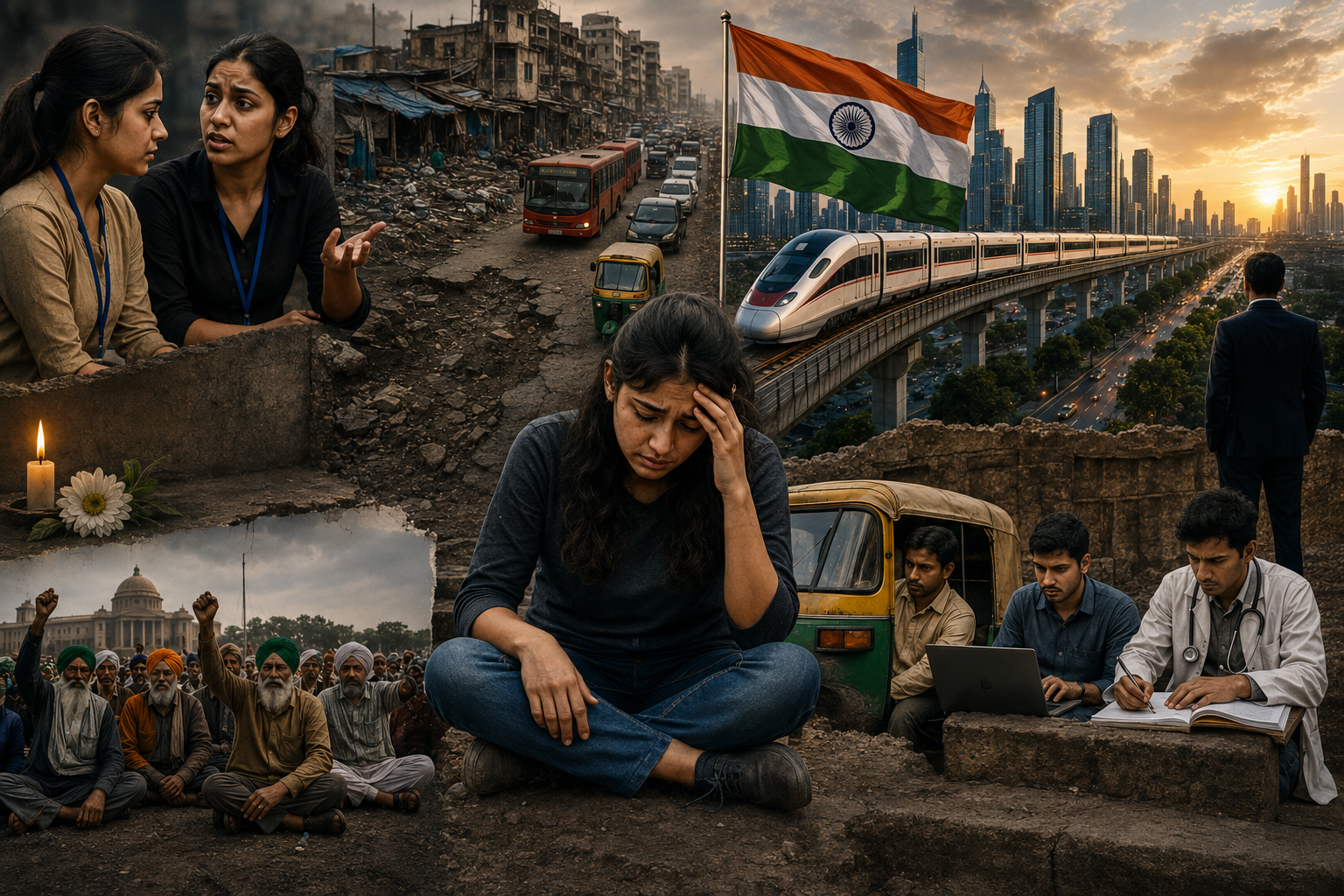






Recently, I heard a conversation between two young, freshly graduated women from one of India’s prestigious professional college, both struggling to find jobs. One of them, out of sheer frustration, told the other that they might as well submit to being sexually exploited by an employer — “at least we will get a job and build our careers.”

On Thursday, news channels in India reported that an 18-year-old girl, a National Eligibility cum Entrance Test (NEET) aspirant from a poor family in rural India, had died allegedly by suicide after falling into depression following reports of irregularities and an alleged paper leak in the medical entrance examination.
Such episodes are not uncommon in India. Yet a large section of Indians who watch or read mainstream media may be unaware of how widespread this desperation and disillusionment with governance truly is. They are not entirely to blame. For decades, much of the Indian electorate has been fed narratives spun by the ruling elite — “Emerging India,” “Shining India,” “Superpower India,” “Vishwaguru India” and so on. The news headlines continue to reassure them that the Indian economy is strong and growing, with impressive numbers for GDP, inflation, employment etc.
Government after government — political and bureaucratic alike — over the last four decades made us believe that economic liberalisation had delivered great prosperity and opportunity, and helped us become a superpower. That the world feared India and Indians, that the West needed us more than we needed it, that India could fight on all fronts simultaneously, that India had finally arrived at the table of the big powers.
All of this boosted national morale, lent hope to poverty-stricken masses, and energised youth to study hard and compete at home and abroad. It did have a positive impact — but was it enough? That judgment becomes clearer when we step away from the grand narrative and look primarily at our most instructive mirror: China — and then turn inward to assess our capacity to deal with crises such as the ongoing global turmoil.
The comparison with China is relevant because, until Deng Xiaoping’s 1978 reforms, both countries had similar population sizes and poverty levels. While China moved hundreds of millions of workers from low-productivity agriculture into export-oriented manufacturing through aggressive reforms, investment, infrastructure building, and integration with global markets, India was not only more than a decade late on reforms but also relied more heavily on services, invested less in infrastructure, and industrialised far more slowly. Crucially, due to its inability to address socio-political grievances, India slowly turned into a security state triggering insurgencies. As a result, considerable effort and resources were spent fighting Pakistan-sponsored cross-border terrorism and Maoist insurgencies, while China was making enormous economic strides. Those were the choices made by both Congress and BJP led coalitions and regional satraps alike.
So even as India’s lower and middle classes slogged and slowly worked their way up, we self-congratulated and celebrated our progress — but in real terms, our roads and streets remain riddled with potholes, our public transport has seen only marginal upgrades, our drinking water requires RO filters to be safe, our electricity outside a few metro cities remains unreliable especially in high-consumption weather, our multi-storeyed buildings are death traps, our flyovers and bridges crack under the weight of substandard material, our cities flood after a single heavy monsoon rain, and our schools, colleges, and universities produce millions of graduates every year only to deliver them into an abyss of joblessness and underemployment.
However, there is one area where India punched well above its weight — narrative-building through three powerful instruments: Bollywood, cricket, and media. Regardless of the hardships the common person faced, there has been entertainment to take refuge in and optimism amplified daily by media. But every time the lower and middle classes were jolted awake by the rising cost of living, brazen corruption, and the scarcity of decent jobs, it resulted in some political change — a bandage on systemic wounds. The India Against Corruption movement captured the imagination of the whole country precisely because there was a simmering discontent about the failure of governance.
It was on the back of that disenchantment with the UPA that the BJP rode to power. Over the last 12 years, the Modi government, apart from carrying forward the economic policies of its predecessors since liberalisation, added Hindu nationalism to its political mix. On the economic front, Prime Minister Modi strengthened services, pharmaceuticals, and entrepreneurship, and distinguished himself from his predecessors by building India’s digital infrastructure and improving tax collection through GST. Critics, however, rightly caution that India’s digital infrastructure remains almost entirely dependent on American technology, leaving it deeply vulnerable to external cyber attacks.
In the same period, China’s economy grew from roughly $10.5 trillion in 2014 to $20 trillion by 2025, cementing its position as the world’s second-largest economy and a genuine global industrial superpower. In real terms, China has the largest number of cities whose GDPs exceed those of entire countries, metro systems larger than those of whole nations, high-speed rail networks, major universities producing pathbreaking research, vast industrial clusters, and an increasingly serious competitor to the US in AI. It remains dominant in manufacturing, infrastructure, industrial technology, and exports. China’s tier-three cities are far ahead of India’s top metros in infrastructure sophistication.
That said, India — without any comparison to global superpowers — is significantly more prosperous than it was 40 years ago. Credit for India’s transformation from a resource-drained British colony goes to all successive prime ministers and governments. Likewise, the blame for India’s uneven economic progress is shared equally among them. Previous governments have taken their fair share of criticism and were voted out primarily for failing to deliver on their promises.
The Modi wave that swept the nation in 2014 was built largely on the Gujarat model of development. Yet after 12 years, there is not a single state or city that can claim development comparable to Gujarat, let alone to any city in the developed world. The Smart Cities Mission has been a spectacular failure — none of the cities under it have seamless public transport, reliable water supply, fully underground electricity cabling, intelligent traffic systems, walkable neighbourhoods, clean air, or efficient local governance. Instead, Indians have received CCTV cameras in every nook and cranny in their cities, command-and-control centres, new street poles, garish clock towers, unaesthetic graffiti or paintings on public walls, mobile apps, some road improvements, and dustbins that many still do not use.
Cities matter because they are centres of productivity, economic growth, and employment. Yet urban unemployment today is higher than rural unemployment — a damning inversion. Data on joblessness is unreliable, and underemployment data is sketchier still, but the anecdotal evidence is overwhelming: there are far fewer meaningful opportunities for degree holders today than there were a decade ago. Educational institutions are producing graduates, not employable professionals. There are more institutions than there are employment opportunities capable of absorbing their output.
Tens of millions of Indians are technically “employed” but trapped in low-wage, low-productivity, informal work that offers no security, no advancement, and barely enough income to survive. India does not merely have an unemployment problem. It has an underemployment crisis.
One may point to the AI revolution, which is rapidly destroying jobs across industries dependent on computers and the internet. But that is precisely where the foresight of a nation’s ruling elite matters. No meaningful preparation was made in the last 40 years — and more specifically in the last 12 — even as it became increasingly evident that AI would cause a major global disruption. The result is that today our graduates from professional colleges drive autorickshaws, trained engineers do data entry, and IIT graduates and doctors spend years preparing for civil service examinations after multiple failed attempts.
If India’s cities and urban youth are in this condition, the state of its villages and small towns requires little imagination. India still has a large share of its workforce in farming, yet agriculture contributes a much smaller share of GDP — meaning the majority of Indians depend on relatively low farm incomes. Rural frustration manifested in protests against the farm laws and in the sight of migrant labourers walking hundreds of miles home during Covid because they could not sustain themselves in cities where living costs and rents are high. At Jantar Mantar in New Delhi, farmers continue to protest round the clock even today, despite the Modi government repealing the farm laws in 2021 after a year-long agitation. They are still seeking a legal guarantee for minimum support prices and relief from rising input costs — diesel, fertiliser, electricity — along with protection from farm debt, better crop insurance, higher compensation for land acquisition, rural employment guarantees, pensions, and protection from agricultural imports.
India’s overdependence on the West, and more specifically on the US and its allies such as Israel since liberalisation, has created a situation where many of these farmers’ concerns will only worsen as fuel prices remain high due to the Iran conflict. Younger generations in rural India remain either jobless or underemployed. Many would previously have been absorbed into the armed forces, but the Agniveer scheme has pushed a large number of them to seek alternatives in an already strained private job market. With oil prices high, transport costs rising, inflation climbing, exports stagnating and public finances under strain, there is little hope forthcoming from the Modi government.
Wealth is concentrated among the top one percent of Indian society. Yet India’s biggest corporations, businesses, and investors are increasingly directing capital abroad, deterred by concerns over returns, currency risk, regulatory uncertainty, and the limited availability of large-scale domestic opportunities in certain sectors. Foreign investors have already withdrawn massive sums, unconvinced that Indian companies were performing well enough to justify their share valuations. As capital has left the country, the rupee has weakened steeply, making imports more expensive and tightening the spiral. This is particularly damaging given that India is a net importer of crude oil, gas, gold, semiconductors, electronics, fertiliser, coal, and critical minerals. Consequently, India is now inching closer to a slowdown.
India’s current difficulties are not simply the result of bad luck or a difficult global environment. They reflect structural weaknesses that have been building since the country first liberalised its economy in 1991 — an economy that has grown impressively at the top while leaving the majority of its workers in poorly paid, insecure, informal employment. The Modi government’s overall economic approach, like that of its predecessors, has been GDP-growth oriented rather than job-growth oriented.

Closing that gap requires more than a strong quarterly GDP number or awards by foreign countries. It requires an honest reckoning with where India actually stands. After 12 years of the Modi government, that honesty, however, remains in shorter supply.